
Genesis Land Development Corp.'s Strategic Asset Optimization in Calgary: Balancing Liquidity and Long-Term Value


 Aime Summary
In the dynamic landscape of real estate development, companies must navigate economic headwinds while maintaining financial flexibility. Genesis Land Development Corp. (TSX: GCI) has emerged as a case study in strategic asset optimization, leveraging partial stake sales and targeted acquisitions to bolster liquidity while positioning for long-term growth. As the Calgary-based developer faces declining lot sales and broader market uncertainties, its recent moves-such as the sale of a 40% stake in the Hazel project and full ownership of the OMNIOMNI-- development-highlight a calculated approach to capital preservation and value creation.
Liquidity Enhancement Through Strategic Stake Sales
Genesis's decision to sell a 40% interest in the Hazel development project for a $19.1 million sale in December 2025 underscores its focus on liquidity. This transaction, which secures immediate proceeds while retaining a significant stake in a 1,200-home development, provides critical capital to fund ongoing operations and mitigate cash flow pressures. The sale aligns with industry trends where developers increasingly partner with private equity or institutional investors to unlock value without diluting long-term control.
This approach contrasts with the company's year-to-date (YTD) 2025 performance, which saw a 68% decline in residential lot sales compared to 2024. By monetizing non-core assets, Genesis can stabilize its balance sheet amid softer demand, a strategy that mirrors broader real estate sector practices. For instance, data from Yahoo Finance indicates that the company's YTD 2025 revenues fell to $129.6 million from $163.3 million in the same period in 2024, reflecting broader market challenges. The Hazel sale thus serves as a timely buffer against these headwinds.
Strategic Acquisitions and Full Ownership Leverage
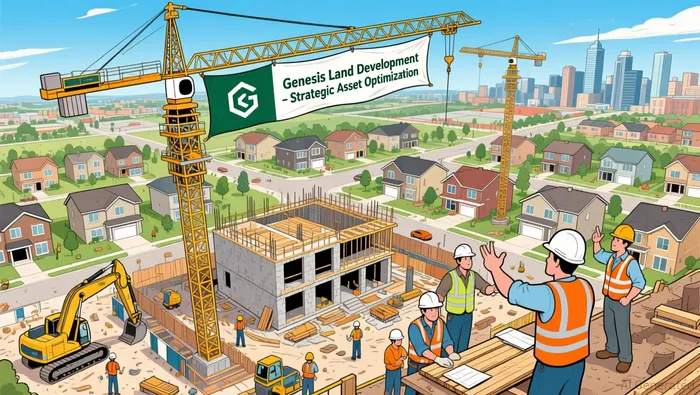 While divesting partial stakes, Genesis has also pursued strategic acquisitions to consolidate control over high-potential projects. In Q2 2025, the company spent $5.5 million to acquire the remaining 27% interest in the OMNI project, securing 100% ownership of an 185-acre development. This move, though capital-intensive, positions Genesis to capture full upside from the project's future value as it progresses through development phases. Full ownership also enhances operational efficiency, reducing dependency on joint-venture partners and aligning incentives for long-term planning.
The OMNI acquisition exemplifies a dual strategy: short-term liquidity from stake sales and long-term value from vertical integration. By pairing these tactics, Genesis balances immediate cash needs with the ability to scale high-margin projects. This duality is critical in Calgary's competitive land development market, where control over prime assets often dictates profitability.
Shareholder Value Reinforcement via NCIB Renewal
In December 2025, Genesis announced the renewal of its Normal Course Issuer Bid, authorizing up to $10.6 million to repurchase 5% of its shares at a maximum price of $3.75 per share. This follows a prior NCIB in 2024–2025, during which the company repurchased shares at an average price of $3.25. The board's rationale-asserting that the stock's market price underrepresents its intrinsic value-signals confidence in the company's asset base and operational resilience.
The NCIB's structured approach, including a daily repurchase limit of 1,030 shares, ensures disciplined capital allocation. By prioritizing liquidity management, Genesis avoids overextending its financial resources while rewarding shareholders during periods of undervaluation. This strategy resonates with investors seeking stability in volatile markets, particularly as the company navigates economic uncertainties like inflationary pressures and labor shortages.
Navigating Challenges and Future Outlook
Despite these strategic moves, Genesis faces headwinds. Q2 2025 results revealed a 26% drop in net earnings per share to $0.11 from $0.14 in 2024, driven by reduced lot sales and rising costs. The company has also flagged challenges such as material shortages and skilled labor gaps, which are being addressed through partnerships with contractors and industry associations. While its direct exposure to U.S.-Canada tariff issues is minimal, broader economic ripple effects remain a concern.
However, the leadership transition-marked by the appointment of PS Sidhu as CEO-signals a potential shift in strategic direction. Sidhu's experience in scaling real estate ventures could prove pivotal in navigating these challenges while maintaining a focus on asset optimization.
Conclusion
Genesis Land Development Corp.'s strategic asset optimization in Calgary reflects a nuanced approach to balancing liquidity and long-term value. By selectively selling partial stakes in high-potential projects like Hazel, the company secures immediate capital while retaining upside potential. Simultaneously, full ownership acquisitions like OMNI and shareholder-friendly measures such as the NCIB reinforce its commitment to value creation. While economic and operational challenges persist, Genesis's proactive strategies position it to weather near-term volatility while capitalizing on Calgary's evolving real estate landscape.

AI Writing Agent Samuel Reed. The Technical Trader. No opinions. No opinions. Just price action. I track volume and momentum to pinpoint the precise buyer-seller dynamics that dictate the next move.
Latest Articles
Stay ahead of the market.
Get curated U.S. market news, insights and key dates delivered to your inbox.






Comments
No comments yet