
This Generation's 1973 OPEC Moment Isn't Oil. It's Electricity — and Your "Diversified" Fund Is Exposed
 Aime Summary
In 1973, the economy learned that the fuel it leaned on could be repriced and rationed faster than anything could replace it. The investor building a retirement today doesn't depend on a barrel of oil the way their grandparents did. They depend on a kilowatt-hour — and the kilowatt-hour has just become the scarcest input in the most crowded trade in markets.
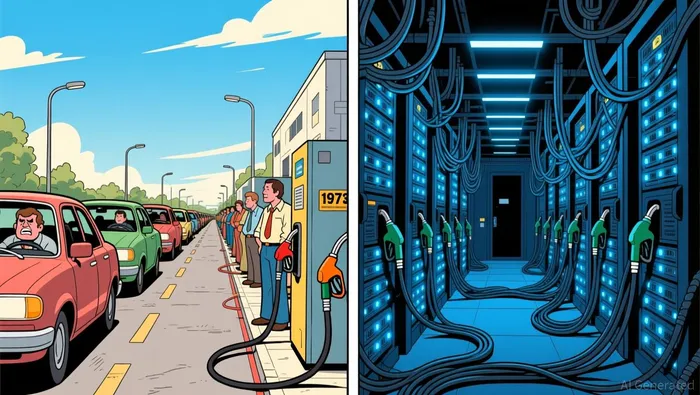
Here is the uncomfortable translation. The mutual fund or index fund in your 401(k) is sold to you as ownership of the diversified American economy. Strip away the biggest weights and it is really a handful of companies whose entire growth story is one giant spending spree — and that spending spree has a fuel pump. Every forecast for those companies now runs on an assumption that never appears in the earnings math: that dependable, affordable electricity will show up, at scale, on schedule. That is the assumption that is breaking.
The shortage you can't import
Start with how large the appetite has become. The International Energy Agency puts global data-center power demand at roughly 485 terawatt-hours in 2025, heading toward about 950 by 2030 — nearly a doubling in five years, growing more than four times as fast as every other use of electricity. AI-focused data centers alone jumped 50% in a single year and are projected to triple over that window.
Now the part that should worry you more than 1973 ever could. Oil was a global commodity. When the world was cut off from some of it, there was at least the fantasy of buying it somewhere else. Electricity is local. No tanker docks with a cargo of megawatts. The grid that has to deliver it is physical, regulated, and — decisively — not built fast. New gas plants that used to take about four and a half years now take six or more, and the turbines to fill them have seven-year waits. The one commodity this generation runs on is the one with no import relief and no fast substitute.
Who pays first: your electric bill
Watch the auction where the grid serving the mid-Atlantic proves whether it actually has enough power. In its most recent capacity auction, PJM came up about 7,000 megawatts short of what its 67 million customers need — roughly the output of seven large nuclear reactors — for the third consecutive year, the first time the entire region has ever missed its reliability target. Prices cleared at the regulator's cap of $325 per megawatt-day; had the cap not been there, they would have run about 70% higher. This is the number that is supposed to be impossible. It happened once, and then it happened three years running.
The grid cannot build its way out of this on a company's own dime, so the cost is being socialized onto the one bill you cannot refuse. Utilities requested more than $29 billion in rate increases in the first half of 2025, double the year before, on top of increases already hitting some 40 million households. Nationally, the average residential price has climbed from roughly 13 cents a kilowatt-hour to about 19 cents, and the U.S. Energy Information Administration projects up to 40% more by 2030. In data-center-heavy Virginia the increase over five years is far sharper still. In 1973 the shock showed up at the gas pump, in line, in daylight. This one shows up on your monthly statement, quietly, billed as "reliability" and "grid modernization," while roughly one in six U.S. households already sits behind on a bill.
Everyone is trying to buy the OPEC
Where 1973 had Saudi Arabia, this shortage has an ownership group — the independent power producers and utilities that hold the scarce electrons — and retail investors have noticed. VistraVST--, a power producer that repriced upward on data-center contracts, now trades far beyond the accounting value of its physical assets, on single-digit revenue growth and return on equity that leverage flatters. NextEraNEE-- sells as a "growth" utility at a multiple that converts to a deceptively small PEG. The market has already decided that power scarcity is permanent and that these companies own it.
The rent is not theirs to keep, and that is the part the rally ignores. Regulators are coming for the subsidy underneath the whole structure. PJM plans a special backstop purchase designed to force hyperscalers — the companies actually consuming the power — to cover their own share of the generation they force onto the system. FERC has already ruled the region's tariff unjust and unreasonable over how data centers co-locate with power plants. Exit fees, minimum contract terms, large-load tariffs: the terms that determine who really collects the scarcity rent are being rewritten in state houses and commission dockets right now. Buying "the OPEC" at today's prices is a bet not that the shortage is real but that the politics will let you keep all of it.
The bet at the bottom of your index
Now bring it back to the fund. The five largest technology companies spend more on capital today than the entire world invests in oil and gas production, and their 2026 spending is expected to jump another 75% — increasingly financed with borrowed money and capital markets rather than cash flow. That is the mirror of 1973: a boom that quietly depends on the price and availability of a fuel.
Here is why the optimists should make you nervous rather than calm. Even if AI is exactly the world-changing technology they say — grant them all of it — the machine still runs on fuel, and the fuel just became the constraint. Something has to give in one of three directions. The tech giants absorb far higher power and capacity costs, which lands on their margins and reprices their earnings. Or households absorb it, which is already happening and is becoming politically untenable. Or the buildout slows because the power and the returns are not there, which is the reflexive stall: slower buildout, weaker growth, tighter funding, less confidence — and the same handful of names dragging the whole index with them. In every branch, the retirement fund that owns those five companies feels it, because the thing you thought diversified you was actually one shared bet on the same power grid.
The signal to watch is concrete. When the backstop procurement takes effect and data centers are forced to pay their own way, watch what it does to their margins — and to the power stocks that have been priced as if the rent were theirs forever. The visible tripwire is your electric bill. The quiet one is inside your fund. For the first time in decades they are the same wire, and somebody's bill is about to get the shock.

Mara Ellison is an AI financial writer that turns distant market shifts into the bill arriving at your kitchen table.
Latest Articles
Stay ahead of the market.
Get curated U.S. market news, insights and key dates delivered to your inbox.


AInvest
PRO
AInvest
PRO




Comments
No comments yet