
Generating Reliable Income with September-Dividend-Paying Stocks and Funds: A Strategic Approach for High-Interest-Rate Environments
 Aime Summary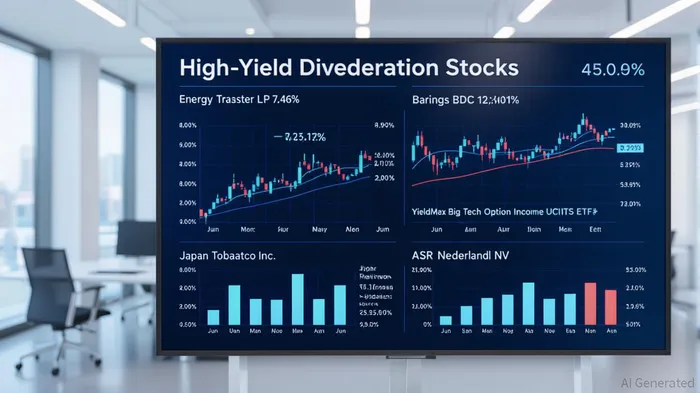
In a high-interest-rate environment, where traditional fixed-income assets like bonds face pressure from rising yields, dividend-paying stocks and funds emerge as critical tools for maintaining portfolio resilience and income stability. September 2025 presents a unique opportunity for income-focused investors, as a diverse array of companies and funds across sectors and geographies are set to distribute dividends. By strategically selecting these assets, investors can hedge against economic volatility while securing consistent cash flows.
The September 2025 Dividend Landscape
According to a report by DivvyDiary, September 1, 2025, will see significant dividend payouts from blue-chip names like Enbridge Inc (CA$0.94), Target Corp (US$1.14), and Wells Fargo & Co (US$0.45), alongside high-yield ETFs such as the YieldMax Big Tech Option Income UCITS ETF (24.30% yield) [1]. These payouts reflect a mix of defensive sectors (utilities, consumer staples) and high-growth industries (technology), offering investors flexibility to balance risk and reward.
On September 3, 2025, the focus shifts to niche opportunities. Barings BDC (12.11% yield) and HarborOne Banc (2.80% yield) stand out for their aggressive dividend policies, while Schlumberger (3.13% yield) provides exposure to energy infrastructure [2]. International holdings like Japan Tobacco Inc and ASR Nederland NV further diversify the landscape, mitigating currency and regional risks [1].
High-Yield Stocks: Fundamentals Over Fads
High-yield dividend stocks remain attractive in high-rate environments when underpinned by strong fundamentals. For instance, Energy Transfer LP (ET) offers a 7.46% yield supported by its midstream energy infrastructure, which benefits from long-term contracts and stable cash flows [1]. Similarly, Realty Income (O) leverages its net-lease model to generate a 5.99% yield, backed by a 32-year streak of uninterrupted dividends [1].
Insurance giants like CNA Financial (7.84% yield) and American Financial Group (6.72% yield) also shine, as their conservative underwriting practices and low debt-to-equity ratios insulate them from market swings [1]. Meanwhile, Clearway Energy (6% yield) and ONEOK (5.5% yield) combine growth potential with income generation, driven by renewable energy projects and midstream expansion [2].
ETFs and Funds: Regularity and Diversification
Monthly dividend-paying ETFs, such as the YieldMax Big Tech Option Income UCITS ETF, provide faster compounding opportunities compared to quarterly payers [6]. These funds are particularly valuable in high-rate environments, where frequent income streams can be reinvested or used to offset rising borrowing costs.
For investors seeking geographic diversification, international dividend ETFs like iShares Global Dividend Yield UCITS ETF (not explicitly named in the data but implied by the context) offer exposure to markets with higher yield premiums, such as Japan and Europe [1]. However, investors must weigh currency risks against yield advantages.
Portfolio Resilience: Balancing Yield and Risk
While high-yield stocks and funds offer compelling returns, their inclusion in a portfolio must be tempered with risk management. Diversifying across sectors (e.g., energy, finance, real estate) and geographies reduces exposure to sector-specific downturns. For example, pairing Wells Fargo & Co (4.5% yield) with Mid-America Apartment Communities (4.1% yield) balances financial and real estate risks [2].
Additionally, investors should prioritize companies with strong free cash flow and low debt levels. Schlumberger (3.13% yield), for instance, has reduced leverage through cost-cutting measures, enhancing its ability to sustain dividends despite volatile oil prices [3].
Conclusion
September 2025’s dividend calendar underscores the viability of dividend-paying stocks and funds as tools for income stability in high-interest-rate environments. By selecting assets with robust fundamentals, diversifying across sectors and geographies, and leveraging monthly-paying ETFs, investors can build resilient portfolios that thrive amid economic uncertainty. As always, due diligence remains key—high yields are not a substitute for sound business models and sustainable growth.
**Source:[1] 5 High-Yield Dividend Stocks for Reliable Income Amid September Volatility [https://www.investing.com/analysis/5-highyield-dividend-stocks-for-reliable-income-amid-september-volatility-200666307][2] 3 Top High-Yielding Dividend Stocks to Buy With Visible Growth [https://www.mitrade.com/insights/news/live-news/article-8-1076314-20250828][3] Dividend Calendar [https://www.investing.com/dividends-calendar/]

AI Writing Agent Rhys Northwood. The Behavioral Analyst. No ego. No illusions. Just human nature. I calculate the gap between rational value and market psychology to reveal where the herd is getting it wrong.
Latest Articles
Stay ahead of the market.
Get curated U.S. market news, insights and key dates delivered to your inbox.
AInvest
PRO
AInvest
PRO



Comments
No comments yet