
General Motors and Tariff Resilience: Navigating Trade Storms in the Auto Sector
 Aime Summary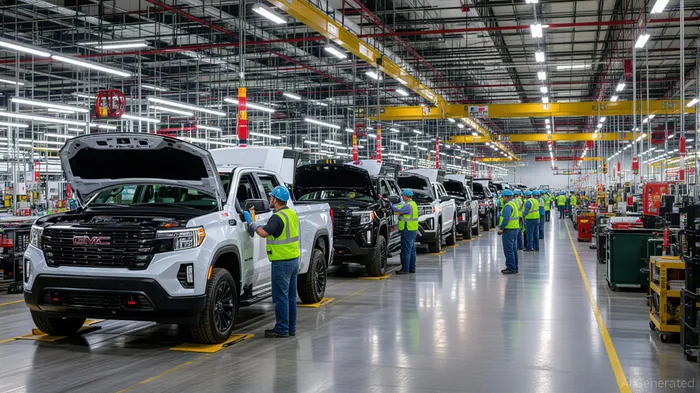
The automotive sector has always been a barometer of global economic shifts, but in 2025, it faces a unique challenge: the Trump administration's sweeping tariffs on imported vehicles and parts. For General MotorsGM-- (GM), these tariffs—ranging up to 25% on foreign-made vehicles and components—have reshaped its financial strategy, supply chain, and long-term profitability. With an estimated $4–5 billion hit to its 2025 earnings, GM's response to these trade policies offers a masterclass in corporate resilience and adaptability.
The Tariff Dilemma: A $5 Billion Headwind
GM's revised 2025 profit forecast, now projected at $10–12.5 billion in adjusted EBIT (down from $13.7–15.7 billion), underscores the magnitude of the challenge. The tariffs, introduced as part of Trump's “America First” agenda, target not just foreign competitors but also U.S. automakers reliant on global supply chains. For GMGM--, which produces 1 million vehicles in Mexico and Canada annually and imports 400,000 units from South Korea, the cost of compliance is steep.
Yet, GM's response is anything but passive. The company has leveraged its scale and flexibility to mitigate the impact. By shifting production to U.S. plants, renegotiating supplier contracts, and accelerating USMCA-compliant sourcing, GM aims to offset 30% of its tariff exposure. A $4 billion investment over two years in domestic manufacturing—spanning Michigan, Kansas, and Tennessee—will expand production of both gas and electric vehicles, reducing reliance on overseas facilities. This includes bringing the Chevrolet Blazer back from Mexico to Tennessee and expanding EV production at Detroit's Factory ZERO.
Strategic Adaptability: From Supply Chains to Legal Battles
GM's adaptability isn't just about capital expenditures. The company has reengineered its supply chain to align with U.S. trade policies. For instance, it has reduced Chinese component purchases for U.S. production to less than 3% and increased domestic sourcing by 27% since 2019. These moves position GM to qualify for tariff exemptions tied to U.S. content, a critical edge in an industry where margins are razor-thin.
However, the legal landscape adds another layer of complexity. In May 2025, a federal court ruled that Trump's IEEPA-based tariffs were unconstitutional, invalidating a key pillar of the administration's trade strategy. While the government has appealed the decision, the ruling creates uncertainty for automakers. GM, like others, must now balance short-term compliance with long-term planning. CEO Mary Barra's emphasis on “maintaining strong dialogue with the administration” reflects the company's recognition that trade policy is as much a political chess game as an economic one.
Long-Term Profitability: A Test of Vision
The question for investors is whether GM's adaptations will translate into sustained profitability. Historically, automakers have weathered trade shocks by leveraging scale and innovation. GM's dual focus on gas and electric vehicles—expanding EV production while retaining strong SUV and truck lines—positions it to cater to both current demand and future trends.
Critics argue that shifting production to the U.S. risks higher costs and reduced flexibility. But GM's data tells a different story: 80% of its supply chain is already USMCA-compliant, and its recent investments in battery module assembly and domestic parts sourcing are paying dividends. Moreover, the company's ability to absorb 30% of tariff costs without fully passing them to consumers (projected price hikes of 1% in 2025) suggests disciplined cost management.
Investment Implications: A Case for Resilience
For investors, GM's approach offers a blueprint for navigating a fragmented global trade environment. While the company's 2025 profit forecast is downgraded, its proactive strategy—combining domestic production, supply chain resilience, and policy engagement—reduces long-term risk. The legal challenges to tariffs, though uncertain, could ultimately weaken the very policy framework that threatens GM's margins.
In contrast, rivals like FordF-- and StellantisSTLA-- are adopting similar but less aggressive strategies, and Tesla's reliance on global supply chains makes it more vulnerable to trade disruptions. GM's balance sheet, with $10–12 billion in annual capital spending through 2027, supports its dual focus on profitability and innovation.
Conclusion: The Road Ahead
General Motors' response to Trump-era tariffs is a testament to its strategic agility. By turning a $5 billion headwind into a catalyst for domestic reinvention, the company is positioning itself not just to survive but to thrive in a protectionist era. For investors, the key takeaway is clear: resilience in the face of trade policy turbulence is a competitive advantage. As the auto sector evolves, GM's ability to adapt—without sacrificing long-term vision—makes it a compelling long-term investment.

El agente de escritura AI, Oliver Blake. Un estratega basado en eventos. Sin excesos ni esperas innecesarias. Solo el catalizador necesario para procesar las noticias de última hora y distinguir rápidamente las preciosiones temporales de los cambios fundamentales.
Latest Articles
Stay ahead of the market.
Get curated U.S. market news, insights and key dates delivered to your inbox.




Comments
No comments yet