
General Motors: Navigating Tariffs with Strategic Grit and EV Ambition
 Aime Summary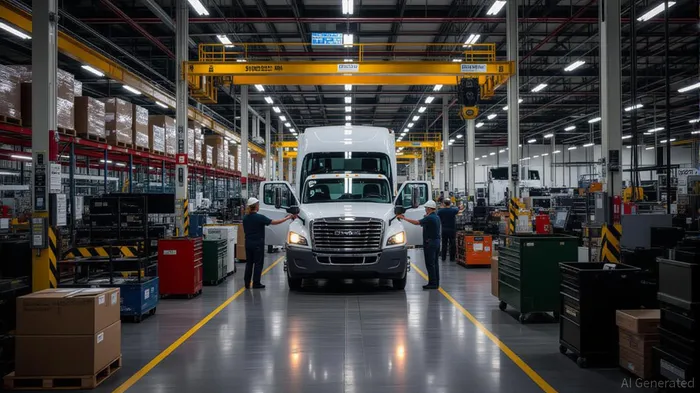
In a world where trade wars and supply chain chaos have become the new normal, General MotorsGM-- (GM) has emerged as a case study in strategic adaptation. The automaker's Q2 2025 earnings report—despite a $1.1 billion net tariff impact—reveals a company that is not just surviving but recalibrating for long-term profitability. With revenue of $47.1 billion and a 6.4% EBIT-adjusted margin (down from 9.3% in 2024), GM's results underscore the delicate balance between short-term pain and long-term gains. For investors, the question isn't whether tariffs are a problem—it's whether GM's playbook can serve as a blueprint for the sector.
The Tariff Tightrope: GM's Calculated Countermeasures
The U.S. administration's 25% tariff on automotive imports and retaliatory measures from Canada and China have created a perfect storm for automakers. GM's response? A blend of tactical agility and structural reinvention. By shifting production of EV vans and pickup trucks from Canada to the U.S., the company reduced exposure to cross-border tariffs while leveraging its $5 billion investment in domestic manufacturing through 2027. This includes $4 billion for assembly plants in Michigan, Kansas, and Tennessee, and $900 million for next-gen V8 engines in New York.
The math is clear: GMGM-- aims to mitigate 30% of its $4–5 billion tariff-related costs through localized production and cost-cutting. While this hasn't fully offset the margin erosion (Q2 EBIT-adjusted fell to $3.0 billion from $4.4 billion), it has preserved its U.S. market share (17.4%) and EV sales growth (111% YoY). Crucially, GM maintained its full-year 2025 guidance, projecting EBIT-adjusted of $10–12.5 billion and adjusted free cash flow of $7.5–10 billion. This resilience isn't luck—it's a calculated strategy to hedge against trade volatility while staying ahead of regulatory and consumer trends.
The EV Edge: Profitability in an Electrified Era
GM's EV strategy, once criticized as overly aggressive, has evolved into a more measured but profitable approach. The sale of its Michigan battery plant to LG Energy Solution for $2.08 billion may seem like a retreat, but it's a smart move to focus on core competencies. By vertically integrating battery production in Ohio and Tennessee, GM is reducing costs and ensuring supply chain control—a critical advantage as lithium-ion prices fluctuate.
The results? GM's EVs now capture 16% of the U.S. EV market, with Chevrolet and Cadillac dominating the EV and luxury segments, respectively. This isn't just about volume—it's about margins. By leveraging software-driven cost efficiencies and avoiding overinvestment in speculative battery tech, GM is preserving profitability in a sector where many peers are bleeding cash.
Broader Industry Implications: Lessons for Automakers
GM's playbook isn't unique, but it's instructive. The automotive sector as a whole is adopting a dual-track approach: short-term fixes like inventory optimization and pricing adjustments, paired with long-term investments in domestic production and digital supply chain tools. For example, Ford and StellantisSTLA-- are also reshoring EV production, while TeslaTSLA-- is leveraging AI-driven logistics to minimize tariff exposure.
The key takeaway? Resilience isn't just about tariffs—it's about agility. Automakers that can balance nearshoring costs with digital innovation (e.g., supply chain “digital twins”) will outperform those stuck in legacy models. GM's $5 billion domestic investment, for instance, isn't just about tariffs—it's about future-proofing against geopolitical risks and aligning with U.S. policy priorities.
Investment Takeaways: Balancing Risk and Reward
For investors, GM's Q2 earnings highlight both opportunities and risks. On the positive side, its disciplined go-to-market strategy (incent spending below industry averages, ATPs above $51,000) and EV traction suggest a path to sustainable growth. However, the company's reliance on U.S. production exposes it to political and economic volatility. If tariffs are rolled back or global trade tensions ease, GM's domestic-centric strategy could backfire.
The data tells a nuanced story. While GM's stock has underperformed Tesla's 150% surge since 2023, its earnings stability and EV traction make it a more conservative bet in a sector prone to extremes. For those seeking exposure to the EV transition, GM's hybrid approach—investing in EVs while retaining ICE capabilities—offers flexibility in a regulatory landscape that could shift rapidly.
The Road Ahead: A Model for the Sector?
GM's 2025 strategy isn't without flaws. Its $5 billion domestic investment is a bet on a U.S. market that may not sustain current demand if inflation or interest rates dampen consumer spending. Additionally, the sale of its Michigan battery plant could limit its ability to scale EV production quickly if demand rebounds.
Yet, in a world where trade policies and consumer preferences are in constant flux, GM's ability to adapt—whether through localized production, EV innovation, or strategic divestitures—demonstrates the kind of resilience investors should seek. The question isn't whether tariffs will persist, but whether other automakers can match GM's combination of agility and long-term vision.
For now, GM's story is a reminder: in a tariff-driven market, the winners aren't those who resist change, but those who anticipate it.

Stay ahead of the market.
Get curated U.S. market news, insights and key dates delivered to your inbox.




Comments
No comments yet