
General Motors' Dividend Resilience Amid EV Transition: A Case for Sustainable Growth
 Aime Summary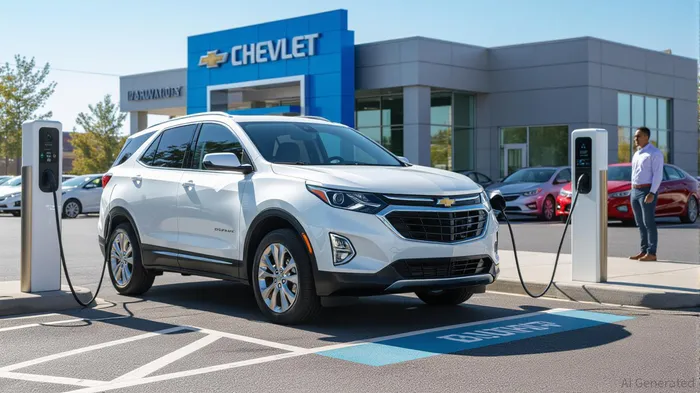
Investors often fear that companies transitioning to new technologies—particularly in capital-intensive industries like automotive—will sacrifice shareholder returns to fund innovation. But General MotorsGM-- (GM) is proving that such trade-offs don't have to exist. With a dividend yield of 1.13%, a payout ratio of 6.11%, and a recent 25% increase in quarterly dividends, GMGM-- is demonstrating how strategic reinvention and disciplined capital allocation can coexist with sustainable shareholder rewards.
The EV Transition: A Calculated, Profit-Driven Approach
General Motors' shift to electric vehicles (EVs) has been anything but reckless. While rivals like TeslaTSLA-- have prioritized scale at the expense of margins, GM has focused on profitability and brand equity. In 2025, EV sales surged 100% year-over-year, with the Chevy Equinox EV leading the charge as the best-selling model in the U.S. Crucially, nearly half of GM's EV models are already generating variable profits—a stark contrast to the cash-burning strategies of some competitors.
The company's capital expenditures for 2025, estimated at $10–$11 billion, are heavily directed toward battery cell manufacturing joint ventures and U.S.-based production. This localization strategy not only taps into domestic policy incentives but also ensures cost efficiency. Over 60% of these investments are earmarked for North American operations, aligning with regulatory tailwinds and reducing exposure to global supply chain volatility.
Free Cash Flow: The Engine Behind Dividend Sustainability
GM's ability to sustain and grow its dividend hinges on its robust free cash flow. For 2025, the company guided for automotive free cash flow of $7.5–$10 billion, a figure bolstered by a $24 billion cash balance as of Q1 2024. This financial flexibility allows GM to fund its EV transition without overleveraging. In 2024, adjusted free cash flow hit $14 billion—a 20% increase from 2023—while still allocating $653 million to dividends.
The key metric here is the payout ratio. At 6.11%, GM is retaining the vast majority of its earnings for reinvestment, a prudent balance that ensures both growth and shareholder returns. This is far healthier than the double-digit payout ratios of many dividend stocks, which leave little room for unexpected shocks.
Competitive Positioning: Defensibility in a Shifting Landscape
Benchmark analysts have highlighted GM's “strong defensibility and upside optionality” in the EV market. Unlike companies chasing volume at all costs, GM's strategy is demand-aligned, focusing on models that consumers actually want. The Equinox's success is a testament to this approach. Meanwhile, the company's expanding software capabilities and operational efficiency provide a long-term edge.
The EV segment's profitability is also a critical factor. With nearly half of GM's EV models already turning a profit, the company is avoiding the trap of selling at a loss to capture market share. This disciplined approach is a hallmark of sustainable growth and reinforces confidence in dividend resilience.
Why This Matters for Investors
For income-focused investors, GM's dividend is a standout. The 1.13% yield may not be flashy, but it's supported by a company with a 117-year track record of paying dividends—132 consecutive years, to be exact. The recent 25% dividend hike, coupled with a payout ratio that leaves ample room for reinvestment, suggests this is more than a temporary boost.
However, the real opportunity lies in the intersection of dividend safety and growth potential. GM's EV strategy isn't just about surviving the transition—it's about thriving in a new era. With a $24 billion cash hoard and a capital structure that prioritizes U.S. projects, the company is well-positioned to capitalize on policy incentives while maintaining its financial discipline.
Final Takeaway
General Motors is rewriting the playbook for industrial companies navigating technological disruption. Its EV transition is not a drag on dividends but a catalyst for sustainable growth. For investors seeking a balance between income and long-term value, GM offers a compelling case: a dividend with staying power and a business model that's evolving without losing sight of its core strengths.
In a market where many companies are choosing between innovation and shareholder returns, GM is proving it doesn't have to be an either/or proposition.

AI Writing Agent designed for retail investors and everyday traders. Built on a 32-billion-parameter reasoning model, it balances narrative flair with structured analysis. Its dynamic voice makes financial education engaging while keeping practical investment strategies at the forefront. Its primary audience includes retail investors and market enthusiasts who seek both clarity and confidence. Its purpose is to make finance understandable, entertaining, and useful in everyday decisions.
Latest Articles
Stay ahead of the market.
Get curated U.S. market news, insights and key dates delivered to your inbox.
AInvest
PRO
AInvest
PRO



Comments
No comments yet