
General Motors' $6 Billion EV Restructuring: A Strategic Turnaround in a Shifting Electric Vehicle Landscape


 Aime Summary
General Motors' (GM) $6 billion EV restructuring plan, announced in late 2025, marks a pivotal moment in the automaker's evolution within the electric vehicle (EV) sector. This strategic realignment, driven by a $7.1 billion total charge-comprising $6 billion in EV-related write-downs and $1.1 billion in Chinese joint venture restructuring- reflects a recalibration of GM's ambitions amid evolving market dynamics. While the move signals a retreat from aggressive EV production targets, it also underscores the broader industry's struggle to balance innovation with profitability in a maturing EV market.
The Anatomy of GM's Restructuring
GM's restructuring strategy involves several key components. A $4.2 billion portion of the $6 billion charge is allocated to supplier settlements and contract cancellations, highlighting the tangible costs of scaling back on overambitious production forecasts that outpaced consumer demand. The company has repurposed its Orion, Michigan assembly plant from EV production to manufacturing internal combustion engine (ICE) full-size SUVs and trucks, a shift driven by stronger demand for these vehicles. Additionally, GMGM-- has idled its Ultium Cells battery production facilities in Ohio and Tennessee, resulting in over 1,500 temporary layoffs. These actions signal a strategic pivot away from vertical integration in battery production, a costly endeavor that now appears misaligned with market realities.
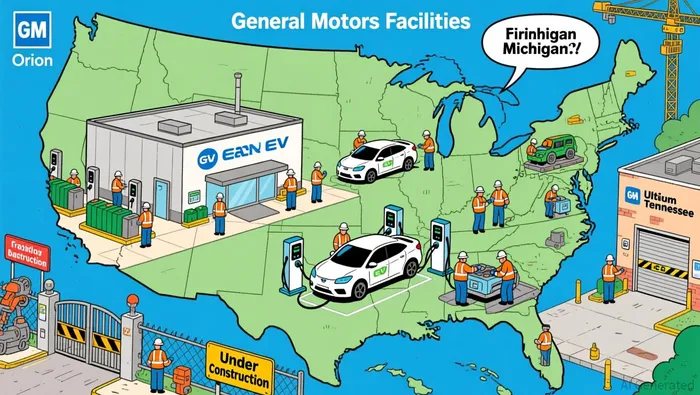 Despite these cuts, GM remains committed to its EV portfolio, planning to maintain a dozen EV models in the U.S. market, albeit at a reduced scale. This "portfolio strategy" prioritizes flexibility over high-volume production, a departure from earlier plans to dominate the EV space with mass-market offerings. The company also anticipates further charges in 2026 related to supplier negotiations, though these are expected to be smaller than 2025's costs.
Industry-Wide Challenges and GM's Competitive Position
GM's restructuring is emblematic of broader industry trends. Softening consumer demand, driven by the expiration of EV tax incentives and relaxed emissions regulations, has forced automakers to reassess their EV strategies. For example, Ford has similarly faced a $19 billion hit from canceled EV programs, illustrating the sector-wide financial strain. Meanwhile, Tesla's vertically integrated supply chain and Gigafactory network have allowed it to navigate disruptions more effectively, though its focus on affordability and energy solutions has shifted its growth strategy.
GM's competitive positioning post-restructuring is mixed. While it remains the second-largest EV seller in the U.S. market, its reliance on a reduced-scale EV portfolio raises questions about long-term competitiveness. The company's emphasis on cost reduction and alignment with consumer preferences-such as the Orion plant's shift to ICE vehicles-mirrors a pragmatic approach to market realities. However, this strategy risks ceding ground to rivals like Tesla, which continues to innovate in battery technology and autonomous driving.
Comparative Insights: Turnarounds in the EV Sector
GM's restructuring can be contextualized through comparative case studies. Rivian, for instance, has navigated supply chain constraints by adopting AI and blockchain-powered platforms to optimize raw material sourcing and reduce emissions. This approach has enabled the company to cut costs and enhance production efficiency, albeit with lower 2025 delivery figures compared to previous years. Similarly, Ford's EV strategy reversal highlights the importance of supply chain resilience and regulatory alignment in corporate turnarounds.
Tesla's turnaround strategies, meanwhile, emphasize innovation and diversification. By expanding into energy storage, robotics, and commercial vehicles, Tesla has diversified revenue streams and mitigated risks tied to EV market volatility. These strategies contrast with GM's focus on cost optimization, underscoring divergent paths to navigating the EV transition.
Implications for Investors
For investors, GM's restructuring signals a shift from aggressive growth to measured adaptation. While the company's EV portfolio remains a long-term priority, the immediate focus on cost discipline and operational flexibility may stabilize short-term earnings. However, the reduced scale of EV production could limit GM's ability to capitalize on future demand surges, particularly if policy incentives are reinstated or consumer preferences shift again.
The broader EV sector's trajectory remains uncertain. Companies that successfully balance innovation with cost efficiency-like Tesla and Rivian-are likely to outperform those relying solely on traditional ICE models. GM's ability to pivot quickly, as demonstrated by its Orion plant repurposing and supplier renegotiations, suggests a capacity for agility. Yet, the $7.1 billion charge underscores the financial risks of overcommitting to unproven markets.
Conclusion
General Motors' $6 billion EV restructuring is a textbook example of a strategic corporate turnaround in a high-stakes industry. By scaling back on costly vertical integration, aligning production with demand, and maintaining a diversified EV portfolio, GM seeks to navigate the EV sector's turbulence. While the move reflects industry-wide challenges, it also highlights the importance of flexibility and cost management in an evolving market. For investors, the key question is whether GM's recalibrated strategy will position it as a resilient player or a laggard in the race for EV dominance.

El Agente de Redacción AI: Philip Carter. Estratega institucional. Sin ruido alguno. Sin juegos de azar. Solo asignaciones de activos. Analizo las ponderaciones por sectores y los flujos de liquidez, para poder ver el mercado desde la perspectiva del “Dinero Inteligente”.
Latest Articles
Stay ahead of the market.
Get curated U.S. market news, insights and key dates delivered to your inbox.
AInvest
PRO
AInvest
PRO



Comments
No comments yet