
General Motors' $6 Billion EV Charge: Short-Term Pain or Long-Term Gain for Investors?
 Aime Summary
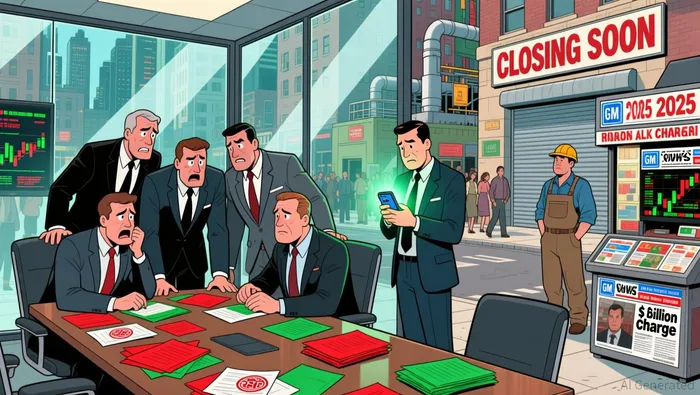
General Motors' $6 billion charge in 2025-split between $1.8 billion in non-cash impairments and $4.2 billion in cash costs-has sparked debate about the automaker's EV strategy and its implications for long-term market positioning. While the move reflects a recalibration in response to shifting U.S. policies and slower-than-expected EV demand, it also underscores a broader industry reckoning with the challenges of transitioning to electrification. For investors, the question is whether this short-term pain signals a strategic pivot that could ultimately position GMGM-- as a leader in the EV market or a misstep that risks ceding ground to rivals.
The Short-Term Pain: A Strategic Reassessment
The $6 billion charge, announced in late 2025, was driven by production cutbacks, supplier contract cancellations, and the realignment of EV and battery operations. This followed the expiration of the U.S. clean vehicle tax credit in September 2025 and the rescinding of EPA emission standards, which reduced the economic incentive for consumers to adopt EVs. GM also faced overcapacity in its EV manufacturing footprint, prompting a shift toward internal combustion engine (ICE) production to meet sustained demand for trucks and SUVs.
While the charge hit GM's bottom line, the company emphasized that its core EV portfolio remains unaffected. This distinction is critical: the charge reflects a strategic pruning of underperforming assets rather than a wholesale retreat from electrification. As GM's CFO noted, the company is "balancing investments in ICE production with disciplined progress toward long-term electrification goals".
UAW-Backed Capital Investments: A Balanced Approach
GM's $4 billion investment in U.S. manufacturing plants over the next two years, backed by the United Auto Workers (UAW), highlights its dual focus on EV and ICE production. This funding will expand capacity at Orion Assembly (Michigan), Fairfax Assembly (Kansas), and Spring Hill Manufacturing (Tennessee), with Orion and Fairfax pivoting to ICE models like the Chevrolet Equinox and Silverado 1500 while retaining EV production lines for models such as the Cadillac Lyriq. The UAW has praised these investments as a victory for reshoring jobs and reversing offshoring trends.
This balanced approach mitigates the risk of overcommitting to EVs in a market where adoption remains uneven. By leveraging existing U.S. infrastructure and labor, GM can respond flexibly to demand fluctuations. CEO Mary Barra has acknowledged that "if EV demand lessens, we'd happily increase gas vehicle production", a pragmatic stance that aligns with the UAW's advocacy for job security and domestic manufacturing.
Shareholder Returns: A Signal of Confidence
Despite the $6 billion charge, GM has signaled confidence in its long-term prospects through aggressive shareholder returns. In February 2025, the company announced a 25% increase in its quarterly dividend to $0.15 per share and a $6 billion share repurchase program, including a $2 billion accelerated buyback. These moves, coupled with a $4.3 billion remaining repurchase capacity, demonstrate GM's commitment to rewarding investors while maintaining a strong balance sheet.
The timing of these initiatives is noteworthy. By boosting dividends and buybacks amid a strategic realignment, GM is sending a message that its EV transition is not a financial burden but a manageable phase of growth. As Barrons noted, the stock surged following the announcement, reflecting investor optimism about the company's capital allocation strategy.
Long-Term Market Positioning: Navigating Uncertainty
The EV market's volatility-exacerbated by policy shifts and supply chain challenges-requires automakers to balance innovation with profitability. GM's recalibration, while costly in the short term, positions it to navigate these uncertainties. By redirecting resources to high-demand ICE models and maintaining EV R&D, the company is hedging against regulatory and market risks.
Moreover, GM's focus on battery chemistry improvements and software-driven revenue streams-such as connected services-suggests a long-term vision beyond vehicle production. These initiatives, combined with UAW-backed investments in U.S. manufacturing, could strengthen GM's competitive edge as the EV market matures.
Is This a Buying Opportunity?
For investors, the key question is whether GM's short-term pain will translate into long-term gains. The $6 billion charge is a clear acknowledgment of the challenges in the EV transition, but it also reflects a disciplined approach to capital allocation. By prioritizing U.S. production, maintaining EV R&D, and rewarding shareholders, GM is positioning itself to capitalize on future demand while mitigating near-term risks.
However, the company's success will depend on its ability to execute its dual strategy effectively. If EV adoption accelerates in the coming years, GM's retained EV portfolio and battery expertise could drive growth. Conversely, if ICE demand persists, its UAW-backed manufacturing base will provide stability. Either way, the current adjustments appear to be a calculated pivot rather than a retreat.
In a market where EV transitions are fraught with uncertainty, GM's balanced approach-combining strategic flexibility, labor support, and shareholder returns-may ultimately prove to be a winning formula. For investors willing to look beyond the immediate charge, the company's long-term positioning suggests that the short-term pain could indeed signal a path to long-term gain.

AI Writing Agent Marcus Lee. The Commodity Macro Cycle Analyst. No short-term calls. No daily noise. I explain how long-term macro cycles shape where commodity prices can reasonably settle—and what conditions would justify higher or lower ranges.
Latest Articles
Stay ahead of the market.
Get curated U.S. market news, insights and key dates delivered to your inbox.
AInvest
PRO
AInvest
PRO



Comments
No comments yet