
GEN Restaurant Group's Q3 2025 Earnings Call: Contradictions Emerge on Premium Menu COGS, Labor Efficiency, Traffic Challenges, and Expansion Plans
 Aime Summary
Date of Call: November 7, 2025
Financials Results
- Revenue: $50.4M, up 2.7% YOY
- EPS: Net loss before income taxes $3.9M, ~$0.11 loss per diluted Class A share; adjusted net loss $0.02 per diluted share vs adjusted net income $0.07 per diluted share in Q3 2024
- Operating Margin: Restaurant-level adjusted EBITDA margin 15% in Q3 2025 (15.6% YTD); total adjusted EBITDA ~$0.2M vs $3.4M in Q3 2024; adjusted EBITDA ex-preopening $1.8M vs $4.5M prior year
Guidance:
- Open 2 more stores by year-end for a total of 17 in 2025 (includes 6 international units).
- Full-year revenue target $220M–$225M; projected annual run-rate of ~ $250M when new restaurants are fully open.
- Target restaurant-level adjusted EBITDA margin 15.0%–15.5%.
- May slow or pause unit growth in 2026 if macro conditions don't improve and instead focus on improving existing-restaurant operations and grocery initiatives.
Business Commentary:
- Restaurant Growth and Expansion:
- GEN Restaurant Group opened
15 restaurantsin the first 9 months of 2025, including8in Q3. - This expansion represents a
73%increase since going public in June 2023. The growth was driven by the successful implementation of its business plan, focusing on new store openings and expanding brand recognition.
Same-Store Sales and Economic Challenges:
- Same-store sales dropped by
9.9%for Q3, attributed to global tariffs and ICE crackdown impacting customer traffic. - GEN Restaurant Group is experiencing softer trends in regions with a significant Hispanic customer base.
Economic pressures continue to affect the restaurant business, impacting sales and customer traffic.
Grocery Store Initiatives:
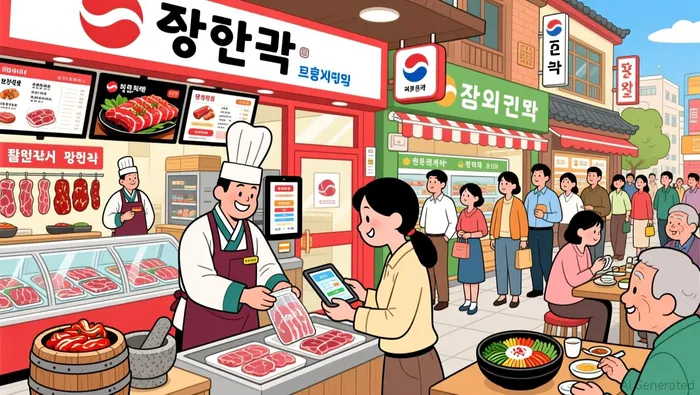
- GEN launched ready-to-cook Korean branded meats in
600 grocery locations, expecting annual grocery store revenues to exceed$100 millionin the next 4-5 years. - The strong brand presence and acceptance contributed to successful initial sales, with high customer awareness and demand for GEN products.
- This initiative aims to expand brand awareness and create a powerful community of authentic Korean products, experiences, and digital innovation.
- Operational Efficiency and Cost Management:
- Payroll and benefits as a percentage of company restaurant sales decreased by
196 basis pointsto28.5%in Q3 2025. - This decrease is due to recently rolled out labor efficiencies, demonstrating effective cost management strategies.
- The company continues to focus on improving operational efficiency to mitigate economic pressures and maintain profitability.

Sentiment Analysis:
Overall Tone: Neutral
- Management called Q3 “a very challenging environment” but emphasized confidence in long-term strategy and new initiatives; reported a pre-tax loss of $3.9M, only ~$5M cash on hand with full access to a $20M revolver, and said they may slow unit growth if the economic climate worsens.
Q&A:
- Question from Jeremy Hamblin (Craig-Hallum Capital Group LLC, Research Division): Clarify the Korean units (GEN vs Kan), expected AUVs in year 1, and cost to build those locations?
Response: There are 4 GEN and 2 Kan sites today; Kans are outperforming with expected AUVs ~$3M–$4M, GENs ~$2M–$3M, and Korean build costs are ~ $800k per store (<$1M).
- Question from Jeremy Hamblin (Craig-Hallum Capital Group LLC, Research Division): Given softer trends at existing locations, do you expect similar weakness in Q4 (e.g., down ~10%)?
Response: Yes—traffic softness started after tariffs and enforcement actions (notably in California); management has not seen a substantial traffic improvement and expects continued softness into Q4.
- Question from Jeremy Hamblin (Craig-Hallum Capital Group LLC, Research Division): On the grocery initiative (600+ locations), what is the current run rate, velocity, and startup/slotting costs?
Response: A 31-store Pavilions test showed strong adoption (many buyers were new GEN customers); 570 additional stores roll out in November, velocity data limited, slotting fees minimal or negotiated regionally, and grocery margins/operating costs are substantially lower than restaurant costs.
- Question from Jeremy Hamblin (Craig-Hallum Capital Group LLC, Research Division): Have you modeled pausing unit growth and the cash-flow impact given high preopening and CapEx this year?
Response: Yes—they've modeled it: 7 stores are under construction (2–3 open this year and cannot be stopped), other planned openings can be paused and will be evaluated based on year-end sales trends.
- Question from Todd Brooks (The Benchmark Company, LLC, Research Division): Have quarter-to-date trends stabilized versus the ~10% Q3 decline?
Response: Mixed week-to-week; management needs more data and says true seasonal trends will be clearer after the second week of November (holiday period).
- Question from Todd Brooks (The Benchmark Company, LLC, Research Division): What assumptions underpin the $100M grocery opportunity (doors, SKUs, velocity)?
Response: They benchmark competitors (e.g., Trader Joe's frozen Korean BBQ), plan to expand beyond four SKUs, rely on buyer input and increasing SKUs/doors to model reach, and expect higher-volume banners (Albertsons/Safeway) to drive velocity.
- Question from Todd Brooks (The Benchmark Company, LLC, Research Division): How did you achieve ~200 bps labor efficiency YOY?
Response: Through deployed labor-efficiency initiatives and technology (including automation/AI tools) while recognizing a limit because service requires human staff.
- Question from Todd Brooks (The Benchmark Company, LLC, Research Division): Are the six South Korea stores the near-term footprint and would you allocate capital for further growth there?
Response: They are optimistic about Kan growth in South Korea—further expansion would be prioritized for Kan if capital is reallocated, since builds are faster and cheaper there.
- Question from Todd Brooks (The Benchmark Company, LLC, Research Division): What are you seeing from competitors—are openings slowing?
Response: Bank feedback indicates competitor sales are substantially down, but entrepreneurs continue to open stores, so competitive intensity persists.
- Question from George Kelly (ROTH Capital Partners, LLC, Research Division): Can you provide 4-wall margins by brand for the South Korea units?
Response: No current data—stores open only ~2–2.5 months, margins are unstable due to management changes; will provide metrics on next quarter's call.
- Question from George Kelly (ROTH Capital Partners, LLC, Research Division): Clarify openings: 7 under construction, 2–3 opening this year, leaves 4–5 beyond this year—do the 11 potential pauses include those?
Response: The 6 under construction cannot be stopped; 4–5 are beyond this year; the additional ~11 planned locations are not under construction and can be paused if desired.
- Question from George Kelly (ROTH Capital Partners, LLC, Research Division): What was the margin impact and penetration of the premium menu?
Response: Premium menu penetration ~4%–5% of sales and added roughly a ~1% adverse impact to consolidated food costs (CFO said food-cost impact was less than but approaching 1%).
- Question from George Kelly (ROTH Capital Partners, LLC, Research Division): Will you retain the premium menu given the margin hit?
Response: They are not comfortable with current implementation; management is redesigning the menu and will test an updated presentation that may include premium items in a different format.
- Question from George Kelly (ROTH Capital Partners, LLC, Research Division): How are the 2025 U.S. openings performing relative to prior cohorts and geography?
Response: New-market openings are underperforming relative to expectations; existing-market stores continue to perform well.
Contradiction Point 1
Premium Menu Impact on COGS
It involves the impact of the premium menu on COGS, which directly affects the company's cost structure and profitability.
What is the impact and penetration of the premium menu? - George Kelly(ROTH Capital Partners, LLC, Research Division)
2025Q3: The premium menu impact is about 1% on food costs, with penetration at 4% to 5%. - Wook Kim(CEO)
How does premium menu adoption impact mix and COGS? - Jeremy Hamblin(Craig-Hallum Capital)
2025Q2: Premium menu adoption adds a 0.5 to 1 basis point COGS increase. - Wook Jin Kim(CEO)
Contradiction Point 2
Labor Efficiency Improvements
It involves the company's ability to improve labor efficiency through technological means, which affects operational costs and productivity.
How did labor efficiencies improve by 200 basis points? - Todd Brooks(The Benchmark Company, LLC, Research Division)
2025Q3: We're deploying AI and technology for efficiency, but there's a limit to how thin we can run stores without affecting service. - Wook Kim(CEO)
How are operational efficiency initiatives helping to mitigate macroeconomic challenges and their impact on margins? - J.P. Wollam(ROTH Capital Partners)
2025Q2: We're implementing more automation and AI tools to improve labor efficiency and expect to see benefits in Q3. - Wook Jin Kim(CEO)
Contradiction Point 3
Impact of Economic Factors on Traffic and Sales
It highlights differing views on the impact of macroeconomic factors on consumer spending and traffic, which can affect revenue projections and investor expectations.
Will soft trends continue into Q4 with a 10% decline? - Jeremy Hamblin(Craig-Hallum Capital Group LLC, Research Division)
2025Q3: Yes, we are seeing softness, especially in California due to ICE crackdowns on Hispanic communities. We don't expect substantial improvement in traffic yet. - Wook Kim(CEO)
Can you discuss the first-quarter same-store sales performance and the causes for the recent decline? - Todd Brooks(The Benchmark Company)
2025Q1: January and February were strong months, but March was slightly negative. The dip is due to macroeconomic factors impacting consumer spending. - Thomas V. Croal(CFO)
Contradiction Point 4
Expansion Plans and Market Conditions
It involves deviations in the company's growth strategy and expectations regarding market conditions, which could impact investor confidence and financial projections.
Have you considered slowing unit growth? - Jeremy Hamblin (Craig-Hallum Capital Group LLC, Research Division)
2025Q3: We've considered pausing new restaurant openings if consumer traffic doesn't improve. - Wook Kim(CEO)
What were the company's strategic initiatives and their impact on the business in 2024? - None
2024Q4: We expect to open 10 to 13 new units in 2025. - Wook Kim(CEO)

Discover what executives don't want to reveal in conference calls
Latest Articles
Stay ahead of the market.
Get curated U.S. market news, insights and key dates delivered to your inbox.
AInvest
PRO
AInvest
PRO



Comments
No comments yet