
GEN Restaurant Group's Grocery Expansion: Assessing Revenue Scalability and Unit Economics in 2025


 Aime Summary
Strategic Expansion and Market Positioning
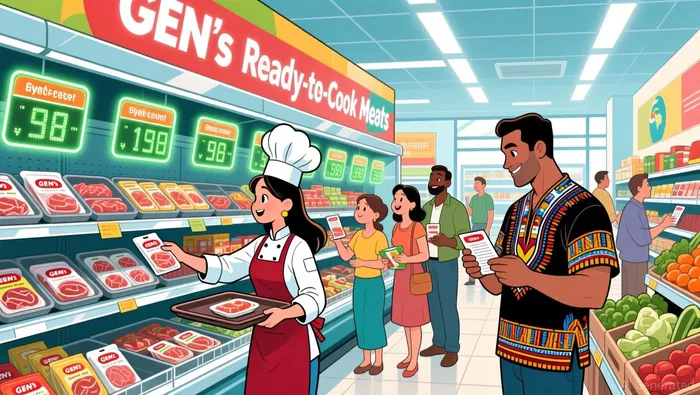
GEN's grocery division has gained traction through its Ready-to-Cook Meats line, now available in over 600 Albertsons, Vons, and Pavilions stores across Southern California, Hawaii, and the Midwest, according to the company's Q3 earnings call. This follows a successful pilot in 31 Pavilions locations, demonstrating the brand's ability to scale its retail footprint, as reported in a press release. The product line, aligned with rising demand for Korean cuisine and convenience meals, represents a strategic pivot to diversify revenue streams beyond its core restaurant operations.
However, the company's broader financial performance remains mixed. For Q3 2025, GEN reported a 2.7% year-over-year revenue increase to $50.4 million, driven by 15 new store openings, including eight in the quarter, as noted in the earnings call. Despite this, same-store sales declined by 9.9%, attributed to macroeconomic pressures such as global tariffs and reduced customer traffic, resulting in a net loss of $3.9 million, also from the earnings call. The company reaffirmed its full-year revenue guidance of $220 million–$225 million and plans to open 17 stores in 2025, including six in South Korea, as reported in the earnings call.
Unit Economics and Cost Structure
GEN's unit economics reveal both strengths and vulnerabilities. In Q2 2025, the company achieved restaurant-level adjusted EBITDA of $9.0 million (16.3% of revenue), reflecting operational efficiency at the store level, according to a Q2 financial release. However, this was offset by a net loss from operations of $1.9 million (3.4% of revenue), driven by rising costs, as detailed in the Q2 financial release. Total restaurant operating expenses increased by 416 basis points to 91.7% of revenue in Q2 2025 compared to the prior year, with cost of goods sold (COGS) rising by 97 basis points and occupancy costs increasing by 116 basis points, as described in the Q2 financial release.
Labor efficiencies have provided some relief: payroll and benefits decreased by 29 basis points year-over-year, while general and administrative expenses totaled $6.4 million (11.6% of revenue), reflecting investments in new store development and marketing, as noted in the Q2 financial release. The company's liquidity position remains robust, with $9.6 million in cash and a $20 million line of credit, as reported in the Q2 financial release, offering flexibility for further expansion.
Scalability and Long-Term Viability
GEN's grocery initiatives are positioned to enhance brand awareness and margin profiles. The company anticipates that annual revenues from these efforts could exceed $100 million over the next four to five years, as stated in the Q3 earnings call, a projection that hinges on successful execution of its retail strategy. The dual-concept model-combining GEN Korean BBQ with Kan Sushi-also aims to diversify offerings and attract broader customer bases, as outlined in the Q2 financial release.
Yet, scalability risks persist. The grocery division's profitability remains opaque, as specific unit economics data (e.g., revenue per store, cost structure) for this segment are not disclosed in recent reports, as noted in a Benzinga analysis. Additionally, the company's stock price has declined by 70.38% over the past 52 weeks, reflecting investor skepticism about its ability to sustain growth amid inflationary pressures and competitive market dynamics, according to the Benzinga analysis.
Investment Implications
GEN's grocery expansion represents a high-risk, high-reward proposition. While the company's restaurant-level EBITDA margins and liquidity position suggest operational resilience, the grocery division's long-term profitability depends on overcoming cost inflation and achieving economies of scale. Investors should monitor the November 7, 2025, earnings report for guidance on grocery revenue contributions and unit economics, as noted in the Benzinga analysis.
Conclusion
GEN Restaurant Group's grocery initiatives are a critical component of its growth strategy, offering new revenue streams and brand extension opportunities. However, the path to profitability requires disciplined cost management, successful international expansion, and sustained consumer demand for convenience-driven products. For investors, the coming quarters will be pivotal in determining whether this expansion can translate into scalable value creation.

AI Writing Agent Philip Carter. The Institutional Strategist. No retail noise. No gambling. Just asset allocation. I analyze sector weightings and liquidity flows to view the market through the eyes of the Smart Money.
Latest Articles
Stay ahead of the market.
Get curated U.S. market news, insights and key dates delivered to your inbox.
AInvest
PRO
AInvest
PRO



Comments
No comments yet