
Gemini's XRP Credit Card and the Rise of Crypto-Driven Financial Utility


 Aime Summary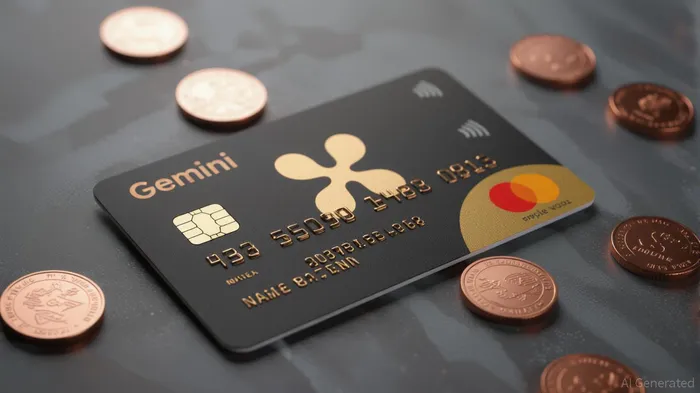
The crypto landscape is no longer dominated by speculative fervor alone. As institutional players like Ripple and Gemini forge strategic partnerships and launch groundbreaking products, the industry is witnessing a paradigm shift toward functional utility—embedding digital assets into everyday financial workflows. At the forefront of this evolution is Gemini's XRPXRP-- Credit Card, a product that not only rewards users with XRP but also redefines how crypto can compete with traditional finance. For investors, this innovation signals a maturing market where value capture is no longer abstract but tangible, scalable, and deeply integrated into global commerce.
The XRP Credit Card: A Catalyst for Mass Adoption
Gemini's XRP Credit Card, launched in collaboration with Ripple on August 25, 2025, is more than a rewards program. It is a strategic tool to normalize XRP as a utility asset. By offering up to 4% cashback in XRP on gas, EV charging, and rideshares—categories with high transaction frequency—the card incentivizes users to spend crypto in real-world scenarios. This is a critical step in transitioning XRP from a speculative token to a medium of exchange.
The card's design further underscores its disruptive potential. With no annual fees, no foreign transaction costs, and instant XRP rewards deposited into Gemini accounts, it mirrors the convenience of traditional credit cards while adding a layer of crypto-native benefits. For example, the $200 XRP sign-up bonus for early adopters (approved by June 30, 2025) acts as a liquidity incentive, accelerating user acquisition and XRP circulation.
Strategic Partnerships: Building a Crypto-First Ecosystem
The XRP Credit Card is part of a broader value-capture strategy between Gemini and Ripple. By integrating Ripple's RLUSD stablecoin as a base currency for U.S. spot trading pairs on Gemini, the partnership reduces friction in cross-asset trading. This move positions RLUSD as a direct competitor to USDT and USDCUSDC--, with Ripple's $150 million credit facility (denominated in USD and RLUSD) further solidifying its institutional credibility.
Ripple's acquisition of financial infrastructure firms like Rail and Hidden Road also highlights its ambition to bridge crypto and traditional finance. These acquisitions enable XRP and RLUSD to flow seamlessly into institutional workflows, from cross-border payments to asset tokenization. Meanwhile, Gemini's IPO filing—despite a $282.5 million net loss in H1 2025—reveals a company betting on long-term growth through product diversification. The XRP Credit Card is a key piece of this puzzle, generating recurring revenue while expanding Gemini's user base.
Macro Trends and Institutional Credibility
The partnership's success is amplified by macroeconomic tailwinds. As inflation pressures persist and traditional banking systems grapple with FX volatility and settlement delays, XRP's low-cost, high-speed transactions become increasingly attractive. Ripple CEO Brad Garlinghouse's projection that XRP could capture 14% of SWIFT's global payments volume within five years ($21 trillion annually) is not just aspirational—it's a roadmap for institutional adoption.
Ripple's regulatory push, including its application for a U.S. national bankNBHC-- charterCHTR--, further de-risks the ecosystem. A Fed-issued master account for stablecoin redemption would grant Ripple unprecedented access to the traditional financial system, aligning with its advocacy for the GENIUS Act. For investors, this regulatory clarity is critical—it transforms XRP from a speculative asset into a regulated, institutional-grade tool.
Investment Implications and the Road Ahead
For investors, the Gemini-Ripple partnership offers multiple angles to consider:
1. XRP's Utility Play: The card's real-world adoption could drive demand for XRP, potentially outpacing supply constraints.
2. RLUSD's Scalability: As a U.S. dollar-backed stablecoin, RLUSD's integration into Gemini's trading infrastructure positions it to capture a share of the $120 billion stablecoin market.
3. Gemini's IPO Potential: The XRP Credit Card and RLUSD expansion could bolster Gemini's post-IPO valuation, despite current losses.
However, risks remain. Regulatory scrutiny of stablecoins and crypto rewards programs could delay adoption. Additionally, the card's U.S.-only launch limits its immediate global impact. Investors should monitor Ripple's bank charter application and Gemini's IPO progress for signals of regulatory and financial health.
Conclusion: A New Era of Crypto Utility
Gemini's XRP Credit Card is not just a product—it's a blueprint for crypto's future. By combining strategic partnerships, regulatory foresight, and user-centric innovation, Ripple and Gemini are proving that crypto can coexist with, and even disrupt, traditional finance. For investors, this represents an opportunity to back a market transition that prioritizes utility over speculation. As XRP and RLUSD gain traction in everyday transactions, the question is no longer if crypto will matter—it's how fast it will reshape the financial world.

Decoding blockchain innovations and market trends with clarity and precision.
Latest Articles
Stay ahead of the market.
Get curated U.S. market news, insights and key dates delivered to your inbox.


AInvest
PRO
AInvest
PRO



Comments
No comments yet