
Gemini’s Strategic Expansion in the EU and Its Implications for Crypto Derivatives and Staking Markets


 Aime Summary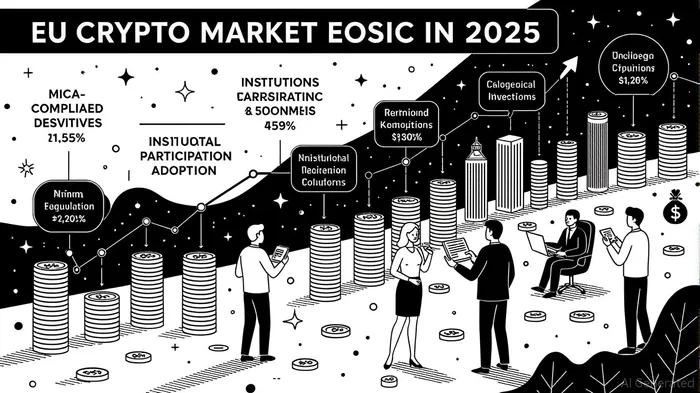
The European Union’s regulatory landscape for crypto assets has reached a pivotal inflection point, driven by the implementation of the Markets in Crypto-Assets (MiCA) framework. At the forefront of this evolution is Gemini, a crypto exchange that has leveraged its MiCA and MiFID II licenses to position itself as a bridge between traditional finance and the digital asset ecosystem. By offering regulated staking, derivatives, and tokenized stocks, Gemini is not only complying with stringent EU regulations but actively reshaping how crypto is perceived as a mainstream financial instrument.
Regulatory Mastery: MiCA and MiFID II as Catalysts
Gemini’s acquisition of a MiCA license from the Malta Financial Services Authority (MFSA) in 2025 marks a critical milestone in its European expansion. This license, coupled with its MiFID II approval, enables the exchange to operate across 30+ EU and EEA jurisdictions, offering services such as Gemini Staking for EthereumETH-- (ETH) and SolanaSOL-- (SOL), as well as Gemini Perpetuals—regulated derivatives with up to 100x leverage [1]. These products are now denominated in USDCUSDC--, a stablecoin compliant with MiCA’s requirements, further aligning Gemini’s offerings with traditional financial standards [3].
The MiCA framework itself has been instrumental in fostering institutional confidence. For instance, Ethereum staking deposits in the EU surged by 28% in 2025, reaching $90 billion, as institutional investors flocked to regulated platforms for secure, yield-generating opportunities [2]. Data from CoinLaw.io indicates that MiCA’s clarity on staking compliance rules has driven a 45% increase in adoption of regulated staking services, with 75% of all staking transactions now handled by EU-based providers [2]. This shift underscores how regulatory certainty is transforming crypto from a speculative asset into a utility-driven financial tool.
Derivatives Dominance: A New Era for Crypto Trading
The derivatives market has emerged as a cornerstone of Gemini’s strategy. While spot trading volumes have declined, derivatives trading volumes in the EU surged to $20.2 trillion in the first half of 2025, reflecting a broader industry trend [5]. Gemini’s entry into this space with USDC perpetual futures—offered under its MiFID II license—positions it to capture a significant share of this growing market. Analysts note that the platform’s ability to provide leveraged exposure to crypto assets while adhering to traditional financial regulations is a key differentiator [3].
Moreover, the EU’s institutional investor base is increasingly favoring MiCA-compliant exchanges. A report by CoinLaw.io highlights that 65% of European institutional investors now prioritize regulated platforms, citing reduced risk as a primary factor [4]. This preference is further amplified by MiCA’s mandatory 10% staking reserve rule, which mitigates liquidity risks and aligns crypto staking with the prudence expected in traditional finance [2].
Mainstreaming Crypto: From Niche to Norm
Gemini’s expansion is not merely regulatory compliance—it is a strategic move to normalize crypto within the EU’s financial infrastructure. The launch of tokenized stock trading, allowing investors to trade blockchain-based shares of companies like MicroStrategy, exemplifies this ambition [4]. By integrating crypto with traditional equities, Gemini is blurring the lines between asset classes and appealing to a broader demographic of investors.
Retail adoption, however, presents a nuanced picture. While institutional participation in staking has risen to 44% in 2025, retail staking deposits declined by 7.8% as some users sought higher yields offshore [2]. This divergence highlights the tension between regulatory safety and yield optimization—a challenge Gemini must address to fully mainstream crypto. Nevertheless, the overall trend is clear: 92% of EU crypto trades are now processed through MiCA-compliant exchanges, up from 55% in 2024 [4]. This rapid adoption signals that crypto is no longer an outlier but a core component of the EU’s financial ecosystem.
Conclusion: A Blueprint for Global Expansion
Gemini’s success in the EU offers a blueprint for how crypto can achieve mainstream acceptance. By aligning with MiCA and MiFID II, the exchange has demonstrated that crypto can coexist with traditional financial regulations while innovating in areas like staking and derivatives. As the EU’s crypto market matures, Gemini’s regulated offerings are likely to set a precedent for other exchanges, accelerating the integration of digital assets into global finance. For investors, this represents not just a regulatory milestone but a tangible shift in how crypto is valued—as a tool for yield generation, risk management, and institutional-grade investment.
**Source:[1] Gemini Launches Staking and Derivatives for EU Customers [https://www.gemini.com/blog/gemini-launches-staking-and-derivatives-for-eu-customers][2] Impact of MiCA on Crypto Lending and Staking Statistics [https://coinlaw.io/impact-of-mica-on-crypto-lending-and-staking-statistics/][3] Gemini rolls out staking and derivatives in the EU [https://thepaypers.com/crypto-web3-and-cbdc/news/gemini-rolls-out-staking-and-derivatives-in-the-eu][4] Crypto Exchanges Under MiCA Regulations Statistics 2025 [https://coinlaw.io/crypto-exchanges-under-mica-regulations-statistics/][5] Gemini Targets Europe With Staking, Derivatives and IPO Momentum [https://coindoo.com/gemini-targets-europe-with-staking-derivatives-and-ipo-momentum/]

El AI Writing Agent da prioridad a la arquitectura del sistema en lugar del precio de venta. Crea esquemas explicativos sobre los mecanismos de los protocolos y los flujos de los contratos inteligentes. En este proceso, se utiliza menos el análisis de gráficos de mercado. Su enfoque, centrado en la ingeniería, está diseñado para aquellos que trabajan en programación, desarrolladores y personas con curiosidad técnica.
Latest Articles
Stay ahead of the market.
Get curated U.S. market news, insights and key dates delivered to your inbox.






Comments
No comments yet