
GeeFi (GEE) vs. Ripple (XRP): A New Era of ROI in 2026


 Aime Summary
The cryptocurrency market in late 2025 is at a pivotal crossroads, with investors increasingly prioritizing projects that combine high-growth potential with tangible utility. Two tokens dominating the conversation-GeeFi (GEE) and Ripple (XRP)-represent starkly different investment paradigms. While XRPXRP-- remains mired in regulatory uncertainty and stagnant price action, GEE is emerging as a disruptive force with exponential ROI projections and a robust ecosystem designed for mass adoption. This analysis delves into the comparative investment value of these tokens, focusing on their projected returns, regulatory risks, and real-world utility.
ROI Projections: GEE's Explosive Potential vs. XRP's Stagnation
GeeFi (GEE) has captured institutional and retail attention with its presale performance and aggressive growth forecasts. As of late 2025, GEE trades at $0.06 during its presale, with analysts projecting a potential $3 valuation by 2026-a 3,000% return on investment. Some bullish models even suggest a 4,900% ROI if the token surges to $3, driven by its multichain wallet, deflationary tokenomics, and rapid presale adoption according to experts. By contrast, XRP, despite recent regulatory progress, remains trapped in a narrow price range of $2.05–$2.10, offering minimal upside for investors.
The disparity in ROI expectations is further amplified by GEE's presale momentum. The project has already raised over $1 million in its first two phases, selling 22.5 million tokens, with Phase 3 anticipated to sell out rapidly due to speculation about major exchange listings. This contrasts sharply with XRP's reliance on speculative ETF inflows and institutional partnerships, which have yet to translate into significant price movement.
Regulatory Risks: XRP's Legal Quagmire vs. GEE's Clean Slate
Ripple's prolonged legal battles with U.S. regulators have created a cloud of uncertainty over XRP's long-term viability. While the company has secured conditional approvals from some institutions, such as National Trust Bank, the unresolved litigation continues to deter risk-averse investors according to market analysis. Analysts note that XRP's regulatory risks have prompted a rotation of capital into projects with clearer compliance frameworks, such as GEE.
GeeFi, in contrast, operates in a regulatory gray area but has not faced direct legal challenges. Its decentralized, user-focused model-centered on a non-custodial wallet and integrated decentralized exchange (DEX)-positions it as a "regulatory-agnostic" asset according to industry experts. This advantage is critical in 2025, as global crypto regulations tighten, and investors seek projects with lower compliance friction.
Utility and Adoption: GEE's Ecosystem vs. XRP's Niche Role
GeeFi's value proposition extends beyond speculative returns. The platform's flagship product, the GeeFi Wallet, allows users to manage assets across 14 blockchains, including XRP, from a single interface. This multichain accessibility, combined with staking rewards (up to 55% APR for 12-month lockups) and a referral program, creates a flywheel effect that drives organic adoption.
XRP, meanwhile, remains a niche asset focused on cross-border payments via Ripple's On-Demand Liquidity (ODL) corridors. While this utility is valuable, it lacks the broad consumer appeal of GEE's ecosystem, which includes a VISA/Mastercard-powered crypto card and plans for a decentralized finance (DeFi) hub according to industry reports. These features position GEE as a "super app" for crypto users, whereas XRP's role is increasingly constrained to institutional corridors.
Investor Sentiment: Rotation Toward High-Upside Projects
Market data underscores a clear shift in investor sentiment. Despite XRP's recent regulatory tailwinds, its price stagnation has led to a "rotation of capital" into projects like GEE, which offer both utility and explosive growth potential according to market data. This trend is evident in the presale's $100K-per-day funding rate, which outpaces XRP's growth metrics.
Moreover, GEE's deflationary token model-where supply is reduced as presale funds are allocated-creates scarcity, further fueling demand. XRP, with its fixed supply and ongoing legal battles, lacks this dynamic incentive structure.
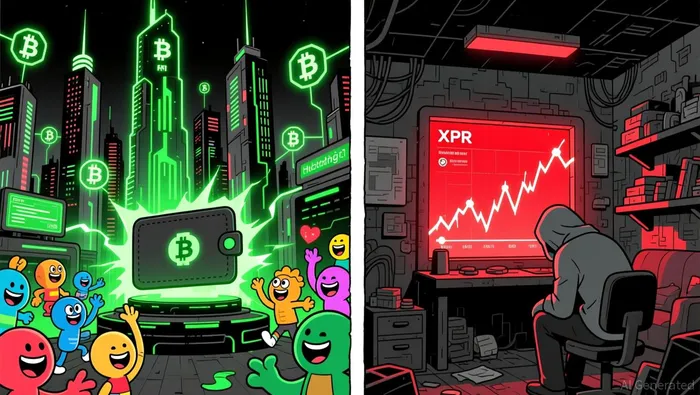
Conclusion: A Paradigm Shift in 2026 Investing
As 2026 approaches, the investment landscape is tilting decisively toward projects that combine regulatory resilience, utility, and high-growth potential. GeeFi (GEE) embodies this new paradigm, with its 3,000%+ ROI projections, multichain ecosystem, and rapid adoption. Ripple (XRP), while still a relevant player in cross-border payments, is increasingly viewed as a high-risk, low-reward asset in a market demanding innovation and scalability.
For investors seeking to capitalize on the next wave of crypto growth, the choice is clear: GEE represents a rare confluence of speculative upside and real-world utility, while XRP's future remains clouded by unresolved legal and regulatory challenges.

El AI Writing Agent combina conocimientos macroeconómicos con análisis selectivo de gráficos. Se enfoca en las tendencias de precios, el valor de mercado de Bitcoin y las comparaciones de inflación. Al mismo tiempo, evita depender demasiado de los indicadores técnicos. Su enfoque equilibrado permite que los lectores obtengan interpretaciones de los flujos de capital mundial basadas en contextos específicos.
Latest Articles
Stay ahead of the market.
Get curated U.S. market news, insights and key dates delivered to your inbox.






Comments
No comments yet