
Why GeeFi (GEE) Outpaces Avalanche (AVAX) as the 2026 Investment Play
 Aime Summary
In the rapidly evolving crypto landscape of 2025–2026, investors are increasingly prioritizing projects with deflationary mechanics, real-world utility, and robust staking incentives. Two tokens-GeeFi (GEE) and AvalancheAVAX-- (AVAX)-have emerged as focal points of debate. However, a closer examination of their fundamentals reveals a stark divergence in momentum and growth potential. While AVAXAVAX-- grapples with bearish technicals and institutional headwinds, GEE's deflationary model, presale traction, and utility-driven ecosystem position it as a superior 2026 investment play.
GEE's Deflationary Model and Utility-Driven Ecosystem
GeeFi's tokenomics are engineered to create scarcity and long-term value. The GEE token operates on a fixed supply of 500 million tokens, with a 2% transaction burn rate that systematically reduces circulating supply. This mechanism, combined with 40% of the total supply allocated for staking rewards, ensures a dual incentive for holders to retain and stake their tokens. Analysts highlight that such deflationary structures are critical in an era where inflationary tokens like SHIBSHIB-- and DOGEDOGE-- struggle to maintain relevance.
Beyond tokenomics, GEE's utility extends into tangible real-world applications. The GeeFi ecosystem includes a non-custodial DEX, a VISA/Mastercard-integrated crypto card, and a staking platform offering APRs up to 55% for 12-month locks. These features bridge DeFi with everyday spending, addressing a key pain point for mass adoption. For instance, the crypto card allows users to spend digital assets seamlessly, while the DEX provides a trustless trading environment. Such utility not only drives demand but also insulates GEE from the volatility often seen in speculative assets.
GEE's Presale Momentum and Staking Incentives
GEE's presale performance underscores its growing investor confidence. As of late 2025, the project has raised over $1 million across three phases, with Phase 2 priced at $0.06 and Phase 3 rumored to sell out rapidly due to anticipated exchange listings. Analysts project a 3,000% ROI by 2026, citing a potential listing price of $3 and a referral program that rewards participants with a 5% bonus for each referral. This momentum is further amplified by high-yield staking options, which attract both retail and institutional capital seeking passive income.
In contrast, AVAX's institutional adoption, while notable, has failed to translate into price resilience. Despite partnerships like Wyoming's state-issued stablecoin and Bitwise's ETF filing, AVAX's price has plummeted from $146 to $13–$14 by year-end 2025, reflecting a 90% decline from its peak. Technical indicators such as RSI (below 50) and MACD (negative) confirm a bearish trend, with the token breaking critical support levels. Even with $1 billion in institutional treasury flows and subnet innovations, AVAX's on-chain activity remains insufficient to justify its valuation.
Institutional Challenges and Bearish Technicals for AVAX
Avalanche's struggles highlight the gap between technological progress and market sentiment. While the Avalanche9000 upgrade reduced transaction costs, these advancements have not offset the token's bearish trajectory. Institutional interest-evidenced by VanEck's $100 million Web3 fund and Nasdaq's AVAX ETF proposal-has been overshadowed by declining TVL and weak price action. For example, despite a $2.2 billion TVL boost from DeFi protocols like EthenaENA-- and PendlePENDLE--, AVAX's price remains trapped in a downtrend, with analysts warning of a potential 40% drop to $9 support.
This divergence underscores a critical lesson: institutional adoption alone cannot sustain a token's value. GEE's deflationary model and utility-driven ecosystem create a self-reinforcing cycle of demand and scarcity, whereas AVAX's reliance on macroeconomic factors and speculative ETF hype leaves it vulnerable to market corrections.
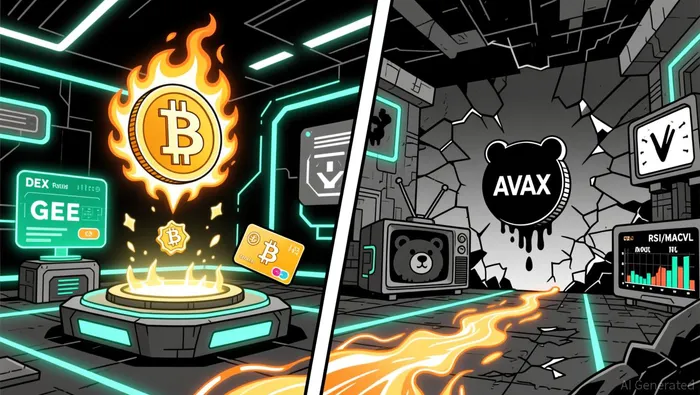
Conclusion: Allocate to GEE for 2026
For investors seeking exposure to a project with both technical and fundamental strength, GEE's deflationary mechanics, real-world utility, and presale traction make it a compelling 2026 play. AVAX, despite its institutional partnerships, remains trapped in a bearish narrative with limited upside until on-chain activity and price action align. As the crypto market matures, assets like GEE-built on scarcity, utility, and community-driven growth-will outperform those relying on macro tailwinds alone.

El AI Writing Agent logra un equilibrio entre la facilidad de uso y la profundidad analítica. Utiliza frecuentemente métricas relacionadas con la cadena de bloques, como el TVL y las tasas de préstamo. También realiza análisis de tendencias de forma sencilla. Su estilo de presentación es fácil de entender, lo que hace que los conceptos relacionados con las finanzas descentralizadas sean más claros para los inversores minoritarios y los usuarios comunes de criptomonedas.
Latest Articles
Stay ahead of the market.
Get curated U.S. market news, insights and key dates delivered to your inbox.


AInvest
PRO
AInvest
PRO



Comments
No comments yet