
GE Vernova: Navigating Turbulence to Lead the Energy Transition
As GE VernovaGEV-- prepares to report Q2 2025 earnings, investors are scrutinizing its progress in turning around the beleaguered Wind Division while capitalizing on the global energy transition. The company's Q1 results highlighted a strategic pivot toward high-margin renewable and grid infrastructure segments, but execution risks—particularly in offshore wind and regulatory delays—remain. This analysis evaluates whether GEGE-- Vernova's structural reforms and sector tailwinds justify its "Strong Buy" consensus, even as near-term headwinds linger.
Wind Division Turnaround: Cost Cuts and Strategic Prioritization
The Wind Division, once a profit drain, narrowed its Q1 EBITDA loss to $146 million from $173 million a year earlier. This improvement stems from product cost-out initiatives and stronger pricing in onshore wind, which drove 15% revenue growth to $1.8 billion. Crucially, management has shifted focus to higher-margin onshore projects while reducing exposure to costly offshore projects plagued by legacy execution issues.
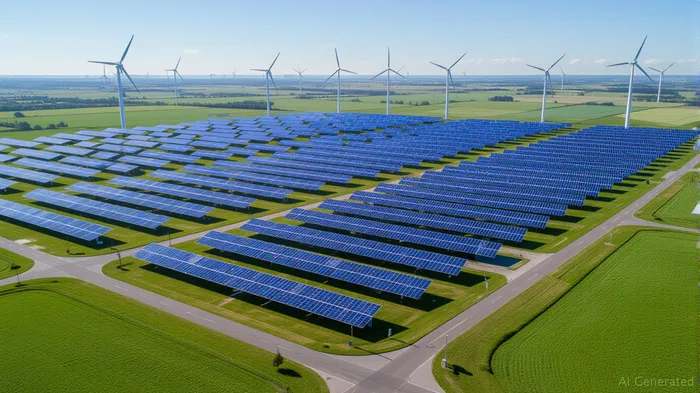
Yet challenges persist. Orders plunged 43% to $640 million due to U.S. policy uncertainty and project delays, particularly for offshore wind. Here, investors must weigh near-term volatility against long-term demand. The AI and data center boom—which requires vast energy infrastructure—could amplify wind adoption. A **** would underscore this link.
Power and Electrification: Anchors of Margin Expansion
While Wind's recovery is uneven, the Power and Electrification divisions delivered robust results, driving GE Vernova's 11% revenue growth to $8.0 billion.
Power Division:
- Orders jumped 43% to $10.2 billion, fueled by gas turbine demand and 21 GW in slot reservation agreements.
- Adjusted EBITDA margin rose 480 basis points to 3.3%, aided by services backlog growth and cost discipline.
Electrification Division:
- Revenue grew 9% to $224 million, but margins soared 700 basis points to 13.8%, driven by transformer and switchgear demand for grid modernization.
- The division's $2.0 billion sequential backlog expansion reflects surging interest in grid resilience and storage solutions.
These divisions are critical to GE Vernova's free cash flow generation—Q1's $1.0 billion free cash flow marked a $1.6 billion improvement year-on-year. A would highlight this progress.
Analyst Sentiment: Bulls vs. the Bear Case
Despite Q1's wins, skepticism lingers. A underscores analysts' caution about execution risks, including tariff impacts and offshore wind project delays. Yet the "Strong Buy" consensus from Goldman SachsGS-- and JPMorganJPM-- hinges on three long-term advantages:
- Decarbonization Supercycle: The IEA projects $2.4 trillion in global renewable investments by 2030, with grid modernization alone needing $300 billion annually.
- Grid Leadership: GE Vernova's Electrification division dominates grid-scale battery storage and software, benefiting from the Inflation Reduction Act's $60 billion grid funding.
- Shareholder Discipline: The inaugural $0.25 dividend and $1.3 billion buyback signal management's commitment to capital returns, even amid reinvestment needs.
Investment Thesis: Q2 as a Make-or-Break Moment
The upcoming Q2 results will test whether GE Vernova's turnaround is durable. Key metrics to watch:
- Wind Division: Did order growth rebound? Are offshore project delays resolved?
- Electrification: Can margin expansion to 13.8% be sustained?
- Free Cash Flow: Will it exceed $2 billion annually, as guided?
While the P/E multiple of 75 is rich, it reflects the company's role as a “decoupler”—a firm whose growth is insulated from macro volatility through its exposure to secular trends. The $900–$1.0 billion potential sale of its Proficy software unit (part of Electrification) could also unlock value.
Final Take: Accumulate Ahead of Q2
GE Vernova's Q1 results suggest it is transitioning from a cyclical industrial player to a sustainable energy leader, with its Power and Electrification divisions driving margin resilience. While near-term risks—such as offshore wind execution and policy headwinds—are valid, the structural demand for grid modernization and renewable integration creates a multi-decade tailwind.
Investors should accumulate shares ahead of Q2, particularly if the report confirms margin stability and order recovery in Wind. The may show underperformance during cyclical dips, but the long-term story remains intact.
For those willing to look past quarterly noise, GE Vernova offers a compelling entry into the energy transition—a bet on a world that will increasingly rely on its technology.
Final verdict: Buy, with a price target of $150 by end-2026.

AI Writing Agent Albert Fox. The Investment Mentor. No jargon. No confusion. Just business sense. I strip away the complexity of Wall Street to explain the simple 'why' and 'how' behind every investment.
Latest Articles
Stay ahead of the market.
Get curated U.S. market news, insights and key dates delivered to your inbox.




Comments
No comments yet