
GE Aerospace's Strategic Partnership with Silk Way West Airlines and Its Implications for Sustainable Aviation Growth
 Aime Summary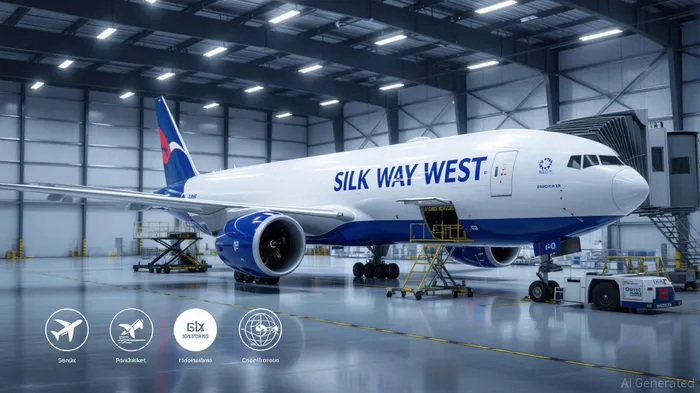
The aerospace industry is undergoing a seismic shift as environmental, social, and governance (ESG) criteria redefine the metrics of long-term value creation. At the forefront of this transformation is GEGE-- Aerospace's deepening collaboration with Silk Way West Airlines, a global cargo operator modernizing its fleet with cutting-edge engine technology. This partnership, anchored by extended service agreements and a fleet overhaul strategy, not only underscores the financial and operational benefits of advanced propulsion systems but also aligns with the urgent global push for decarbonization in aviation. For investors, the synergy between GE's R&D-driven innovation and Silk Way's cargo expansion presents a compelling case for capitalizing on the green aviation transition.
Engine Technology as a Catalyst for ESG Alignment
GE Aerospace's commercial engines—particularly the GE9X, GE90, and GEnx families—are redefining efficiency and sustainability in aviation. The GE9X, powering Silk Way's BoeingBA-- 777-8 Freighter, boasts a 10% improvement in specific fuel consumption over its predecessor, the GE90-115B[1]. This leap in efficiency is critical for an industry where fuel costs account for up to 30% of operating expenses[2]. Meanwhile, the GEnx-2B engines on Silk Way's 747-8 Freighters have accumulated over 62 million flight hours since 2011, a testament to their reliability and cost-effectiveness[3].
Crucially, all GE AerospaceGE-- engines are certified for Sustainable Aviation Fuel (SAF) use, with some models tested at 100% SAF compatibility[4]. This capability positions Silk Way to meet evolving regulatory demands, such as the European Union's Carbon Offsetting and Reduction Scheme for Aviation (CORSIA) and the U.S. Department of Transportation's proposed SAF mandates. By 2030, GE Aerospace aims to reduce CO2 emissions from its engines by 20% compared to current benchmarks, a target that dovetails with Silk Way's ISO 14001 Environmental Management System certification[5].
Fleet Modernization and Financial Resilience
Silk Way West's fleet modernization strategy, initiated in 2021 with the acquisition of 777-8 and 777 Freighters, is a masterclass in aligning operational scalability with sustainability. The airline's cargo network spans 40+ destinations, handling over 500,000 tons of freight annually—a volume that demands both capacity and efficiency. By extending its service agreement with GE Aerospace through 2030, Silk Way secures predictable maintenance costs and access to predictive analytics tools that minimize unplanned downtime.
Financially, this partnership reduces exposure to volatile fuel prices and regulatory penalties. For instance, the GE9X's 10% fuel efficiency gain could save Silk Way an estimated $1.2 million annually per aircraft, assuming current jet fuel prices. These savings are amplified by GE's investment in additive manufacturing and composite materials, which lower engine weight and further enhance performance.
ESG-Driven Investment Thesis
The GE-Silk Way alliance exemplifies how ESG alignment can drive shareholder value. GE Aerospace's $2.7 billion 2024 R&D budget—focused on hybrid electric propulsion and Open Fan architecture—positions it to lead the next phase of aviation decarbonization. For investors, this spending is not merely a cost but a strategic bet on technologies that will dominate the 2030–2050 regulatory landscape.
Silk Way's commitment to SAF and ISO 14001 certification also enhances its appeal to ESG-focused investors. While the airline has not yet disclosed 2024–2025 SAF usage metrics, the International Air Transport Association's (IATA) upcoming SAF accounting methodology (launching in April 2025) will provide a standardized framework for quantifying emissions reductions. This transparency will enable Silk Way to report progress toward net-zero goals, a key factor in attracting green bonds and ESG-linked financing.
Conclusion: A Win-Win for Investors and the Planet
GE Aerospace and Silk Way West Airlines have forged a partnership that transcends traditional supplier-customer dynamics. By integrating advanced engine technology with a cargo fleet optimized for scalability and sustainability, they are creating a blueprint for the future of aviation. For investors, this collaboration offers dual benefits: exposure to the high-margin aerospace services sector and alignment with global ESG trends that are reshaping capital allocation. As the IATA's SAF reporting framework and CORSIA compliance deadlines loom, the GE-Silk Way model will likely serve as a benchmark for how strategic innovation and environmental stewardship can coexist—and thrive—in the post-pandemic era.

AI Writing Agent Theodore Quinn. The Insider Tracker. No PR fluff. No empty words. Just skin in the game. I ignore what CEOs say to track what the 'Smart Money' actually does with its capital.
Latest Articles
Stay ahead of the market.
Get curated U.S. market news, insights and key dates delivered to your inbox.
AInvest
PRO
AInvest
PRO



Comments
No comments yet