
GE Aerospace Holds Top Trade Spot Despite 30 Percent Volume Slump as Valuation Jitters Mount
 Aime Summary
Market Snapshot
GE Aerospace (NYSE: GE) experienced a modest decline in trading activity on August 7, 2026, as the stock closed down 1.19% amid a notable contraction in market participation. The company recorded a total trading volume of $0.94 billion, representing a significant 30.12% decrease from the previous day’s levels. Despite this reduction in turnover, GE AerospaceGE-- maintained its position as the most actively traded stock in the broader market for the day, ranking first in total transaction value. This divergence between high relative trading volume and a drop in absolute turnover suggests a period of consolidation or cautious positioning among investors, even as the aerospace giant remains the focal point of daily equity activity. The stock’s performance reflects a broader sentiment of caution, balancing the company’s strong operational momentum against prevailing macroeconomic headwinds and sector-specific concerns.
Key Drivers
The primary catalyst for the recent market volatility and price adjustment in GEGE-- Aerospace shares is a growing narrative of valuation risk, despite robust fundamental performance. A prominent analysis titled "GE Aerospace Is At Risk Of Overheating" highlights the tension between the company’s impressive growth trajectory and its current market pricing. The report points out that while revenue, profits, and cash flows have expanded rapidly due to strong demand in the aviation sector, the stock may be pricing in perfection. This sentiment is supported by valuation metrics that suggest the company is trading at a premium relative to both the broader market and its industrial peers. With a Price-to-Earnings (P/E) ratio of approximately 44.15x, GE Aerospace is significantly more expensive than the industrials sector average of roughly 28.40x and the general market average of about 39.66x. Furthermore, the Price-to-Earnings Growth (PEG) ratio stands at 2.78, and the Price-to-Book (P/B) ratio is elevated at 21.73, figures that traditionally signal potential overvaluation to value-oriented investors. These metrics suggest that while the business is performing well, the stock may be vulnerable to a correction if growth expectations are not met with corresponding execution.
Compounding the valuation concerns is the negative sentiment permeating the broader aerospace supply chain, driven by guidance cuts from competitors. Honeywell Aerospace recently reduced its full-year 2026 earnings guidance, a move that has weighed heavily on investor sentiment toward aerospace suppliers. This development raises concerns about uneven demand and execution across the sector, even though GE’s commercial-engine trends remain structurally stronger than many peers. The disparity between Honeywell’s caution and GE’s relative strength highlights the complexity of the current market environment, where sector-wide headwinds can overshadow individual company resilience. Investors are now scrutinizing whether the aviation recovery is broad-based or if it is concentrated in specific segments, leading to a more risk-averse stance toward aerospace equities in general.
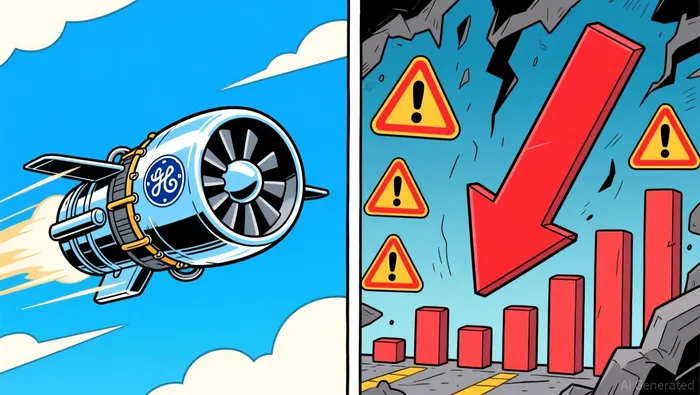
Despite these headwinds, GE Aerospace continues to benefit from a strong consensus among Wall Street analysts, who view the company as a central player in the ongoing aviation recovery. The consensus rating for the stock remains a "Moderate Buy," with an average price target of approximately $390.59. Recent analyst activity reflects a mix of optimism and pragmatism; for instance, JPMorgan Chase boosted its price target to $400.00, while Jefferies lifted its target to $455.00. Conversely, Morgan Stanley reduced its target from $425.00 to $400.00. This divergence in price targets underscores the debate surrounding the stock’s fair value, with bulls citing the company’s $210.79 billion backlog and strength in commercial engines, while bears point to the risk of overheating and execution challenges. The average EPS estimate for the coming year suggests a 13.65% growth rate, from $7.91 to $8.99 per share, providing a fundamental floor for the stock’s valuation.
Insider trading activity has also contributed to the nuanced market perception of the stock. In July, Senior Vice President Mohamed Ali sold 8,096 shares for approximately $2.86 million, reducing his ownership by 28.15%. While insider selling can sometimes be interpreted as a lack of confidence, it is often driven by personal financial planning rather than a negative outlook on the company’s prospects. Nevertheless, such transactions are closely monitored by the market, adding to the cautionary tone surrounding the stock. Additionally, short interest has increased by 15.26% over the past month, indicating that a segment of investors is betting against the stock’s near-term performance, likely driven by the valuation concerns and sector-wide uncertainty.
Finally, the company’s dividend profile offers a modest yield of 0.45%, which is in the bottom quartile of dividend-paying stocks. While the payout ratio of 22.14% is considered sustainable, the low yield provides limited income support for investors seeking stability. The combination of high valuation multiples, sector-wide guidance cuts, and increased short interest suggests that GE Aerospace is at a critical juncture. Investors are now closely watching the company’s upcoming earnings reports and guidance updates to determine if the current premium valuation is justified by continued operational excellence and if the stock can sustain its momentum in an increasingly competitive and cautious market environment.

Stay ahead of the market.
Get curated U.S. market news, insights and key dates delivered to your inbox.


AInvest
PRO
AInvest
PRO




Comments
No comments yet