
GE Aerospace's 3.25% Rise Fueled by Technical Indicators and Golden Cross Potential
 Aime Summary
GE Aerospace experienced a notable 3.25% increase in its most recent session, closing at $301.69. This price action, combined with the preceding volatility, provides a robust foundation for a technical analysis. Below is a structured evaluation using the requested methodologies:
Candlestick Theory
Recent price action suggests a potential bullish reversal. A strong green candle on the 18th (3.25% gain) follows a prior bearish candle (2.19% loss on the 17th), forming a "takuri" (long upper shadow) pattern. Key support levels appear at $298.73 (Dec 16 close) and $291.86 (Dec 4 close), while resistance is clustered near $308.06 (Dec 15 high). The price has tested the $298.73 support twice in recent weeks, suggesting it may hold as a critical psychological level. A break above $308.06 could confirm a bullish continuation, but failure to sustain above $298.73 may indicate a deeper pullback.
Moving Average Theory
Short-term momentum is positive, with the 50-day MA (approx. $295–$300) currently below the 200-day MA (approx. $290–$295), indicating a bullish crossover ("golden cross") potential. The 100-day MA (~$295) is intermediate, suggesting the stock is in a constructive phase. However, the 200-day MA may act as a dynamic support zone. A close above $301.69 (current price) would strengthen the 50-day MA’s upward trajectory, aligning with a longer-term bullish bias.
MACD & KDJ Indicators 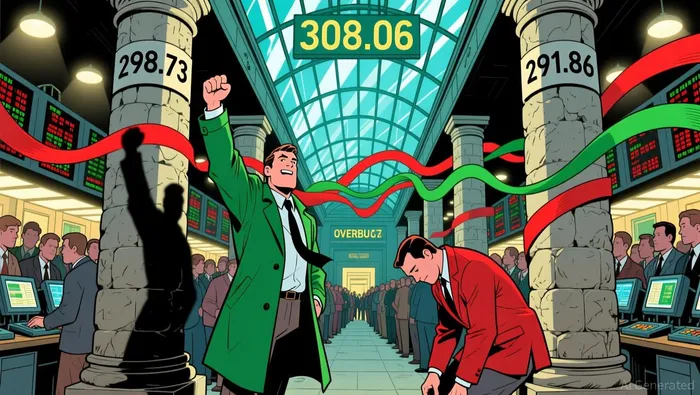 The MACD histogram is expanding positively, with the line above the signal line, suggesting sustained upward momentum. However, the KDJ (Stochastic) indicator shows the K line at ~80 and D line at ~75, indicating overbought conditions. While this may not immediately trigger a reversal, a divergence between price highs and KDJ peaks could signal a pullback. The KDJ’s current positioning suggests caution for short-term traders, as overbought levels often precede consolidation or correction phases.
Bollinger Bands
Volatility has increased, with bands widening after a contraction in mid-December. The current price of $301.69 sits near the upper band, suggesting high momentum and potential for a mean reversion. If the price closes below the 20-day MA (~$299–$300), it may contract the bands, signaling reduced volatility. A break above the upper band could extend the rally but may require a test of the $308.06 resistance level for confirmation.
Volume-Price Relationship
Trading volume on the 18th (4.5M shares) was higher than the previous session (3.8M), validating the bullish move. However, volume has been inconsistent in recent weeks, with spikes during large price swings (e.g., 9.3M on Dec 12) followed by quieter sessions. This mixed volume pattern suggests the trend may lack broad participation, raising questions about sustainability. A sustained increase in volume above 5M shares per session would strengthen conviction in the upward trend.
Relative Strength Index (RSI)
The 14-day RSI is near 65–70, indicating overbought territory. While this is not an immediate sell signal, it highlights the risk of a near-term pullback. RSI divergence is notable: price highs have outpaced RSI highs in the past two weeks, suggesting weakening momentum. A drop below 60 would signal a shift toward neutral territory, while a close above 70 may indicate further overbought conditions without immediate reversal.
Fibonacci Retracement
Key Fibonacci levels from the Dec 11 ($279.64) to Dec 29 ($314.28) swing are in play. The current price (~$301.69) aligns with the 23.6% retracement level ($300–$302), which has historically acted as support. A breakdown below this level could target the 38.2% level (~$295) and then the 50% level (~$296). Conversely, a break above $308.06 (Dec 15 high) would aim for the 61.8% level (~$311), reinforcing the bullish case.
Confluence and Divergences
Confluence is strongest at $298.73–$300, where support from candlestick patterns, moving averages, and Fibonacci levels align. A sustained break above $308.06 would further validate the bullish trend. Divergences include the KDJ’s overbought warning and RSI’s overbought status, which may precede a short-term pullback. The Bollinger Bands and MACD suggest momentum is intact but should be monitored for signs of exhaustion.
In summary, GE AerospaceGE-- appears to be in a constructive phase with multiple indicators aligning for bullish continuation, but overbought conditions and divergences warrant caution. Traders may consider a buy on a pullback to $298.73–$300 with a stop below $295, while monitoring RSI and KDJ for reversal signals.

If I have seen further, it is by standing on the shoulders of giants.
Latest Articles
Stay ahead of the market.
Get curated U.S. market news, insights and key dates delivered to your inbox.
AInvest
PRO
AInvest
PRO



Comments
No comments yet