
GDS's Q3 2025 Earnings Call: Contradictions Unveiled on AI Demand, China's Market, and Power Quota Challenges
 Aime Summary
Date of Call: August 9, 2025
Financials Results
- Revenue: Revenue increased 10.2% year‑on‑year in 3Q 2025
Guidance:
- On track to achieve midpoint of revenue guidance and at or above the top end of EBITDA guidance for full‑year 2025.
- Full‑year organic CapEx expected ~RMB 4.8bn; net of asset monetization ~RMB 2.7bn.
- Operating cash flow for full year expected ~RMB 2.5bn; China business nearly self‑funding after monetization.
- CREET: first post‑IPO asset injection eligible from 2Q 2026; target EV for initial injection ~RMB 4–6bn.
- Expect nearly 300 MW of bookings for full year 2025 (≈65% AI‑related).
- Expect MSR to decline ~3–4% in 2026 (quarter‑over‑quarter comps).
Business Commentary:
- Revenue Growth and Adjusted EBITDA Boost:
- GDS Holdings Limited reported
revenueincreased by10.2%and adjustedEBITDAincreased by11.4%year-on-year for Q3 2025. The growth was driven by strong demand for AI-related services and a healthy backlog, marking the continuation of a recovery trend from the previous year.
AI Demand and Market Inflection:

- GDS Holdings' total new bookings for the first nine months were
75,000 sq m, or240 megawatts, with expectations to achieve nearly300 megawattsfor the full year. The growth in AI demand is attributed to the significant financial commitments of major tech players in AI infrastructure and the rapid development of domestic chip technologies.
Capital Access and Asset Monetization:
- The company completed the first IPO of a data center REIT in China, with CREET units up
45.8%from the IPO price toRMB 4.375. This strategic move enables GDS to access capital from the domestic equity market efficiently and repeatedly, unlocking value for shareholders and funding future investment.
Financial Strength and Debt Reduction:
- GDS' net debt to last quarter annualized adjusted EBITDA multiple decreased from
6.8 timesat the end of 2024 to6.0 timesat the end of Q3 2025. The reduction is attributed to favorable interest rates, asset monetization, and offshore equity capital raises, strengthening the company's financial position.
Aggressive Expansion and Strategic Land Acquisition:
- GDS plans a more aggressive approach to new business, focusing on acquiring land in regions with lower power tariffs and close to tier-one cities.
- This strategy is driven by the strong domestic demand and the company's position as a reliable partner with access to ample capital and powered land.
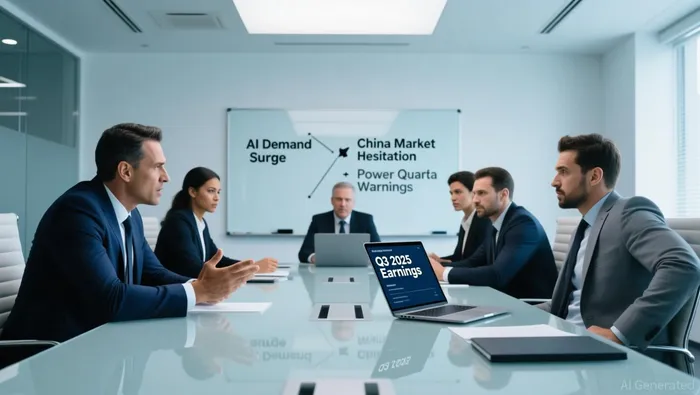
Sentiment Analysis:
Overall Tone: Positive
- Management: "revenue increased by 10.2% and our adjusted EBITDA increased by 11.4% year‑on‑year." CREET units trading 45.8% above IPO price (RMB 4.375). "On track to achieve the midpoint of our revenue guidance and at or above the top end of our EBITDA guidance." Management repeatedly described accelerating AI demand and strong financing optionality via CREET.
Q&A:
- Question from Yang Liu (Morgan Stanley): What needs to happen for the China market inflection to materialize; please elaborate on the more aggressive China strategy (locations, project types); and what is the investment return profile with the CREET scheme?
Response: Management: China demand is strengthening (domestic chips improving); GDS is acquiring powered land near tier‑one and low‑power‑cost locations to serve AI (especially inferencing); CREET enables repeatable monetization delivering ~11–12% cash‑on‑cash, low‑to‑mid‑teens IRR over 5–6 years and levered equity returns in the 20s.
- Question from Sarah Wang (UBS): Do the booking expectations include newly acquired powered land in lower‑tariff regions? Any difficulties acquiring new power quota given recent government guidance?
Response: Management: Bookings outlook does not depend solely on new land, but additional powered land would enable more deployments; power quota is generally tight but GDS views it as manageable due to long‑standing government and utility relationships and extensive experience.
- Question from Frank Louthan (Raymond James & Associates): Update on Day One private round funding and potential IPO; outlook on customers obtaining GPUs and ramping installs?
Response: Management: Day One is independent and GDS cannot provide specifics; Day One’s business is reported as strong and demand remains positive, but no details on GPU timing or funding provided on this call.
- Question from Michael Elias (PD Cohen): Are training workloads in China expected at gigawatt scale like the U.S.? What is the build time for AI data centers versus traditional cloud data centers, and any long‑lead constraints?
Response: Management: Customers are discussing gigawatt‑scale demand; GDS can build very quickly in China (typically 9–12 months, record ~8 months) and does not see major supply‑chain bottlenecks for development.
- Question from Daily Lee (Bank of America Securities): For recent ~30 MW orders, what share is AI and is it inferencing or training? Also, any impact from government 'window guidance' tightening power quotas?
Response: Management: ~65% of 2025 bookings are AI‑related, primarily inferencing (or a combo of inferencing and training) in tier‑one markets; GDS holds ~900 MW of powered land which mitigates tier‑one power allocation constraints, though power quota is tighter in those markets.
- Question from Timothy Chow (Goldman Sachs): Color on pricing/MSR trend into Q4 and next year given contract renewals; and views on overall industry supply/demand and competition?
Response: Management: Expect MSR to decline ~3–4% in 2026 due to downward price resets and higher move‑in dilution; pricing on new builds has been stable and development costs are near historical lows, and GDS cites a competitive edge from combined land/power position plus superior access to capital.
Contradiction Point 1
AI Exposure and Demand in China
It involves the level of AI exposure in recent orders and the demand for AI data centers in China, which are crucial for understanding GDS's growth strategy in the AI market.
What is the AI exposure in recent orders, and is it mainly inferencing or a mix of inferencing and training? Is there any impact from China's data center supplier guidance? - Daily Lee (Bank of America Securities)
2025Q3: AI exposure in recent orders is around 65%, mainly for AI inferencing in tier-one markets. - Dan Newman(CFO), William Huang(CEO)
Are customers showing increased interest in AI orders due to Q3 optimism? - Gokul Hariharan (JPMorgan)
2025Q2: Orders are delayed due to chip supply issues. When the supply is resolved or new technology (like next-gen NVIDIA chips) emerges, large orders may follow. - Daniel A. Newman(CFO)
Contradiction Point 2
Demand and Order Lead Time
It involves changes in reported demand and order lead times, which could impact investor expectations regarding revenue growth and supply chain management.
What is the training workload scale in China compared to the U.S.? What is the AI data center construction time compared to traditional cloud data centers? - Michael Elias (PD Cohen)
2025Q3: Demand in China is at gigawatt scale, similar to the U.S. GDS can build data centers quickly, typically in 9-12 months, with records as low as 8 months. There are no significant supply chain bottlenecks. - William Huang(CEO)
What is the current book-to-bill rate, and how long does it take to fully bill under contracted terms? - Frank Louthan (Raymond James & Associates)
2024Q4: The current lead time is about 12 months, improved from previous two-year lead times. Contract terms are longer, facilitating quicker delivery. - William Huang(CEO)
Contradiction Point 3
AI Demand and Exposure
It involves changes in reported AI demand and exposure, which are crucial for understanding the company's strategic focus and growth potential.
What is the AI exposure in recent orders, and is it primarily for inferencing or a mix of inferencing and training? Is there any impact from China's data center supplier guidance? - Daily Lee (Bank of America Securities)
2025Q3: AI exposure in recent orders is around 65%, mainly for AI inferencing in tier-one markets. - Dan Newman(CFO)
Can you provide details on orders and demand for DayOne, particularly for AI versus non-AI workloads? - Timothy Zhao (Goldman Sachs)
2024Q4: DayOne's demand is diverse, not mainly AI but cloud and video applications. - William Huang(CEO)
Contradiction Point 4
DayOne's Growth and Commitments
It pertains to the growth targets and commitments of DayOne, a critical subsidiary for GDS's expansion into international markets, which impacts investor expectations regarding the company's global strategy.
Can you update on the private round funding and the potential for additional installs to ramp up for Day One? - Frank Louthan (Raymond James & Associates)
2025Q3: DayOne remains independent, with GDS not representing it. - William Huang(CEO)
What is the current target for DayOne in terms of total area or megawatts by year-end or next year? - Yang Liu (Morgan Stanley)
2025Q2: DayOne is ahead of schedule in achieving its 1-gigawatt target. - Wei Huang(CEO)
Contradiction Point 5
Power Quota Availability and Challenges
It addresses the availability and acquisition of power quotas, which are crucial for GDS's data center expansion and operational sustainability.
Will next year's increased bookings include new land in regions with lower power tariffs? How should we approach acquiring new power quotas under current regulatory rationalization? - Sarah Wang(UBS)
2025Q3: Power quotas are not a major challenge due to GDS's track record and relationships, although they are still not easy to secure. - William Huang(CEO)
What is the risk from new regulations on AI data center expansion? Are private companies a preferred option for building AI data centers? - Edison Lee(Jefferies Hong Kong)
2025Q1: Current regulations and power quotas do not impact GDS's development plans. Most of the 900 megawatts capacity has already obtained power energy quotas. - William Huang(CEO)

Discover what executives don't want to reveal in conference calls
Latest Articles
Stay ahead of the market.
Get curated U.S. market news, insights and key dates delivered to your inbox.
AInvest
PRO
AInvest
PRO



Comments
No comments yet