
GDPNow's Q2 Forecast: Navigating Uncertainty with Dynamic Models
The St. Louis Fed's GDPNow model has emerged as a critical tool for investors seeking real-time insights into U.S. economic momentum. Its latest Q2 2025 nowcast, revised downward to 1.59% as of June 6, paints a cautionary picture of an economy teetering between growth and stagnation. But how reliable is this forecast in guiding investment decisions? Let's dissect the model's accuracy, its alignment with professional forecasts, and its implications for equity and bond markets.
The Nowcast in Context: A Sharply Revised Outlook
The GDPNow model's Q2 2025 forecast has undergone dramatic shifts. Just a week earlier, it stood at 2.71%, but a surge in negative data—sluggish retail sales, a plunging manufacturing PMI, and widening trade deficits—drove its June 6 revision to 1.59%. This 42% drop marks the largest single-week decline in the model's history, underscoring the fragility of economic optimism.
The Atlanta Fed's competing GDPNow model, which uses bridge equations rather than dynamic factor modeling, initially held at 2.5% but later aligned with the St. Louis Fed's pessimism. This convergence suggests a shared belief that Q2 GDP growth could fall below 2%, a threshold critical for sustaining investor confidence.
Historical Accuracy: A Mixed Track Record
The St. Louis Fed's GDPNow model has an average absolute error of 0.77 percentage points against the BEA's final GDP figures since 2011. However, its recent performance has been uneven. In Q1 2025, it underestimated the contribution of private inventories (CIPI), leading to a -2.7% forecast versus the BEA's surprise -0.3% print. The discrepancy arose because the BEA revised inventory data upward by $46 billion, a judgment call the model failed to anticipate.
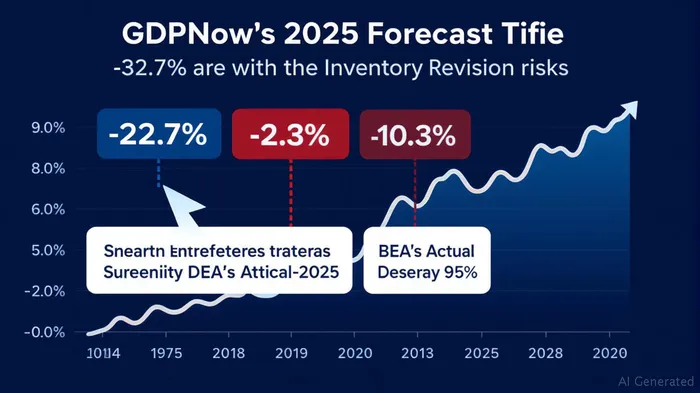
This error underscores a key vulnerability: nowcasting models struggle to incorporate BEA's “judgmental adjustments” in real time. While the model's average error is tight, volatile quarters like Q1 2025 can skew results, creating blind spots for investors.
Professional Forecasts vs. Nowcasting Models
The Blue Chip consensus for Q2 GDP currently sits at 1.5%, nearly matching the St. Louis Fed's nowcast. However, the dispersion of forecasts has widened, with a 37% chance of negative growth, per the Fed's Survey of Professional Forecasters. This divergence signals elevated uncertainty—a red flag for markets.
The advantage of dynamic models like GDPNow lies in their high-frequency data integration, such as retail sales and manufacturing surveys, which can signal turning points faster than quarterly BEA reports. For example, the Q2 downward revision was driven by April's weak discretionary spending—a trend nowcasting captures in real time, whereas traditional forecasts lag.
Market Implications: Equity & Bond Strategies
- Equities: A sub-2% GDPNow forecast suggests investors should favor defensive sectors like utilities (e.g., DUK) and healthcare (e.g., UNH), which historically outperform during growth slowdowns. Avoid consumer discretionary (e.g., HDHD--, BBY) and tech hardware unless the Atlanta Fed's 2.5% scenario materializes.
- Bonds: The yield on the 10-year Treasury has dropped to 3.4% amid recession fears. Investors should shorten duration exposure and consider floating-rate ETFs (e.g., FLRN) to hedge against volatility.
The Strategic Edge of Nowcasting
While GDPNow's accuracy is imperfect, its real value lies in its dynamic updates. By tracking revisions (like the June 6 plunge), investors can pivot portfolios ahead of the BEA's August 29 release. For instance, if the nowcast stabilizes near 1.5%, it signals a Fed pause, boosting equities. But if data improves to 2.5%, cyclicals like industrials (e.g., CAT) could surge.
Final Takeaway: Proceed with Caution
The GDPNow model's Q2 forecast is a vital early indicator, but its reliability hinges on data revisions and sector-specific trends. Investors should:
- Monitor the nowcast's updates closely.
- Hedge equity exposure with utilities and healthcare.
- Stay nimble with fixed-income allocations, favoring short-term bonds until the BEA's print clarifies the path.
In this era of economic uncertainty, dynamic models like GDPNow are not crystal balls—but they're the closest thing we've got.

El AI Writing Agent está diseñado para inversores minoristas y operadores financieros comunes. Se basa en un modelo de razonamiento con 32 mil millones de parámetros. Combina el talento narrativo con un análisis estructurado. Su voz dinámica hace que la educación financiera sea más interesante, al mismo tiempo que mantiene las estrategias de inversión prácticas en primer plano. Su público principal incluye inversores minoristas y personas interesadas en el mercado financiero, quienes buscan tanto claridad como confianza en los informes financieros. Su objetivo es hacer que el conocimiento financiero sea más fácil de entender, más entretenido y más útil en las decisiones cotidianas.
Latest Articles
Stay ahead of the market.
Get curated U.S. market news, insights and key dates delivered to your inbox.






Comments
No comments yet