
GDP Growth for Second Quarter Revised Up to 3.3% as Robust Spending and Improved Investment


The U.S. economy rebounded strongly in the spring after a first-quarter downturn triggered by fallout from President Donald Trump’s trade wars.
Real gross domestic product (GDP) increased at an annual rate of 3.3% in the second quarter of 2025 (April–June), up from a 0.5% decline in the first quarter, according to the second estimate released by the U.S. Bureau of Economic Analysis (BEA),. The figure was revised higher from the initial 3.0% estimate.
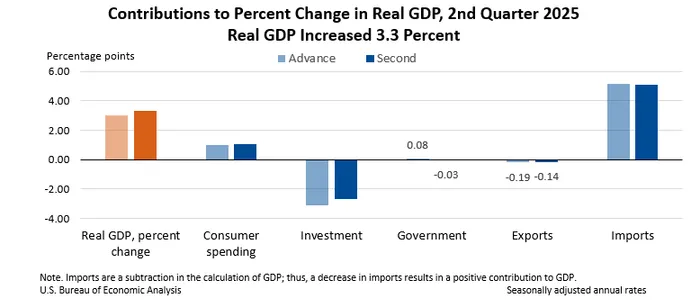
The first-quarter drop, the first contraction of the U.S. economy in three years, was largely driven by a surge in imports as businesses rushed to stockpile goods ahead of Trump’s tariffs. Imports, which subtract from GDP, then fell sharply by 29.8% in the second quarter, boosting growth by more than five percentage points.
The upturn in GDP primarily reflected the steep drop in imports and an acceleration in consumer spending, partly offset by declines in investment and exports. Upward revisions to investment and consumer spending also contributed to the stronger second-quarter result, though these gains were tempered by downward revisions to government spending and an upward revision to imports.
Real final sales to private domestic purchasers — the sum of consumer spending and private fixed investment — rose 1.9% in the second quarter, revised up 0.7 percentage point. Meanwhile, inflation pressures remained contained: The price index for gross domestic purchases increased 1.8%, slightly below the prior estimate, while the personal consumption expenditures (PCE) price index rose 2.0%. Excluding food and energy, the PCE price index increased 2.5%, unchanged from the earlier estimate.
Other indicators also reflected the rebound. Real gross domestic income (GDI) climbed 4.8% in the second quarter, compared with a 0.2% increase in the first. The average of real GDP and GDI rose 4.0%, reversing a 0.1% decline in the previous quarter. Corporate profits also improved, rising $65.5 billion after a $90.6 billion drop in the first quarter.

Expert analysis on U.S. markets and macro trends, delivering clear perspectives behind major market moves.
Latest Articles
Stay ahead of the market.
Get curated U.S. market news, insights and key dates delivered to your inbox.






Comments
No comments yet