
Gdańsk's Emerging Role in European Logistics and Trade


 Aime Summary
Gdańsk, Poland's northern gateway to the Baltic Sea, is rapidly transforming into a linchpin of European logistics and trade, driven by strategic infrastructure investments and the shifting dynamics of post-Ukraine trade realignments. As global supply chains adapt to the war in Ukraine, the city's ports and terminals are emerging as critical nodes for transshipment, energy security, and industrial connectivity. This evolution is not only reshaping regional trade flows but also unlocking significant investment opportunities for stakeholders seeking to capitalize on Europe's new economic geography.
Strategic Infrastructure Development: A Catalyst for Growth
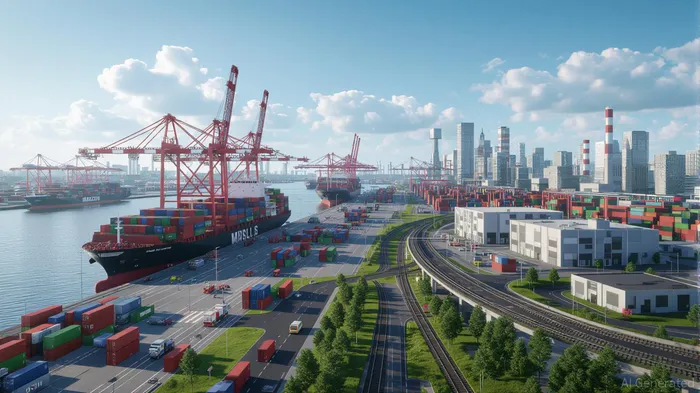
The Port of Gdańsk has been at the forefront of this transformation, with its Baltic Hub Container Terminal (BHCT) serving as a flagship example of strategic infrastructure expansion. The recent completion of the T3 terminal-a €470 million project-has elevated BHCT's annual container-handling capacity to 4.5 million TEUs,
a 50% increase from its previous capacity. This expansion,
funded through a combination of Baltic Hub's own resources and a €863.5 million multi-bank financing package-including a €100 million loan from the European Bank for Reconstruction and Development (EBRD)-has positioned Gdańsk as a premier container hub in the Baltic Sea. The T3 terminal's
717-meter deep-water quay, equipped with semi-automatic ship-to-shore cranes and green-energy-powered infrastructure, underscores the port's commitment to sustainability and scalability.
 Complementing this,
the launch of Naftoport's new cargo handling station "W"-capable of processing 9 million tonnes of oil and fuel annually-has enhanced Poland's energy security.
According to the EU monitoring report, such developments align with the redirection of Ukrainian and global energy supplies away from Black Sea ports disrupted by the war. Such projects highlight Gdańsk's dual role as a logistics and energy hub, attracting investments from both public and private sectors.
Post-Ukraine Trade Realignments: Redefining Regional Connectivity
The Russia-Ukraine war has catalyzed a seismic shift in European trade routes, with Ukrainian agricultural and industrial exports rerouted through Polish ports.
According to the European Commission, 60% of Ukraine's non-agricultural exports and 20% of its grain and oilseed exports now transit through Polish ports, including Gdańsk, under the EU-Ukraine Solidarity Lanes initiative. This surge in cargo volume has
spurred infrastructure upgrades, such as the modernization of rail networks and border crossings, to accommodate the increased demand for intermodal transport.
The EU-Ukraine Deep and Comprehensive Free Trade Area (DCFTA) 2.0, which entered into force in October 2025,
further solidifies this realignment by providing calibrated market access for Ukrainian agricultural products while aligning with EU production standards. The Port of Gdańsk, with its expanded container and energy infrastructure, is uniquely positioned to benefit from this framework. For instance,
Mediterranean Shipping Company (MSC) has integrated Gdańsk into its Asian service routes, adding new connections to China, South Korea, and Vietnam. This strategic inclusion has not only boosted the port's visibility but also attracted logistics operators seeking to leverage its proximity to Central and Eastern European markets.
Investment Opportunities: A Convergence of Demand and Innovation
The confluence of infrastructure development and trade realignments has created a fertile ground for investment in Gdańsk's logistics sector. Key opportunities include:
Intermodal Connectivity:
The Polish government's €1 billion investment in the Sławków rail terminal-a critical hub for broad-gauge trains connecting Ukraine to the EU-highlights the region's focus on enhancing rail infrastructure. This project, which will increase the terminal's capacity by 75%, is expected to attract private-sector participation in logistics and warehousing.Green Infrastructure:
The Baltic Hub's commitment to reducing carbon emissions by 50% by 2030 and achieving net-zero by 2050 aligns with EU sustainability goals, making green logistics projects in Gdańsk attractive to ESG-focused investors.Industrial Real Estate:
The demand for industrial and logistics facilities in Gdańsk has surged, driven by the port's role in transshipping Ukrainian goods. Developers are capitalizing on this trend, with new warehouse and distribution centers being constructed to meet the needs of global supply chains.Energy Security Projects:
Naftoport's expansion and the development of protective energy infrastructure-such as steel structures for power grids-reflect the growing importance of energy logistics in the region. These projects are supported by EU funding and private-sector partnerships.
Conclusion: A Strategic Hub for the Future
Gdańsk's strategic infrastructure developments, coupled with the post-Ukraine trade realignments, have cemented its status as a vital logistics and trade hub in Europe. The city's ability to adapt to shifting global dynamics-whether through expanding container terminals, enhancing energy infrastructure, or integrating into EU-Ukraine trade frameworks-positions it as a prime destination for investors. As the EU and Ukraine continue to align their economic strategies, Gdańsk's role in facilitating this transition will only grow, offering long-term value for stakeholders who recognize the region's potential.

Stay ahead of the market.
Get curated U.S. market news, insights and key dates delivered to your inbox.


AInvest
PRO
AInvest
PRO



Comments
No comments yet