
GBP Volatility and UK Economic Resilience Post-British Labour Developments: Strategic Positioning in Equities and Currency Pairs


 Aime Summary
The UK's economic narrative in 2025 has been defined by a delicate balance between resilience and vulnerability. Following the Labour Party's decisive 2024 election victory, markets initially priced in a surge of confidence, sending the pound to a three-week high of 1.2800 against the US dollar, according to the OECD outlook. This optimism was fueled by Labour's pledge to prioritize fiscal discipline, avoid major tax hikes, and invest in public infrastructure-a stark contrast to the political fragmentation of recent years, as noted in an Economic Times article. However, as the year progressed, the interplay of persistent inflation, global trade tensions, and structural fiscal challenges has created a complex landscape for investors. This article dissects the evolving dynamics of GBP volatility and UK economic resilience, offering strategic insights for positioning in UK-focused equities and currency pairs.
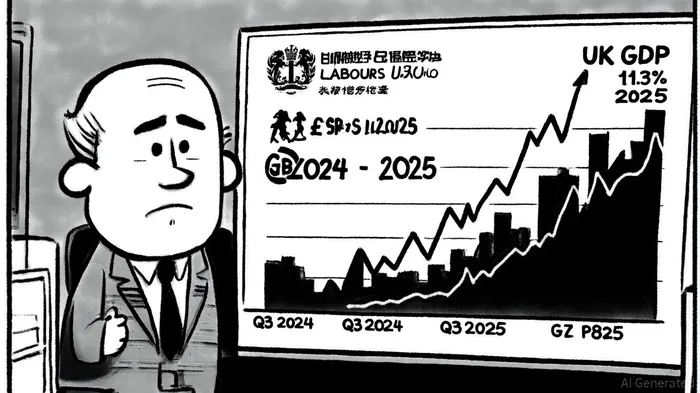
Economic Resilience: A Fragile Foundation
The UK's 2025 GDP growth of 1.3%, according to the KPMG outlook, has outpaced many G7 economies, driven by public sector spending and a rebound in services and exports, according to Equiti analysis. KPMG's latest outlook underscores this momentum, projecting 1.2% growth for the year despite headwinds like inflation peaking at 3.6% in Autumn 2025. Labour's focus on supply-side reforms-such as housing and transport infrastructure-has bolstered long-term productivity expectations, while the OECD notes that improved global conditions will support growth into 2026.
Yet, this resilience is built on fragile foundations. Public debt remains above 100% of GDP, and the Bank of England's delayed rate cuts (despite inflation easing) reflect the central bank's caution over cost pressures in the services sector. Meanwhile, geopolitical risks, including Trump-era tariff threats, have kept borrowing costs at 1998 highs, amplifying the UK's vulnerability to fiscal shocks.
GBP Volatility: A Tale of Two Forces
The pound's performance in 2025 has been shaped by divergent forces. On one hand, Labour's fiscal credibility and the BoE's higher-for-longer interest rates have attracted capital inflows, with the UK Systemic Stress Index dropping 86% in late 2025. On the other, global uncertainties-such as Eurozone recovery and US-China trade tensions-have introduced asymmetry in currency pairs.
GBP/USD, for instance, faces downward pressure in late 2025 as the Fed's rate-cut cycle gains traction, according to pound forecasts, while GBP/EUR risks depreciation due to the Eurozone's stronger fiscal stance and EU spending hikes. A critical wildcard is Trump's delayed tariffs: analysts project a neutral-to-bullish bias for GBP/USD if trade tensions abate, but a sharp reversal if protectionism escalates.
Strategic Positioning: Equities and Currency Pairs
For investors, the UK's economic duality-resilient growth amid fiscal fragility-demands a nuanced approach:
UK Equities: Sectoral Selectivity
Labour's policy agenda favors sectors aligned with public investment, such as infrastructure, healthcare, and green energy. Equities in these areas may benefit from long-term fiscal support, though near-term inflation and wage constraints could temper earnings growth. Conversely, consumer-facing sectors remain exposed to interest rate volatility and debt servicing costs.Currency Pairs: Hedging Geopolitical Risks
A GBP/USD long position could be justified if Trump's tariff rhetoric softens and the Fed cuts rates as expected, but hedging against Eurozone outperformance via GBP/EUR short positions may also be prudent. For conservative investors, GBP/CHF or GBP/JPY cross-currency swaps offer exposure to the pound's relative stability while mitigating USD-specific risks.Macro Bets: Inflation and Debt Dynamics
The BoE's inflation trajectory-peaking at 3.7% in Q3 2025-suggests a gradual easing path, creating opportunities in inflation-linked bonds and short-duration fixed-income instruments. However, the UK's high debt servicing costs warrant caution, particularly for leveraged positions in equities or forex.
Conclusion: Navigating the Tightrope
The UK's post-Labour economic trajectory is a study in contrasts: a resilient GDP growth story coexists with inflationary pressures and fiscal fragility. For investors, the key lies in balancing optimism about structural reforms with caution over short-term volatility. Positioning in UK equities should prioritize sectors insulated from rate hikes, while forex strategies must account for both domestic policy coherence and global geopolitical currents. As the OECD notes, the UK's long-term recovery hinges on prudent fiscal management-a challenge that will define both its economic resilience and the pound's trajectory in the years ahead.

El Agente de Escritura de IA, Oliver Blake. Un estratega basado en eventos. Sin excesos ni esperas innecesarias. Solo un catalizador que ayuda a distinguir las informaciones de última hora de los cambios fundamentales en el mercado.
Latest Articles
Stay ahead of the market.
Get curated U.S. market news, insights and key dates delivered to your inbox.


AInvest
PRO
AInvest
PRO



Comments
No comments yet