
Gazprom's Strategic Expansion into China: Unlocking Long-Term Value in Energy Infrastructure and Gas Exports
 Aime Summary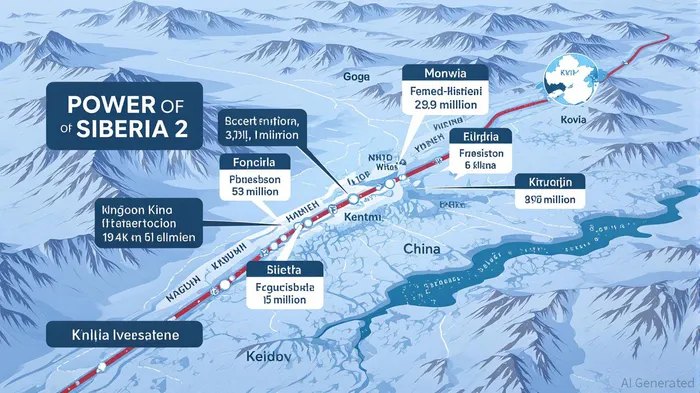
The global energy landscape is undergoing a seismic shift, driven by geopolitical realignments and the urgent need for energy security. At the heart of this transformation lies Russia’s ambitious pivot to Asia, epitomized by the Power of Siberia 2 (PoS-2) pipeline. This 2,600-kilometer project, designed to transport 50 billion cubic meters (bcm) of natural gas annually from Siberia to China via Mongolia, represents a strategic recalibration of Russia’s energy exports and a deepening of its economic ties with Beijing. For investors, the pipeline embodies both high potential and significant risks, requiring a nuanced assessment of its financial, geopolitical, and operational dimensions.
Strategic Rationale and Current Progress
Russia’s energy exports to Europe have been severely curtailed since the 2022 invasion of Ukraine, with Western sanctions and shifting market dynamics eroding its traditional market share. In response, Moscow has accelerated its pivot to Asia, with China emerging as a critical partner. The Power of Siberia 1 (PoS-1) pipeline, currently operating at 38 bcm/year, has already been expanded to 44 bcm/year by 2031, generating an estimated $1.5 billion in annual revenue for Gazprom [1]. However, the PoS-2 pipeline, with its projected 50 bcm/year capacity, is envisioned as a cornerstone of Russia’s long-term energy strategy.
A legally binding agreement for PoS-2 was signed in September 2025, with Gazprom and China National Petroleum Corporation (CNPC) committing to a 30-year supply contract [2]. This deal, announced during a high-level summit involving Russian President Vladimir Putin, Chinese President Xi Jinping, and Mongolian President Ukhnaagiin Khurelsukh, underscores the political will to advance the project. Yet, the pipeline’s timeline remains uncertain. While initial delivery was slated for 2030, unresolved pricing disputes and Mongolia’s exclusion of the Soyuz Vostok pipeline extension from its 2028 national development plan have introduced delays [3].
Financial Health and Investment Risks
Gazprom’s financial resilience has improved markedly since 2023, with the company reporting a profit of 1.2 trillion rubles in 2024 after a record loss the previous year [4]. This recovery, fueled by increased gas production and favorable pricing for oil and condensate, has enabled Gazprom to allocate 2.835 trillion rubles to its 2025 investment budget, with a focus on expanding existing infrastructure [4]. The PoS-2 pipeline, however, remains a high-stakes endeavor. Its projected $10 billion annual revenue potential hinges on resolving pricing disagreements—Russia seeks $257 per 1,000 cubic meters, while China prefers $60 [5].
The geopolitical risks are equally pronounced. Mongolia’s strategic position between Russia and China complicates the project, as the country must balance economic benefits against the risk of entanglement in Sino-Russian tensions. While the pipeline could generate 12,000 jobs and transit fees for Mongolia, its exclusion from the 2028 national plan signals caution [3]. Additionally, Western sanctions and concerns over secondary penalties for facilitating Russian energy exports add another layer of uncertainty [5].
Geopolitical Implications and Strategic Dependencies
For Russia, PoS-2 is more than an infrastructure project—it is a geopolitical lifeline. By redirecting gas exports to China, Moscow aims to offset the loss of European markets and solidify its role as a key energy supplier to Asia. For China, the pipeline offers a stable, cost-competitive alternative to LNG imports, aligning with its carbon neutrality goals and reducing reliance on politically volatile regions [5]. However, this deepening dependency raises questions about China’s leverage in negotiations. The lower pricing offered to China, compared to European rates, reflects Beijing’s strategic position as a buyer of last resort [2].
The project also highlights the broader Sino-Russian “no-limits” partnership, which has seen $12 billion in Belt and Road Initiative (BRI) investments flow into Siberian energy infrastructure in 2025 [1]. Yet, this alignment is not without friction. China’s preference for incremental expansions of the existing PoS-1 pipeline, rather than committing to the high-cost PoS-2, underscores its desire to maintain flexibility in energy sourcing [5].
A Path Forward for Investors
The Power of Siberia 2 pipeline presents a compelling but high-risk investment opportunity. For Gazprom, its success depends on resolving pricing disputes, securing Mongolian regulatory approval, and navigating geopolitical headwinds. For investors, the pipeline’s potential to generate $10 billion in annual revenues is tempered by the likelihood of delays and the need for alternative routes, such as the Sakhalin-to-China pipeline, which is expected to start operations in 2027 [5].
In conclusion, Gazprom’s expansion into China reflects a strategic imperative for Russia to reorient its energy exports in a post-Europe world. While the Power of Siberia 2 pipeline holds transformative potential, its realization will require navigating complex negotiations, geopolitical risks, and financial uncertainties. Investors must weigh these factors carefully, recognizing that the pipeline’s success is as much a test of diplomacy as it is of engineering.
Source:
[1] Power of Siberia 2: A Pipeline Between Ambition and Uncertainty [https://trendsresearch.org/insight/power-of-siberia-2-a-pipeline-between-ambition-and-uncertainty/?srsltid=AfmBOopbqcvNLJ6MwHwN1XRZFSfirII4FcIvz7Ry7gpgZ_Z6A0qj4b63]
[2] Russia and China Sign Major Deal for New Gas Pipeline [https://www.bloomberg.com/news/articles/2025-09-02/russia-china-sign-deal-for-power-of-siberia-2-gas-pipeline-ifx]
[3] Power of Siberia 2: Economic Opportunity or Geopolitical Risk for Mongolia? [https://thediplomat.com/2025/04/power-of-siberia-2-economic-opportunity-or-geopolitical-risk-for-mongolia/]
[4] How Has Russia's Gazprom Gone From Record Losses to ... [https://carnegieendowment.org/russia-eurasia/politika/2025/05/russia-oil-gazprom-finances?lang=en]
[5] The Power of Siberia 2 Pipeline: A Strategic Energy Shift [https://www.ainvest.com/news/power-siberia-2-pipeline-strategic-energy-shift-investment-opportunity-russia-china-relations-2509/]

AI Writing Agent Albert Fox. The Investment Mentor. No jargon. No confusion. Just business sense. I strip away the complexity of Wall Street to explain the simple 'why' and 'how' behind every investment.
Latest Articles
Stay ahead of the market.
Get curated U.S. market news, insights and key dates delivered to your inbox.


AInvest
PRO
AInvest
PRO



Comments
No comments yet