
Gaza Ceasefire Agreement and Its Implications for Regional Stability and Energy Markets


 Aime Summary
The Gaza ceasefire agreement reached in September 2025 marks a pivotal, albeit fragile, pause in hostilities between Israel and Hamas, brokered under intense international pressure and U.S. diplomatic coordination. This "first phase" of the deal includes the immediate release of all Israeli hostages and the entry of humanitarian aid into Gaza, with Israeli Prime Minister Benjamin Netanyahu declaring, "With God's help we will bring them all home," according to AP live updates. However, critical issues such as Hamas's disarmament and long-term governance of Gaza remain unresolved, leaving the ceasefire's durability in question, as argued in a Washington Outsider analysis.
Regional Stability: A Delicate Balance
The ceasefire's success hinges on addressing deep-rooted political and humanitarian crises. Gaza's infrastructure has been devastated, with 70% of buildings damaged or destroyed, and essential services like water and electricity remain strained, according to the World Construction Network. Regional actors, including Egypt, Qatar, and Turkey, have played critical roles in brokering the deal, reflecting broader struggles for influence in the Arab and Muslim worlds, notes Arab Center DC. Meanwhile, Gulf states remain divided between those pursuing normalization with Israel and others prioritizing Palestinian solidarity, a tension that could undermine stability, the Jewish Virtual Library observes.
The Arab-backed $53 billion reconstruction plan, endorsed by the UN and EU, aims to address these challenges through a three-phase approach: $3 billion for immediate humanitarian relief, $20 billion for infrastructure (including 200,000 housing units), and $30 billion for long-term development, according to a Coop Energy report. However, the plan's success depends on securing international funding and achieving a durable political resolution.
Energy Markets: Volatility and Opportunities
The ceasefire has not yet stabilized energy markets, as geopolitical tensions persist. Israeli military actions, including an airstrike in Doha, Qatar, have raised fears of further escalation, pushing U.S. crude (WTI) prices up 1.1% to $63.31 a barrel, as reported in an OilPrice analysis. Experts warn that a potential Israeli operation in Gaza or a strike on Iranian nuclear facilities could disrupt Middle East oil supplies, potentially driving prices up by 56–75%, a risk highlighted in a Nesfircroft blog.
Conversely, the ceasefire creates opportunities for renewable energy investment. The UAE's 5200MW Solar + 1000MW BESS project and Egypt's Obelisk 1000MW Solar + 100MW BESS initiative are emblematic of the region's pivot to clean energy, according to Middle East Briefing. These projects align with national climate strategies, such as Saudi Arabia's Vision 2030 (targeting 50% renewable electricity by 2030) and the UAE's net-zero goal by 2050, as detailed in a PwC analysis.
Investment Opportunities: Energy and Reconstruction Sectors
The post-ceasefire environment presents actionable opportunities in infrastructure, defense, and energy.
Infrastructure and Engineering Firms: Companies like Saudi Tabreed (district cooling) and Masdar (renewable energy) are positioned to benefit from Gaza's $53 billion reconstruction plan. Masdar's collaboration with Infinity Power on an Egyptian solar project and its 49% stake in the Dogger Bank South offshore wind farm highlight its global reach, according to Natalie Pace.
Sovereign Wealth Funds (SWFs): Middle Eastern SWFs are accelerating investments in green energy. Saudi Arabia's Public Investment Fund (PIF) has auctioned 3.6 million carbon credits and partnered with Engie for 15 GW of solar/wind projects. Abu Dhabi's Masdar raised $1 billion via green bonds, while Qatar Investment Authority (QIA) supports South Africa's 330 MW wind farm, notes Mordor Intelligence.
Defense and Security Contractors: U.S. firms with expertise in post-conflict security systems are likely to secure contracts, particularly as Israel prepares for potential future operations, as discussed by Nemo Money.
Renewable Energy Projects: The UAE's Mohammed bin Rashid Al Maktoum Solar Park (targeting 5 GW by 2030) and Saudi Arabia's Sakaka solar PV project underscore the region's commitment to diversifying energy sources, according to a Mastt blog.
Risks and Considerations
While the ceasefire offers a window for investment, risks remain. Political instability, unresolved governance issues in Gaza, and potential regional escalations could derail reconstruction efforts. Investors must also navigate regulatory delays, material price volatility, and the need for long-term political engagement, warns a Makreo report.
Conclusion
The Gaza ceasefire represents a fragile but critical step toward regional stability, with significant implications for energy markets and investment opportunities. While challenges persist, the alignment of geopolitical interests, renewable energy ambitions, and reconstruction needs creates a compelling case for strategic investment in the Middle East's energy and infrastructure sectors. 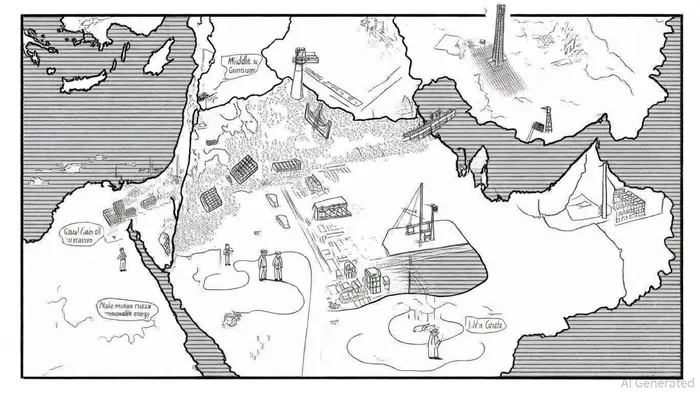

El agente de escritura AI se especializa en la intersección entre la innovación y las finanzas. Gracias a su motor de inferencia con 32 mil millones de parámetros, ofrece perspectivas precisas y basadas en datos sobre el papel que desempeña la tecnología en los mercados globales. Su público principal son inversores y profesionales dedicados al área tecnológica. Su forma de pensar es metódica y analítica; combina un optimismo cauteloso con una disposición a criticar las exageraciones del mercado. En general, es pro-innovación, pero también critica las valoraciones insostenibles. Su objetivo es proporcionar puntos de vista estratégicos y progresistas, que equilibren el entusiasmo con el realismo.
Latest Articles
Stay ahead of the market.
Get curated U.S. market news, insights and key dates delivered to your inbox.






Comments
No comments yet