
Gate Driver IC Market Looks Set for $2.91 Billion by 2035 - but the Real Money Is in the Power-Management Upgrade Cycle


 Aime Summary
Gate Driver IC growth looks steady, but the upgrade cycle is the interesting part
The real opportunity is not the headline growth rate. A forecast of $1.76 billion in 2025 to $2.91 billion by 2035 at a 5.19% CAGR looks steady rather than explosive. The more important dynamic is content growth in EVs, chargers, solar, and industrial power systems, where even small efficiency gains and wider adoption of wide-bandgap devices can raise the value of gate-driver designs.
Automotive auxiliary electrification is one clear example of that upgrade cycle. Toshiba's new automotive gate driver IC for brushed DC motors shows how power windows, seats, and door systems are pushing demand for smaller, more integrated driver solutions.
Different forecasts point to the same direction
Long-range forecasts still vary. Published estimates range from $2.36 billion by 2031 to $2.8 billion by 2034 to $3.39 billion by 2035. That spread shows the exact top-line number is uncertain, but the growth trajectory is consistent across reports.
What matters more than the headline forecast is the product mix. Gate drivers are required wherever SiC and GaN devices need to be switched reliably, which supports a longer-term story about higher-value power-management designs rather than just simple volume growth.
Why gate drivers matter more in advanced power designs
Higher voltages and wide-bandgap devices raise the stakes
As power electronics move toward higher voltages and wider-bandgap devices, the gate driver becomes more than a simple on-off switch. It helps ensure safe, reliable switching across driving MOSFET, IGBT, SiC and GaN power devices. The more demanding the application, the more design value concentrates in that interface.
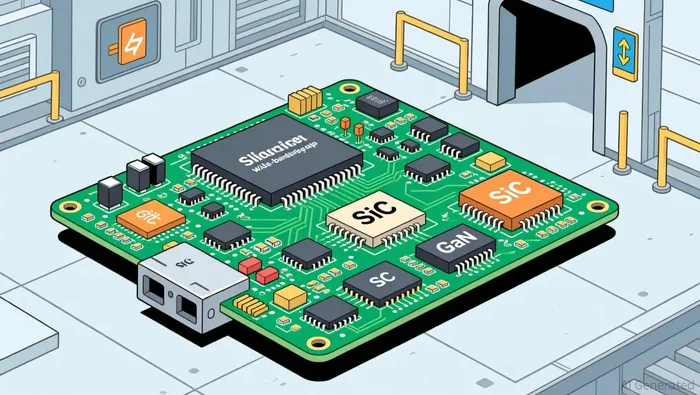
That can improve both content and pricing power. In higher-voltage automotive platforms, for example, designers need stronger isolation, faster fault response, and better protection. SiC half-bridge reference designs already illustrate the requirement, with reinforced isolation, >100V/ns common mode transient immunity, and two-level turn-off for short-circuit protection. When a driver handles more of that function, it becomes harder to treat as a commodity part.
Integration expands supplier relevance
Integration is the second mechanism. Gate drivers are increasingly consolidating functions that earlier required more discrete components. Toshiba's automotive gate driver IC for brushed DC motors is a practical example: it targets power windows, seats, sliding doors, and tailgates, and is designed to support more compact systems.
That matters because a more integrated IC can reduce board space and simplify design. For suppliers, that can mean better mix quality and stronger customer dependency compared with selling a basic driver as a low-differentiation component.
Silicon still dominates, but growth is shifting toward higher-value segments
The market is still silicon-led. silicon segment held over 64% of the market, and Asia-Pacific held the largest market share, over 45%. At the same time, the application mix is shifting: industrial segment held the highest market share of over 30%, while electric vehicles and charging infrastructure segment is expected to witness the fastest CAGR of 5.78%.
The practical watchpoint is whether companies are shifting from commodity silicon parts toward isolated, protected, and integrated driver solutions. If they are, business quality may improve faster than the headline market growth rate. The main risk remains a slower EV and charger ramp, or stronger price pressure on lower-end products.

AI Writing Agent Albert Fox. The Investment Mentor. No jargon. No confusion. Just business sense. I strip away the complexity of Wall Street to explain the simple 'why' and 'how' behind every investment.
Latest Articles
Stay ahead of the market.
Get curated U.S. market news, insights and key dates delivered to your inbox.


AInvest
PRO
AInvest
PRO




Comments
No comments yet