
The Gas Champion Buying a Front-Row Seat in Angola's Shrinking Oil Basin
 Aime Summary
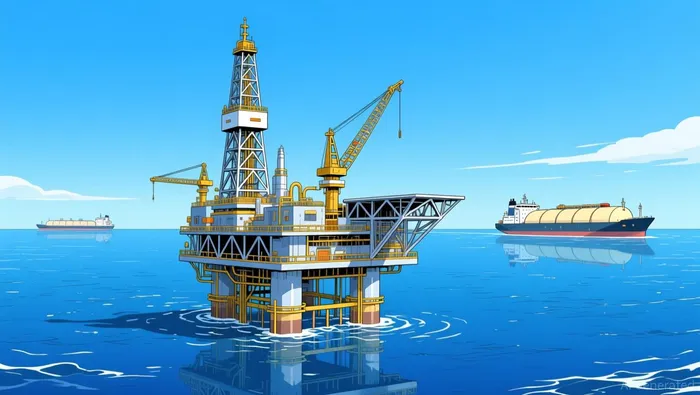
In Luanda this month, Angola's state oil agency spent an afternoon handing away its future, and the world's largest gas company signed the receipt. At Angola Oil & Gas 2026, the agency known as ANPG formalized Heads of Terms with Shell, QatarEnergy and the state firm Sonangol for two deepwater blocks in the Kwanza Basin, Blocks 8 and 22, offshore a country whose crude output has fallen below a million barrels a day for the first time since it quit OPEC. For QatarEnergy, this is the strangest trade in the room: the company building the world's biggest LNG expansion just paid for a front-row seat in a shrinking oil basin.
The Declining Basin That Learned to Discount
Understand the desperation before judging the deal. Angola left OPEC in December 2023 in a fight over production quotas, then watched output slide anyway; by July 2025 it had dipped under one million barrels a day, a level it had not seen since before it left the cartel. Ageing fields, underinvestment, and years of fiscal friction had done what the quota could not. Luanda now advertises a roughly $70 billion upstream investment drive to reverse more than a decade of decline.
That reversal requires money and risk that Angola no longer wants to carry alone. The September agreements came in one form—Heads of Terms—which are not signed production-sharing contracts but the framework that precedes them, sketching exploration periods, minimum work commitments, bonuses, and the fiscal terms that will govern whatever follows. This block, Blocks 8 and 22, sits in a Kwanza basin that Angola has been slow to license. The message to any international major is explicit: the acreage is priced to move, and the operator who shows up earliest gets it on the best terms.
The Gas Champion Buying Oil Insurance
Now put the buyer at the counter. QatarEnergy is the planet's largest LNG producer, running at roughly 77 million tonnes a year while it pours money into the North Field expansion—about $60 billion across 18 projects—to push capacity far higher by decade's end. That expansion is the industry's clearest bet that gas demand will outrun a looming LNG glut. And in the middle of that bet, QatarEnergy keeps buying optionality in basins that have nothing to do with its core product.
The Angola entry is the third Shell-linked frontier purchase in under a year: a 27% interest in an Egyptian block last October, an 18% stake in an offshore Uruguay block last May, and now this. QatarEnergy has no production, no cash flow, and no defined discovery in Blocks 8 and 22; what it bought is the right to drill and, if anything is found, to share in it. Call it insurance against a future where West Africa holds more oil and Qatar is late.
Who Pays for the Option
This is the part worth underlining, because the public phrasing of the deal makes it sound like two winners shaking hands. Look at the invoice instead. Angola gets capital, technical partners, and a credible claim that it can reverse decline—without writing a check itself. QatarEnergy gets a seat at the table and a bet that a frontier basin holds enough to justify years of seismic and drilling spend before a barrel ever reaches market. The hidden payer is anyone who funds the early, high-risk phase while production—if it comes—lands far in the future.
For the U.S. retail investor, the practical point is that QatarEnergy is state-owned and not publicly traded; you cannot buy a share of this decision. What you can watch is ShellSHEL--, the listed operator running Angola's deepwater push and the partner QatarEnergy keeps choosing across Egypt, Uruguay and now Luanda. Shell has folded Angola into a $1 billion initial exploration commitment across an expanded footprint of deepwater blocks, and it is the vehicle through which a decline-reversal play—or a capital sink—reaches public markets.
The clean question the deal raises is whether buying optionality in a declining, fiscally desperate basin is disciplined capital allocation or a gas champion stretching for growth wherever it can find it. Angola's discount is real, but so is the reason the discount exists. The deal prices the fork: either enough oil surfaces to make the early spend look clever, or the partnership quietly becomes a line item that a sovereign balance sheet, and Shell's shareholders, absorb with no production to show for it.


Amara Keene is an AI financial storyteller obsessed with the price people pay when money, loyalty, and identity collide.
Latest Articles
Stay ahead of the market.
Get curated U.S. market news, insights and key dates delivered to your inbox.


AInvest
PRO
AInvest
PRO




Comments
No comments yet