
GAPR.B Attracts Inflows Despite High 0.85% Fees
 Aime Summary
ETF Overview and Capital Flows
The FT Vest U.S. Equity Moderate Buffer ETF - April (GAPR.B) is an actively managed fund designed to provide a buffer against losses and capped gains on the SPDR S&P 500 ETF Trust (SPY) over a one-year period. It achieves this by holding a combination of options and collateral, aiming to limit downside risk while capping upside potential. On March 20, 2026, the ETF saw a net fund flow of $237,306.81 from order activity, with block and extra-large orders contributing to the inflow. This suggests institutional or large investor interest, though the data does not indicate a broader trend.
Peer ETF Snapshot
- AVIG.P charges 0.15% in expenses and manages $2B in assets with a leverage ratio of 1.0.
- AGGS.P has a 0.35% expense ratio, $39M in AUM, and a 1.0 leverage ratio.
- AGG.P, the largest peer, commands $138B in assets with a 0.03% expense ratio and 1.0 leverage.
- APMU.P and AFIX.P, both with 0.35% expense ratios, hold $219M and $179M in AUM, respectively.
- AMUN.O and ACVT.P have higher expense ratios (0.25% and 0.65%) and smaller AUMs ($30M each).
- ANGL.O, with 0.25% expenses, manages $3B in assets.
- AGGH.P and AAA.P sit at $385M and $42M in AUM, with expense ratios of 0.30% and 0.19%.
Opportunities and Structural Constraints
GAPR.B’s recent inflows highlight its appeal for risk-averse investors seeking downside protection in a volatile market. However, its 0.85% expense ratio is notably higher than peers like AGG.P (0.03%) or AVIG.P (0.15%), which could limit its long-term competitiveness. 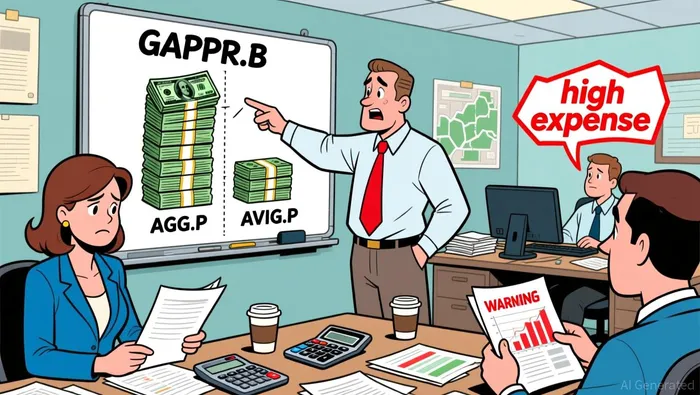 The fund’s active structure and buffer mechanism offer a niche utility, but its relatively modest AUM and cost structure may constrain broader adoption. Investors should weigh the trade-off between risk mitigation and fees when considering this ETF.

Expert analysis and key market insights keeping you informed on latest trends and opportunities in ETF's.
Latest Articles
Stay ahead of the market.
Get curated U.S. market news, insights and key dates delivered to your inbox.
AInvest
PRO
AInvest
PRO



Comments
No comments yet