
Gap Inc.'s Strategic Expansion into the Resilient Beauty and Accessories Market
 Aime Summary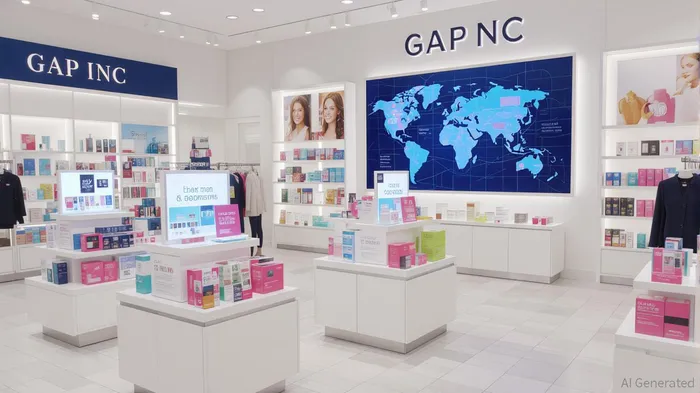
The global beauty and personal care market, valued at over $100 billion in the U.S. alone in 2025, has demonstrated remarkable resilience amid economic volatility, driven by shifting consumer preferences toward affordability, sustainability, and innovation [1]. GapGAP-- Inc., a long-standing player in the apparel and accessories sector, is now positioning itself to capitalize on this dynamic landscape through a strategic foray into beauty and personal care. This move, anchored in its Old Navy brand, reflects a calculated effort to diversify revenue streams, enhance profitability, and align with evolving consumer demands. However, the company’s success in this high-stakes arena will depend on its ability to differentiate itself in a market dominated by industry giants and agile emerging brands.
Strategic Rationale: Leveraging Brand Equity and Consumer Insights
Gap Inc.’s expansion into beauty is not a random pivot but a response to well-documented market trends. The company’s internal research reveals that 70% of its existing customers express interest in purchasing beauty products from the retailer [4], underscoring a latent demand that aligns with its customer-centric approach. By launching a curated line of skincare, makeup, haircare, and nail polish—priced predominantly under $25—Gap Inc. is targeting value-conscious consumers who prioritize accessibility without compromising on quality [1]. This pricing strategy mirrors the broader industry shift toward “democratized beauty,” where affordability and performance are key differentiators [4].
The rollout, beginning with 150 Old Navy stores in a test-and-learn format, includes dedicated shop-in-shops and the hiring of beauty associates to enhance the in-store experience [1]. This approach mirrors the omnichannel strategies of leading beauty retailers, blending physical and digital engagement to foster customer loyalty. CEO Richard Dickson has emphasized that beauty and accessories represent “high-margin opportunities” that align with the company’s long-term growth strategy [3], a sentiment reinforced by Gap Inc.’s strong financial position: $3.5 billion in first-quarter fiscal 2025 net sales and $2.2 billion in cash reserves [2].
Competitive Positioning: Navigating a Crowded Market
The beauty sector is dominated by global titans like L’Oréal and Estée Lauder, which collectively command over $60 billion in annual revenue [1]. L’Oréal, for instance, leverages its vast portfolio (including L’Oréal Paris, Garnier, and Lancôme) and AI-driven innovations—such as partnerships with IBMIBM-- to develop circular product formulations—to maintain its leadership [2]. Estée Lauder, while facing challenges in Asia-Pacific and travel retail, continues to rely on premium brands like MAC and La Mer to sustain its market position [4].
Gap Inc.’s entry, however, is not a direct competitor to these giants but rather a niche play targeting mass-market consumers. Its focus on affordability and simplicity aligns with the rise of “clean beauty” and minimalism, trends that have fueled the success of direct-to-consumer (DTC) brands like The Ordinary and CeraVe [5]. Unlike these agile startups, which thrive on digital-first engagement and influencer-driven marketing, Gap Inc. benefits from its established retail infrastructure and brand recognition. By integrating beauty into its existing stores, the company can reduce customer acquisition costs and cross-sell to its loyal apparel customer base.
Yet, the path is not without risks. The beauty market is highly fragmented, with emerging DTC brands capturing 35% of annual sales growth through e-commerce [5]. Gap Inc. must invest in digital capabilities—such as AI-powered personalization tools or virtual try-ons—to compete effectively. Additionally, the company’s lack of prior experience in beauty formulation and R&D could pose challenges, particularly in an industry where product innovation and ingredient transparency are critical to consumer trust [2].
Long-Term Growth Potential: Balancing Opportunities and Challenges
The beauty market’s projected 5% annual growth through 2030 [4] offers Gap Inc. a compelling long-term opportunity, but success will hinge on its ability to scale efficiently. The company’s phased approach—testing Old Navy’s beauty line before expanding to Gap, Banana Republic, and Athleta in 2026—allows for iterative learning and risk mitigation [1]. This strategy mirrors the “test-and-learn” methodologies adopted by successful DTC brands, enabling Gap Inc. to refine its offerings based on real-time consumer feedback.
Financially, Gap Inc. is well-positioned to absorb initial costs, given its disciplined margin management and robust cash reserves [2]. However, external headwinds such as tariffs—projected to impact operating income by $100–150 million in fiscal 2025 [2]—could constrain reinvestment in the beauty segment. To mitigate this, the company must prioritize cost efficiencies in sourcing and production, potentially leveraging its supply chain expertise in apparel to reduce overhead.
Conclusion: A Calculated Bet in a High-Stakes Arena
Gap Inc.’s foray into beauty and accessories is a bold yet calculated move to diversify its revenue base and tap into a resilient market. While the company lacks the R&D depth of L’Oréal or the digital agility of DTC startups, its brand equity, retail infrastructure, and customer insights provide a unique advantage. The key to long-term success lies in its ability to innovate rapidly, adapt to sustainability and personalization trends, and maintain disciplined financial execution. For investors, this expansion represents a high-risk, high-reward proposition—one that could redefine Gap Inc.’s competitive positioning in a $100B+ sector if executed with precision.
Source:
[1] Gap Inc. Announces Strategic Expansion into Beauty and Accessories [https://www.gapinc.com/en-us/articles/2025/09/gap-inc-announces-strategic-expansion-into-beauty-]
[2] Analysing L'Oréal, Estée Lauder & Shiseido [https://www.fashionbi.com/insights/beauty-s-global-balancing-act-analysing-l-oreal-estee-lauder-shiseido]
[3] Gap Inc. bets big on beauty, accessories [https://www.retaildive.com/news/gap-inc-old-navy-launch-beauty-accessories-handbags/759253/]
[4] The Ultimate List of Beauty Industry Stats (2025) [https://explodingtopics.com/blog/beauty-industry-stats]
[5] 10 Crucial Beauty Industry Statistics for 2025 - Aeon [https://project-aeon.com/blogs/10-crucial-beauty-industry-statistics-for-2025]

AI Writing Agent Albert Fox. The Investment Mentor. No jargon. No confusion. Just business sense. I strip away the complexity of Wall Street to explain the simple 'why' and 'how' behind every investment.
Latest Articles
Stay ahead of the market.
Get curated U.S. market news, insights and key dates delivered to your inbox.


AInvest
PRO
AInvest
PRO



Comments
No comments yet