
GameStop's Volatile Resurgence: Retail Frenzy and the Shadow of Short Sellers


 Aime Summary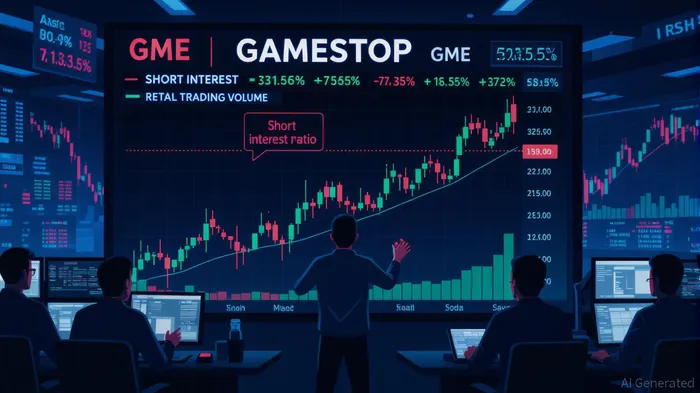
In the ever-shifting landscape of speculative trading, few stocks have captured the imagination of retail investors and institutional players alike like GameStopGME-- (GME). As of August 2025, the retail-driven volatility that once defined GME's 2021 saga appears to be resurfacing, albeit with a more nuanced backdrop. This article dissects the interplay between short interest dynamics, retail participation, and the broader implications for short-term traders and institutional risk management.
Short Interest: A Bearish Overhang with Mixed Signals
As of August 15, 2025, GME's short interest stood at , . While this suggests a slight easing of bearish sentiment, the short interest ratio (SIR) of remains elevated. This metric, calculated by dividing short interest by average daily trading volume, indicates that short sellers would need nearly a week to liquidate their positions at current trading levels—a scenario that could trigger a self-reinforcing short squeeze if the stock rallies.
The short interest as a percentage of float . With over 1 in 6 shares in the float currently shorted, GMEGME-- remains a magnet for both institutional short sellers and retail traders seeking to exploit perceived overvaluation. Notably, off-exchange short volume—trades executed in dark pools and non-lit venues—accounted for , highlighting the opaque nature of shorting activity in this stock.
Retail Participation: The Double-Edged Sword of Speculation
Retail investor activity, though less quantifiable in recent data, remains a wildcard. The absence of granular retail trading volume metrics (as noted in multiple search attempts) does not diminish the historical precedent: GME's price action has often been driven by coordinated retail buying, particularly during periods of heightened social media buzz. While current retail volume spikes are not explicitly documented, the Short Squeeze Score—a proprietary metric incorporating short interest, float, and borrowing costs—suggests a moderate risk of retail-driven volatility.
The short borrow fee rate of (as of September 10, 2025) adds another layer of intrigue. A stable fee rate implies that institutional lenders are not aggressively restricting access to shares, which could allow short sellers to maintain or even expand their positions. However, a sudden spike in borrowing costs could signal a shift in sentiment, potentially triggering a scramble to cover short positions.
Implications for Short-Term Traders and Institutional Risk Management
For short-term traders, GME's current profile presents a high-risk, high-reward scenario. A short squeeze could be catalyzed by positive news (e.g., earnings surprises, retail buying campaigns) or broader market rotations into speculative assets. Traders should monitor on-chain data for unusual buying patterns and social media sentiment for signs of retail mobilization.
Historical data reveals that GME's post-earnings performance has been mixed. From 2022 to the present, a simple buy-and-hold strategyMSTR-- following earnings beats showed a 60% win rate over 3, 10, and 30 days, with a maximum 30-day return of . While this suggests consistent short-term momentum, the modest returns highlight the stock's limited upside potential in the absence of broader retail-driven catalysts.
Institutional investors, meanwhile, must grapple with the dual risks of short position exposure and retail-driven liquidity shocks. The presence of major shorters like Wolverine Trading LLC and Sculptor Capital LP indicates that institutional bearishness persists, but the concentration of short positions in a single stock (especially one with a history of retail activism) demands rigorous risk controls. Diversification and dynamic hedging strategies are essential to mitigate potential losses from a sudden price reversal.
A Turning Point or a False Dawn?
GME's current short interest levels and retail dynamics suggest a potential inflection point. While the stock is not in the extreme territory of 2021 (when short interest exceeded 20% of float), the combination of a moderate SIR, active short sellers, and a retail base primed for action creates a volatile cocktail. For investors, the key takeaway is to treat GME as a speculative asset with binary outcomes: either a continuation of sideways trading or a sharp, unpredictable move.
Investment Advice:
- Short-term traders should consider small, directional bets with tight stop-loss orders, favoring long positions during short squeeze catalysts or short positions during overbought conditions. Historical data suggests a in the 3–30 day window post-earnings, but returns remain modest, reinforcing the need for disciplined exit strategies.
- Institutions should limit GME exposure to their portfolios and use derivatives to hedge against liquidity risks. The observed in past earnings-driven rallies underscores the stock's limited long-term upside.
- Retail investors must recognize the inherent risks of speculative trading and avoid overleveraging in a stock with a history of extreme volatility.
As the market navigates this delicate balance between bearish positioning and retail fervor, GameStop remains a case study in the unpredictable power of crowd psychology. For now, the stock's future hinges on whether the retail-driven resurgence is a fleeting flare-up or the prelude to a new chapter in its storied volatility.
"""

Stay ahead of the market.
Get curated U.S. market news, insights and key dates delivered to your inbox.
AInvest
PRO
AInvest
PRO



Comments
No comments yet