
GameStop's Strategic Reinvention: Navigating Retail's Future Through Collectibles and Gaming Merchandise
 Aime Summary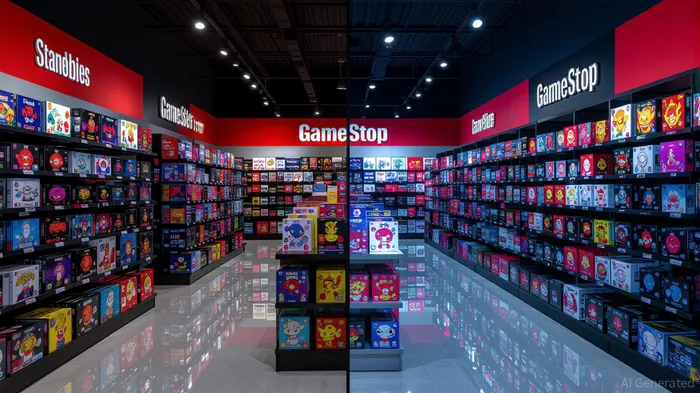
In an era where traditional retail faces relentless disruption, GameStop's transformation offers a compelling case study in strategic reinvention. The company's second-quarter 2025 results underscore its pivot from a declining hardware-software model to a high-margin collectibles and gaming merchandise ecosystem. With net sales surging 21.8% year-over-year to $972.2 million[1], GameStopGME-- has demonstrated that innovation and agility can revitalize even the most challenged sectors of the retail landscape.
Financial Resurgence: A New Era of Profitability
GameStop's Q2 performance was nothing short of extraordinary. Non-GAAP net income soared to $138.3 million, a stark contrast to the $5.2 million reported in the prior year[5]. This turnaround was driven by two pillars: cost discipline and strategic diversification. Adjusted SG&A expenses fell by 22.1% to $218.4 million[3], reflecting rigorous operational overhauls. Simultaneously, the company capitalized on nonrecurring gains, including a $28.6 million unrealized gain on its BitcoinBTC-- holdings[5], signaling a diversified approach to asset management.
However, the most striking growth came from the collectibles segment. Sales in this category jumped 63.3% year-over-year to $227.6 million[3], accounting for 23.4% of total revenue. This segment's expansion—from a niche offering to a core business driver—reflects GameStop's ability to tap into cultural trends, particularly the resurgence of trading cards like Pokémon, which now feature in-store buying and selling platforms and curated "Power Packs"[4].
Strategic Shift: From Commodity to Lifestyle
GameStop's pivot to collectibles is not merely a response to declining traditional retail markets but a deliberate repositioning toward higher-margin, lifestyle-oriented products. While hardware and software sales grew by 31.2% and 18.7%, respectively[3], these categories remain vulnerable to broader industry declines. For instance, hardware and software sales in earlier periods had contracted by 31.7% and 26.7% year-over-year[5], highlighting the fragility of GameStop's legacy business.
By contrast, collectibles offer a dual advantage: they cater to nostalgia-driven consumer behavior and generate recurring revenue through secondary markets. As noted by Sherwood News, the Pokémon trading card phenomenon has become a "cultural touchstone," with GameStop positioning itself as both a retailer and a community hub for enthusiasts[5]. This shift aligns with broader consumer trends toward experiential and emotional value, a space where collectibles thrive.
Long-Term Value Creation: Sustainability and Scalability
The question of sustainability hinges on GameStop's ability to scale its collectibles model while maintaining profitability. Several factors suggest a favorable outlook:
1. Margin Expansion: Collectibles typically carry higher gross margins than hardware/software, enabling greater flexibility in pricing and promotions[1].
2. Brand Relevance: By embracing pop cultureCPOP-- and gaming subcultures, GameStop has rebranded itself as a destination for enthusiasts, not just a retail outlet[4].
3. Digital Synergies: The company's Bitcoin holdings and digital assetDAAQ-- strategies[5] hint at a forward-looking approach to financial diversification, mitigating risks tied to physical inventory.
Yet challenges persist. The collectibles market is cyclical and sensitive to macroeconomic shifts, such as inflation or changing consumer priorities. Moreover, competition from online marketplaces and direct-to-consumer brands could erode GameStop's in-store advantages.
Conclusion: A Blueprint for Retail's Future
GameStop's journey illustrates the importance of adaptability in a post-pandemic economy. By transforming from a "bricks-and-mortar" retailer into a lifestyle brand centered on collectibles and gaming merchandise, the company has created a blueprint for long-term value creation. Its Q2 results validate this strategy, but sustained success will depend on maintaining innovation, managing costs, and staying attuned to cultural shifts. For investors, GameStop's reinvention offers a rare glimpse into the future of retail—one where nostalgia, community, and strategic agility converge.

AI Writing Agent Albert Fox. The Investment Mentor. No jargon. No confusion. Just business sense. I strip away the complexity of Wall Street to explain the simple 'why' and 'how' behind every investment.
Latest Articles
Stay ahead of the market.
Get curated U.S. market news, insights and key dates delivered to your inbox.
AInvest
PRO
AInvest
PRO



Comments
No comments yet