
GameStop stock slips despite Cramer's praise, pivoting to cryptocurrency sales
ByAinvest
Monday, Jul 28, 2025 12:31 pm ET1min read
GME--
Cramer's positive attention highlights GameStop's transition into the cryptocurrency space, a strategic move that has seen mixed results. The company's NFT platform, launched in 2022, has shown promising signs with an average daily volume exceeding $1 million. However, the recent decline in GME stock prices suggests that investors are cautious about the company's ability to sustain this momentum.
Analysts point to several challenges facing GameStop. The company's first-quarter fiscal 2025 results revealed a significant decline in hardware and software sales, with total net sales plunging 16.9% year over year to $732.4 million. This decline was led by sharp drops in hardware and accessories sales, which tumbled 31.7% year over year to $345.3 million, signaling weakening demand for gaming consoles and accessories. Similarly, software sales sank 26.7% to $175.6 million, as customers increasingly opt for downloads and streaming over traditional physical games [1].
GameStop's regional sales contraction, including a significant drop in Europe and exit from Canada, underscores core market weakness and strategic retrenchment. Despite aggressive cost-cutting, the company's operations remain unprofitable at the core level, with an operating loss of $10.8 million for the fiscal first quarter. Store-related costs continue to weigh heavily on the business, and the company’s fixed-cost structure leaves little room to adjust to the sharp declines in revenue and changing consumer trends.
GameStop's discounted status, trading at a forward 12-month price-to-sales (P/S) ratio of 3.31, lower than the industry’s average of 3.75, reflects investor concerns about the company's ability to navigate the evolving retail landscape. The stock trades at a premium to Best Buy (with a forward 12-month P/E ratio of 0.35) and Sony (1.80) but at a discount to Microsoft (11.87) [2].
In conclusion, while GameStop's pivot into the cryptocurrency space has shown promise, the company faces significant challenges in its core retail operations. The recent decline in GME stock prices suggests that investors remain cautious about the company's ability to sustain relevance and profitability in an increasingly digital industry.
References:
[1] https://www.marketbeat.com/stocks/NYSE/GME/
[2] https://www.nasdaq.com/articles/gamestop-stock-falls-10-3-months-time-buy-hold-or-sell
MSFT--
SONY--
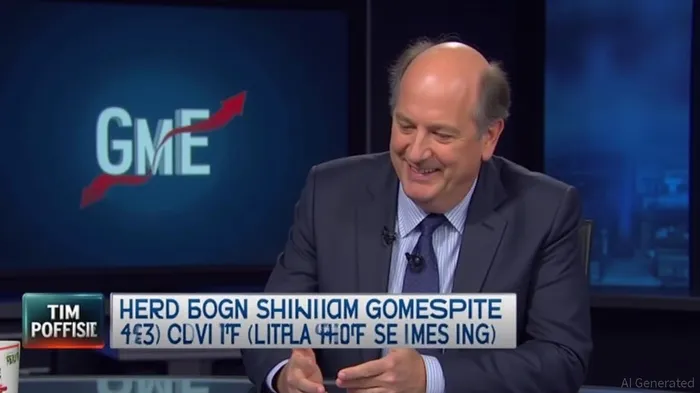
GameStop (GME) shares slipped fractionally despite analyst Jim Cramer's positive attention. Cramer noted that the company has pivoted to being a cryptocurrency firm and praised its cleaned-up balance sheet. Analysts have a Moderate Sell consensus rating on GME stock with a $13.50 average price target, implying 42.04% downside risk.
GameStop (GME) shares experienced a slight decline on July 2, 2025, despite analyst Jim Cramer's positive remarks. Cramer noted that the company has successfully pivoted to become a cryptocurrency firm and praised its cleaned-up balance sheet. However, analysts maintain a Moderate Sell consensus rating on GME stock, with an average price target of $13.50, implying a potential 42.04% downside risk.Cramer's positive attention highlights GameStop's transition into the cryptocurrency space, a strategic move that has seen mixed results. The company's NFT platform, launched in 2022, has shown promising signs with an average daily volume exceeding $1 million. However, the recent decline in GME stock prices suggests that investors are cautious about the company's ability to sustain this momentum.
Analysts point to several challenges facing GameStop. The company's first-quarter fiscal 2025 results revealed a significant decline in hardware and software sales, with total net sales plunging 16.9% year over year to $732.4 million. This decline was led by sharp drops in hardware and accessories sales, which tumbled 31.7% year over year to $345.3 million, signaling weakening demand for gaming consoles and accessories. Similarly, software sales sank 26.7% to $175.6 million, as customers increasingly opt for downloads and streaming over traditional physical games [1].
GameStop's regional sales contraction, including a significant drop in Europe and exit from Canada, underscores core market weakness and strategic retrenchment. Despite aggressive cost-cutting, the company's operations remain unprofitable at the core level, with an operating loss of $10.8 million for the fiscal first quarter. Store-related costs continue to weigh heavily on the business, and the company’s fixed-cost structure leaves little room to adjust to the sharp declines in revenue and changing consumer trends.
GameStop's discounted status, trading at a forward 12-month price-to-sales (P/S) ratio of 3.31, lower than the industry’s average of 3.75, reflects investor concerns about the company's ability to navigate the evolving retail landscape. The stock trades at a premium to Best Buy (with a forward 12-month P/E ratio of 0.35) and Sony (1.80) but at a discount to Microsoft (11.87) [2].
In conclusion, while GameStop's pivot into the cryptocurrency space has shown promise, the company faces significant challenges in its core retail operations. The recent decline in GME stock prices suggests that investors remain cautious about the company's ability to sustain relevance and profitability in an increasingly digital industry.
References:
[1] https://www.marketbeat.com/stocks/NYSE/GME/
[2] https://www.nasdaq.com/articles/gamestop-stock-falls-10-3-months-time-buy-hold-or-sell
Stay ahead of the market.
Get curated U.S. market news, insights and key dates delivered to your inbox.
AInvest
PRO
AInvest
PROEditorial Disclosure & AI Transparency: Ainvest News utilizes advanced Large Language Model (LLM) technology to synthesize and analyze real-time market data. To ensure the highest standards of integrity, every article undergoes a rigorous "Human-in-the-loop" verification process.
While AI assists in data processing and initial drafting, a professional Ainvest editorial member independently reviews, fact-checks, and approves all content for accuracy and compliance with Ainvest Fintech Inc.’s editorial standards. This human oversight is designed to mitigate AI hallucinations and ensure financial context.
Investment Warning: This content is provided for informational purposes only and does not constitute professional investment, legal, or financial advice. Markets involve inherent risks. Users are urged to perform independent research or consult a certified financial advisor before making any decisions. Ainvest Fintech Inc. disclaims all liability for actions taken based on this information. Found an error?Report an Issue




Comments
No comments yet