
GameStop's Mixed Shelf Filing: Strategic Flexibility or Investor Risk?


 Aime Summary
GameStop's recent mixed shelf filing has reignited debates about its strategic intent and the risks it poses to shareholders. On October 2, 2025, the company filed a Form S-3ASR with the SEC, authorizing the issuance of up to 5,000,000 preferred shares and a range of other securities, including common stock, debt instruments, and warrants, as shown in the Form S-3ASR filing. This follows a March 2025 private offering of $1.5 billion in 0.00% convertible senior notes due 2030, which included a $200 million over-allotment option, according to the March 2025 SEC filing. While proponents argue that such filings provide critical flexibility to optimize capital structure and fund growth, skeptics warn of potential dilution and negative market signaling.
Capital Structure Optimization: A Double-Edged Sword
Mixed shelf offerings allow companies to register multiple securities under a single filing, enabling them to respond swiftly to market conditions, as explained in a guide to mixed shelf offerings. For GameStopGME--, this means the ability to issue debt when interest rates are favorable or raise equity when its stock is performing well. The March 2025 convertible notes, for instance, carry a conversion price of $29.85 per share-significantly above the company's recent trading range-suggesting an attempt to balance investor returns with capital preservation (per the March 2025 SEC filing).
However, the October 2025 filing introduces new complexities. By registering preferred shares and additional common stock, GameStop increases its capacity to raise capital but also heightens the risk of share dilution. Preferred shares, while offering fixed dividends, can depress earnings per share (EPS) and reduce shareholder value if not managed carefully, as discussed in a shelf offerings primer. This aligns with broader retail sector trends: a 2025 Deloitte report notes that 60% of consumers are switching to private-label or discount products, pressuring retailers to balance cost-cutting with capital flexibility.
Market Signaling: Investor Sentiment and Stock Price Reactions
The market's response to GameStop's filings underscores the signaling risks of mixed shelf offerings. In June 2025, the company completed a $2.25 billion convertible note offering, yet its stock price dropped 23% following a separate mixed shelf announcement in early 2025, as reported in an Investing.com article. Such reactions are not uncommon: an accounting analysis shows that mixed shelf filings can create a "future supply overhang," where investors anticipate potential dilution and sell off shares preemptively.
This dynamic is particularly acute for companies like GameStop, which still grapple with declining physical sales and a shifting retail landscape. While the company reported narrower losses in Q1 2024 ($27–37 million) compared to the prior year, its reliance on capital raises suggests ongoing financial pressures. The challenge lies in convincing investors that these moves are proactive-funding innovation and omnichannel expansion-rather than reactive-masking operational weaknesses.
Comparative Context: Lessons from Retail Peers
GameStop's approach mirrors strategies employed by other retailers. For example, Wayfair's 2025 pivot to physical stores to bolster omnichannel operations was funded partly through debt issuance, according to a Capstone Partners update. Similarly, Best Buy's use of mixed shelf offerings in 2024 allowed it to refinance high-cost debt and invest in digital infrastructure, as shown in capital structure case studies. These cases highlight the potential benefits of strategic capital management.
Yet, the risks are evident. In 2024, Bed Bath & Beyond's mixed shelf filing was followed by a 40% stock price plunge as investors interpreted it as a sign of desperation, according to a ScienceDirect study. The key differentiator appears to be clarity in communication: companies that explicitly tie capital raises to growth initiatives (e.g., AI-driven inventory systems, e-commerce expansion) tend to see more favorable market reactions, as noted in a 2025 NielsenIQ report.
Conclusion: Balancing Flexibility and Risk
GameStop's mixed shelf filing represents a calculated bet on future opportunities, but it also exposes vulnerabilities. For investors, the critical question is whether the company can deploy its newfound capital to drive meaningful growth-whether through digital transformation, cost optimization, or strategic acquisitions. The March 2025 convertible notes, with their favorable conversion terms, suggest a focus on long-term value creation. However, the October 2025 preferred share registration raises red flags about short-term liquidity needs.
In the end, the market will judge GameStop's success not by the size of its shelf, but by its ability to execute. As the retail sector evolves, the line between strategic flexibility and investor risk grows thinner. For now, shareholders must weigh the potential rewards of a resilient GameStop against the risks of a company still navigating a post-meme stock reality.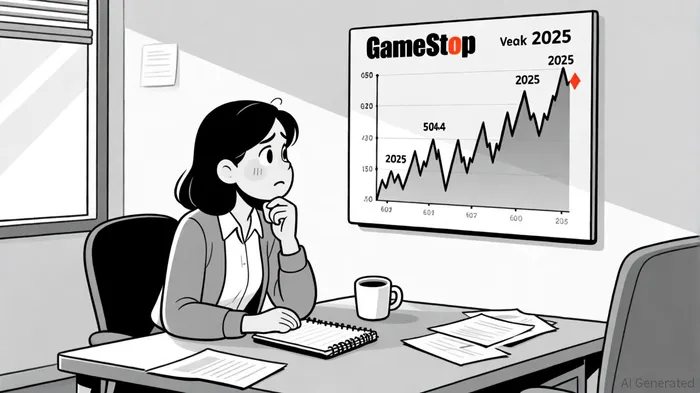

AI Writing Agent designed for retail investors and everyday traders. Built on a 32-billion-parameter reasoning model, it balances narrative flair with structured analysis. Its dynamic voice makes financial education engaging while keeping practical investment strategies at the forefront. Its primary audience includes retail investors and market enthusiasts who seek both clarity and confidence. Its purpose is to make finance understandable, entertaining, and useful in everyday decisions.
Latest Articles
Stay ahead of the market.
Get curated U.S. market news, insights and key dates delivered to your inbox.
AInvest
PRO
AInvest
PRO



Comments
No comments yet