
GameStop's Crypto Gamble: Can a Retail Giant Turn Bitcoin and Minerals into a New Era of Growth?
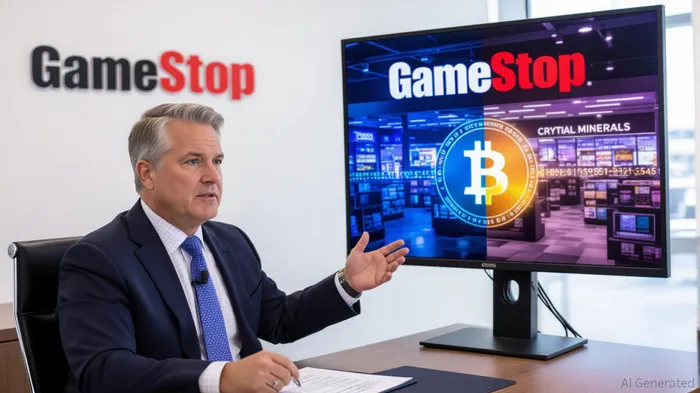
GameStop's Q2 2025 results reveal a company at a crossroads. While its traditional video game and hardware sales continue to decline, the retailer is aggressively pivoting toward cryptocurrencies and critical minerals—a strategy that could redefine its future or mark a costly overreach. With $6.4 billion in cash reserves, CEO Ryan Cohen is betting big on diversification amid a volatile macroeconomic landscape. The question is: Is this a sustainable reinvention or a speculative leap into the unknown?
The Financial Crossroads
GameStop's core retail business is contracting. Hardware and software sales fell to 47% and 24% of revenue, respectively, as collectibles—a category buoyed by NFTs and memorabilia—surged to nearly 29%. While this shift signals customer demand for niche products, it also highlights a core problem: the traditional video game market is maturing, and GME's physical stores are struggling to adapt.
The silver lining is a turnaround in profitability. Net income turned positive at $44.8 million, driven by cost-cutting and asset sales, including the divestiture of its Canadian operations. Adjusted EBITDA rose to $38.6 million, and free cash flow hit $189.6 million—a stark improvement from its $114.7 million deficit in 2024. Yet these gains are fragile. Operating losses, excluding restructuring charges, remain at $10.8 million, underscoring persistent operational challenges in its legacy business.
The Crypto Play: Bitcoin as a Treasury Reserve
The most audacious move is GameStop's $516.6 million Bitcoin purchase, which now represents roughly 8% of its total cash reserves. By holding Bitcoin as a treasury asset, GME aims to hedge against inflation and currency volatility—a strategy gaining traction among corporations like MicroStrategyMSTR--.
However, this exposes GME to cryptocurrency's extreme volatility. Bitcoin's price dropped nearly 30% in the first half of 2025 alone. Should crypto markets tank further, GME's balance sheet could take a hit. Proponents argue Bitcoin's potential as a store of value justifies the risk, but critics counter that GME lacks the expertise or scale to compete with crypto-native firms.
The Mineral Opportunity: Antimony and Gold in Alaska
GameStop's partnership with Nova MineralsNVA-- adds another layer of risk and reward. High-grade antimony (up to 60.5% purity) and gold samples from Alaska's Stibium prospect are promising, given antimony's rising use in batteries and its spot price near $60,000/tonne. Yet this venture is nascent: exploration carries geological, regulatory, and geopolitical risks, especially in regions with unstable supply chains.
The move reflects a broader trend of companies seeking to secure critical minerals for energy transitions. But GME's lack of mining expertise raises questions about execution. Unlike established miners, it has no operational track record in this space—only financial exposure.
Risks and Rewards: A Balancing Act
The risks are clear. GME's legacy business is declining, and its new ventures lack proven revenue streams. Bitcoin's valuation remains speculative, and mineral exploration is capital-intensive with long timelines. Meanwhile, competitors like WalmartWMT-- and Target are accelerating their own digital and sustainability initiatives, leaving GME in a niche.
Yet there are tailwinds. Inflation remains elevated, boosting demand for hard assets like Bitcoin and minerals. Collectibles' growth suggests a path to monetizing nostalgia-driven markets. And GME's $6.4 billion cash hoard provides a buffer against missteps.
Investment Considerations: Speculative Upside or Overvalued Risk?
Analysts are divided. Bulls argue that GME's strategic moves position it as a hybrid of retailer, crypto custodian, and resource explorer—a unique value proposition in a fragmented market. They point to its 28% YTD stock surge, outperforming the S&P 500's flat trajectory.
Bears counter that the stock trades at a 10x price-to-sales ratio—far above peers—despite unproven revenue streams. A conservative estimate suggests a $50–$70 price target if crypto and minerals yield modest returns, but a $20–$30 downside if core retail declines accelerate and speculative assets falter.
Conclusion: A High-Reward, High-Risk Gamble
GameStop's pivot is bold, but its success hinges on two factors: executing its diversification while stabilizing its core business. For investors, this is a call option on innovation—rewarding those willing to bet on GME's ability to leverage its cash and brand to build new revenue streams. However, the risks are substantial, and the legacy business's decline remains unresolved.
The verdict? GME is a speculative play for aggressive investors with a long-term horizon, not a core holding for conservative portfolios. Monitor Bitcoin's price stability and Nova Minerals' exploration results closely—their outcomes will likely decide whether this gamble pays off or becomes another chapter in GME's storied resilience.

Delivering real-time insights and analysis on emerging financial trends and market movements.
Latest Articles
Stay ahead of the market.
Get curated U.S. market news, insights and key dates delivered to your inbox.
AInvest
PRO
AInvest
PRO



Comments
No comments yet