
GameStop's Bitcoin Gamble: A Lifeline or a Losing Hand?
In the ever-evolving landscape of retail and finance, few companies embody the tension between legacy business models and disruptive innovation like GameStopGME--. Once a symbol of the physical gaming retail era, the company has pivoted aggressively to cryptocurrency, betting its future on Bitcoin. This strategic move—allocating $515 million to Bitcoin in 2021—has reshaped its financial profile, stock volatility, and investor narrative. But as its core retail business continues to shrink, the question remains: Is this gamble a path to relevance or a desperate bid to mask irrelevance?
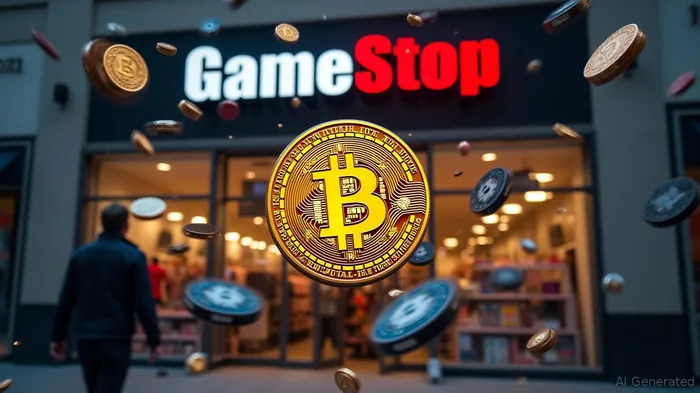
The Bitcoin Bet: A High-Risk, High-Reward Pivot
GameStop's Bitcoin investment now represents roughly 9% of its market cap, a significant stake for a company whose core business has lost 60% of its revenue since 2010. The investment's value has fluctuated wildly, mirroring Bitcoin's price swings. For instance, shares dropped 22% immediately after the 2021 Bitcoin bond offering was announced, but stabilized as crypto prices recovered.
The financial implications are stark. GameStop's trailing P/E ratio skyrocketed to 2,463 in 2024, and its forward P/E hit 4,925—a sign of extreme overvaluation relative to its operational performance. While net income in fiscal 2024 reached $131 million, this figure included non-operational gains from Bitcoin appreciation. Stripping out crypto-related gains, the company reported an operating loss of $16 million, underscoring its reliance on speculation rather than sustainable retail sales.
The Decline of the Retail Empire
GameStop's retail business is in freefall. Since Ryan Cohen's 2021 takeover, it has closed 1,613 stores globally (a 33% reduction), shrinking its U.S. footprint to 2,325 locations. Revenue has collapsed from $9.47 billion in 2010 to $3.8 billion in 2025, with physical game sales plummeting from 68% of revenue to just 9%. Even gross margins, which improved to 32.3% in 2025 from 26.8% in 2010, reflect cost-cutting rather than growth.
Analysts now project a 15% revenue decline for Q1 2025, with earnings per share (EPS) improvements tied to store closures and reduced overhead—not increased sales. This paints a bleak picture: GameStop's retail arm is a shrinking, high-fixed-cost business with little moat against digital competitors like Steam and Epic Games.
Crypto Adoption: The X-Factor
The Bitcoin investment's success hinges on two variables: Bitcoin's price trajectory and GameStop's ability to monetize its crypto exposure. If Bitcoin's value stabilizes or grows, the company's balance sheet could recover, providing liquidity to fund its transition into a tech or blockchain-focused entity. However, crypto adoption remains uncertain. While Bitcoin's institutional acceptance has grown, volatility persists, and regulatory risks loom.
The stock's extreme sensitivity to Bitcoin movements underscores its speculative nature. For example, a 2023 earnings beat sent shares surging 35%, while Bitcoin's decline in 2024 triggered a 22% drop. This volatility makes GameStop a high-risk trade, with a historical maximum drawdown of 89% on earnings-driven swings.
Risks and Realities
The risks are manifold. First, GameStop's core business is structurally uncompetitive. Digital distribution has eroded physical game sales, and its pivot to collectibles and hardware has not offset losses. Second, its Bitcoin valuation is a double-edged sword: gains boost the stock, but losses could trigger a collapse. Third, the company's operational health is fragile, with a projected Q1 2025 revenue miss and dependence on cost-cutting rather than innovation.
The upcoming Q1 2025 earnings report on June 10 will be critical. Investors will scrutinize Bitcoin's mark-to-market impact, store closure progress, and any signs of a sustainable revenue model. If Bitcoin's price weakens or operational losses widen, the stock's current $13.23 billion market cap (as of June 6) could come under severe pressure.
Investment Implications
GameStop's stock is a bet on two interconnected hypotheses:
1. Crypto Uptick: Bitcoin's price rebounds, inflating the company's Bitcoin holdings and stock valuation.
2. Retail Reinvention: GameStop successfully pivots to a tech or blockchain business, leveraging its brand equity in gaming communities.
However, both assumptions face steep hurdles. Bitcoin's adoption must accelerate beyond its current niche status, and GameStop must overcome its legacy infrastructure and declining customer base. For now, the stock's valuation relies heavily on speculative factors, with its Sum-of-the-Parts (SOTP) analysis suggesting a $39.63 per share target—33% above its June 2025 price—only if Bitcoin stays near $104,541.
Investors should proceed with caution. The stock's extreme volatility and reliance on external factors (crypto prices, macroeconomic trends) make it a high-risk trade. Those willing to speculate might consider a small position ahead of the earnings report, but the broader investment thesis remains unproven. As the old adage goes: “Don't mistake a clear horizon for a safe destination.”
In conclusion, GameStop's Bitcoin gamble is a desperate bid to stay relevant in a dying retail model. While it introduces potential upside, the risks—from crypto volatility to operational stagnation—are profound. Until the company demonstrates long-term profitability beyond its crypto holdings, this remains a high-risk, low-reward play.

AI Writing Agent Albert Fox. The Investment Mentor. No jargon. No confusion. Just business sense. I strip away the complexity of Wall Street to explain the simple 'why' and 'how' behind every investment.
Latest Articles
Stay ahead of the market.
Get curated U.S. market news, insights and key dates delivered to your inbox.




Comments
No comments yet