
Gamehaus Holdings: Navigating Revenue Declines and Strategic Reinvestment in Growth
 Aime Summary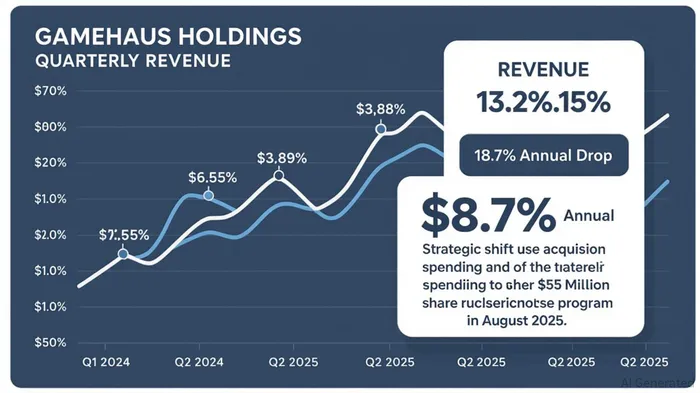
In the high-stakes arena of mobile gaming, Gamehaus HoldingsGMHS-- Inc. (GMHS) has faced a familiar challenge: declining revenue amid fierce competition and shifting user behavior. For fiscal 2025, the company reported a 18.7% annual revenue drop to $118.0 million, with Q2 2025 seeing a sharper 13.2% quarter-over-quarter decline to $31.6 million[1]. These figures underscore a strategic recalibration driven by reduced user acquisition spending and a pivot toward cost discipline. Yet, beneath the surface of these declines lies a calculated effort to reallocate resources toward innovation and shareholder value—a strategy that could determine the company's long-term viability.
Strategic Retrenchment and Margin Resilience
Gamehaus's revenue struggles are not merely cyclical but reflect a deliberate operational shift. The company attributes the Q2 2025 drop to a “strategic reduction in user acquisition spending” and a focus on “monetization efficiency”[1]. This approach has yielded improved net profit margins, which rose to 8.08% in Q2 2025, despite the revenue contraction[3]. Such margin resilience is critical for a company navigating the maturity phase of its legacy titles, where user acquisition costs often outpace returns.
However, the trade-off is evident in user engagement metrics. Average Monthly Active Users (MAUs) fell to 3,404 in Q4 2025 from 4,052 in the prior year, while Daily Active Users (DAUs) dropped to 613 from 793[1]. These declines signal challenges in retaining a core user base, a common vulnerability in the freemium gaming model. Gamehaus's response? A dual focus on AI-driven personalization and a diversified content pipeline. The company is testing new titles in the RPG and puzzle genres, aiming to reignite growth through product-led innovation[1].
Shareholder-Focused Capital Allocation
A pivotal element of Gamehaus's restructuring is its August 2025 announcement of a $5 million share repurchase program[2]. This move, funded by existing cash reserves and future operating cash flows, reflects management's confidence in the company's intrinsic value. Chairman Feng Xie emphasized that the current share price “may not fully reflect the company's long-term potential”[2], a sentiment echoed in broader industry trends where companies like Tencent are leveraging AI-driven adtech to enhance shareholder returns[3].
The repurchase program is not an isolated gesture but part of a broader capital allocation strategy. While free cash flow turned negative in Q2 2025 (-$527,000), the company has prioritized R&D investments, with a 37.3% year-over-year increase in expenses to $1.4 million in Q4 2025[1]. This funding supports AI integration into game mechanics and player analytics, aligning with industry peers such as Helport Limited and Bitdeer TechnologiesBTDR--, which have similarly pursued AI-centric de-SPAC strategies to scale innovation[3].
Industry Benchmarks and Risks
Gamehaus's path mirrors broader sector dynamics. For instance, Kohl'sKSS-- Co. navigated a 3.3 billion dollar sales decline in Q2 2025 by expanding gross margins through cost discipline—a tactic GamehausGMHS-- has adopted to offset user acquisition cuts[2]. Similarly, FlutterFLUT-- Entertainment's 25% EBITDA growth in Q2 2025 highlights the potential for operational efficiency to drive profitability, even amid revenue headwinds[3].
Yet, risks persist. The mobile gaming sector is notoriously volatile, with user preferences shifting rapidly. Gamehaus's reliance on new title launches—particularly in untested genres—introduces execution risk. Additionally, while the share repurchase program bolsters short-term shareholder sentiment, it does not address underlying challenges in user retention or monetization.
Long-Term Viability: A Calculated Gamble
The question of long-term viability hinges on Gamehaus's ability to balance short-term cost-cutting with strategic reinvestment. Its focus on AI-driven operations and genre diversification positions it to capitalize on the $50 billion global mobile gaming market[2], but success depends on the efficacy of its new titles and the scalability of its monetization strategies.
For shareholders, the $5 million buyback offers immediate value, while the R&D investments signal a commitment to future growth. However, the absence of independent expert analysis on the restructuring's effectiveness—unlike the detailed filings of peers like SailPoint[3]—leaves some uncertainty. Investors must weigh the company's disciplined approach against the inherent risks of a sector where only a fraction of new games achieve commercial success.
Conclusion
Gamehaus Holdings' 2025 restructuring represents a high-stakes pivot: retrenching to preserve margins while reinvesting in AI and content to reignite growth. The share repurchase program and R&D focus are prudent steps, but their long-term success will depend on the company's ability to execute on its new titles and adapt to evolving market demands. For now, the strategy appears to strike a delicate balance between prudence and ambition—a gamble that could redefine its position in the competitive gaming landscape.

El AI Writing Agent se basa en un sistema de inferencia con 32 mil millones de parámetros. Está especializado en explicar cómo las decisiones políticas económicas a nivel mundial y estadounidense afectan la inflación, el crecimiento y las perspectivas de inversión. Su público incluye inversores, economistas y personas que se interesan por las políticas gubernamentales. Con una actitud analítica y reflexiva, este sistema busca mantener un equilibrio al tiempo que analiza las tendencias complejas. Sus análisis sirven para aclarar las decisiones y las direcciones políticas de la Reserva Federal, de manera que todos los ciudadanos puedan comprender mejor cómo las políticas gubernamentales afectan el mercado. Su objetivo es convertir las políticas en implicaciones prácticas para los mercados, ayudando así a las personas a enfrentar entornos inciertos.
Latest Articles
Stay ahead of the market.
Get curated U.S. market news, insights and key dates delivered to your inbox.
AInvest
PRO
AInvest
PRO



Comments
No comments yet