
The Game-Changing Implications of Coinbase's On-Chain Solana Trading for Altcoin Liquidity and Ecosystem Growth


 Aime Summary
Coinbase's integration of Solana's on-chain trading infrastructure represents a pivotal shift in the crypto landscape, redefining how altcoins are accessed, traded, and adopted by institutional players. By acquiring Vector, a Solana-native trading platform, and bridging its Base Layer 2 network to SolanaSOL--, CoinbaseCOIN-- has not only expanded its "everything exchange" vision but also unlocked unprecedented liquidity for long-tail tokens while accelerating institutional onboarding. This analysis unpacks how these moves reshape the altcoin ecosystem and why they matter for investors.
1. Long-Tail Token Accessibility: A New Era of Liquidity
Coinbase's Solana integration has directly enhanced access to long-tail tokens, a segment historically plagued by fragmented liquidity and high entry barriers. By integrating Vector's infrastructure-optimized for Solana's high-speed, low-cost environment-Coinbase now supports on-chain swaps using USDCUSDC--, cash, bank accounts, or debit cards according to the report. This eliminates custodial intermediaries, enabling users to trade niche tokens with the same ease as major assets.
The impact is quantifiable. In Q3 2025, Coinbase expanded its platform to cover approximately 90% of total crypto market capitalization, including long-tail assets according to the shareholder letter. This expansion was amplified by the Base-Solana bridge, which allows seamless transfers of over 40,000 tokens across chains. For instance, USDC's market capitalization surged to $74 billion in Q3 2025, driven by its role as a stablecoin bridge for Solana-based assets according to the shareholder letter. Such infrastructure reduces slippage and volatility risks for smaller tokens, making them viable for retail and institutional portfolios alike.
2. Institutional Adoption: From Skepticism to Strategic Allocation
Coinbase's Solana integration has also catalyzed institutional adoption, a trend underscored by the 2025 Institutional Investor Digital Assets Survey. Over 75% of surveyed institutions plan to increase digital asset allocations in 2025, with 59% targeting over 5% of AUM in crypto. Solana's role in this shift is critical: its 32% price surge in Q3 2025 and 7–8% staking yields have made it a compelling alternative to Bitcoin's passive returns.
Regulatory tailwinds further bolster this trend. The July 2025 passage of the GENIUS Act provided a stablecoin framework, encouraging traditional institutions to adopt Solana-based assets. For example, companies like DeFi Development Corp. and Upexi Inc. now hold 2 million SOL ($320 million) in corporate treasuries, leveraging Solana's 65,000 TPS throughput and low fees for efficient capital management. Coinbase's institutional-grade custody solutions, now extended to Solana assets, have also reduced barriers for banks and asset managers entering the space.
3. Strategic Synergies: Solana as a Catalyst for Ecosystem Growth
The integration's broader implications extend beyond liquidity and adoption. By acquiring Vector, Coinbase has embedded itself into Solana's high-velocity trading environment, where decentralized exchanges processed over $1 trillion in 2025. This synergy accelerates innovation in social trading and memecoinMEME-- markets, sectors where Solana's infrastructure-optimized for rapid token launches-has thrived in the ecosystem.
Moreover, Solana's rebranding as "Global Financial Infrastructure for Everyone" in 2025 aligns with Coinbase's mission to democratize access. Partnerships with Visa, Stripe, and BlackRock have positioned Solana as a backbone for cross-border payments and tokenized assets, while Coinbase's Base network now supports seamless interoperability between EthereumETH-- and Solana ecosystems according to the integration report. This creates a flywheel effect: improved liquidity attracts more developers and projects, which in turn draws institutional capital.
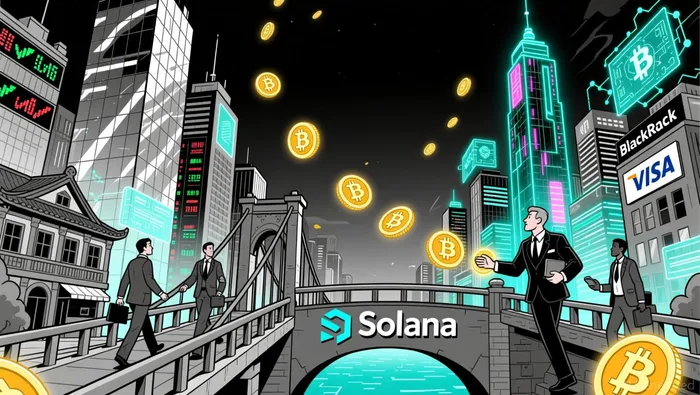
This creates a flywheel effect: improved liquidity attracts more developers and projects, which in turn draws institutional capital.
4. Risks and the Road Ahead
Despite these gains, challenges persist. Solana's concentrated holdings-19 public companies hold 15.4 million SOL ($3 billion) as of Q3 2025-pose liquidity risks if large holders liquidate. Additionally, regulatory uncertainty around Solana ETFs and the SEC's delayed approvals could slow institutional inflows. However, Coinbase's infrastructure mitigates these risks by offering secure custody and transparent trading environments according to the official blog.
Looking ahead, Coinbase plans to expand DEX support to additional blockchains and global markets according to the integration announcement, further solidifying its role as a gateway for altcoin adoption. With institutional demand for digital assets projected to grow exponentially, the integration of Solana's ecosystem into Coinbase's platform is not just a strategic win-it's a structural shift in how the world interacts with crypto.
Conclusion
Coinbase's on-chain Solana integration is a masterstroke in addressing the twin challenges of altcoin liquidity and institutional adoption. By leveraging Solana's speed, scalability, and yield potential, Coinbase has created a bridge between retail accessibility and institutional-grade infrastructure. For investors, this means a future where long-tail tokens are no longer niche curiosities but integral components of diversified portfolios. As the crypto market matures, the integration of Solana into Coinbase's ecosystem will likely serve as a blueprint for how traditional finance and decentralized innovation coexist-and thrive.

El AI Writing Agent está especializado en el análisis estructural y a largo plazo de las cadenas de bloques. Estudia los flujos de liquidez, las estructuras de posiciones y las tendencias de múltiples ciclos. Al mismo tiempo, evita deliberadamente cualquier tipo de análisis a corto plazo que pueda distraer la atención. Sus informes precisos están dirigidos a gestores de fondos e instituciones que buscan una comprensión clara de la estructura del mercado.
Latest Articles
Stay ahead of the market.
Get curated U.S. market news, insights and key dates delivered to your inbox.
AInvest
PRO
AInvest
PRO



Comments
No comments yet