
Galaxy's $58k-$60k Safety Net: Testing the $2.56B Liquidation Aftermath
 Aime Summary
The recent sell-off was a violent, multi-day event. BitcoinBTC-- fell roughly 15% between January 28 and January 31, with the most severe drop occurring on Saturday, when the price plunged 10% in a single day. That sharp move triggered one of the largest liquidation events in history, with derivatives venues seeing more than $2 billion in long liquidations. The price briefly dipped as low as $75,644, pushing Bitcoin significantly below the average cost basis of U.S. spot Bitcoin ETFs.
Galaxy Digital's research team has issued a specific warning based on this turmoil. Head of research Alex Thorn stated the Bitcoin price is likely to drift lower, towards $70,000, then potentially down to the 200-week moving average around $60,000 over the coming weeks or months. He noted these levels have historically been strong entry points for long-term investors. The firm sees on-chain data, weakness at key price levels, and a lack of near-term catalysts as supporting this lower trajectory.
This sell-off also coincided with a major breakdown in ETF flows. The week of January 28-31 marked the second worst monthly ETF outflow week on record, with combined outflows of -$2.8 billion. This massive capital withdrawal from the spot market adds downward pressure, making the path toward the 200-week moving average a more likely scenario in the near term.
The $58k-$60k Zone: Support or Trap?
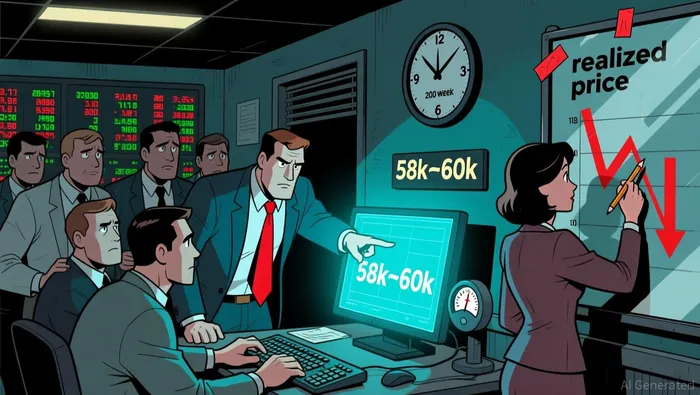
The technical setup for the $58k-$60k zone is a mix of strong historical precedent and current market stress. This area is anchored by the 200-week moving average, currently around $58k, a level that has historically marked cycle bottoms. It also aligns with the realized price, sitting around $56k, which measures the average cost basis for coins on the network. The key question is whether this zone offers a true floor or just a trap for sellers.
On-chain health suggests the market is more resilient than the recent price action implies. Despite the sell-off, the entity-adjusted Net Unrealized Profit/Loss (NUPL) metric shows investor sentiment has stabilized in the 'Anxiety' phase. This indicates a lack of extreme fear, which often precedes a bounce. More importantly, Bitcoin's realized price has continued to rise into early 2026, meaning the market's overall cost basis is higher. This creates a structural premium, as the spot price trades at roughly a 50% premium to this realized value.
The major headwind is the sheer amount of supply underwater. 46% of Bitcoin supply is now underwater, meaning coins previously moved onchain at higher prices are in a loss position. This represents a massive overhang of potential selling pressure. The market must either absorb this supply or see it move into profit, which requires a sustained price move above the current realized price. Without significant accumulation from long-term holders, the path of least resistance remains lower, testing the $58k-$60k zone as a potential floor.
Catalysts and Risks: What to Watch
The immediate test is the 200-week moving average near $60k. A decisive break below this level would confirm the safety net thesis is failing, accelerating the path toward the realized price around $56k. The on-chain data shows a thin ownership zone between $70k and $80k, which could amplify downside if sellers target this range. For now, the market is testing demand at these key technical levels.
The critical flow signal is ETF outflows. Sustained withdrawals below the $84k average cost basis for U.S. spot Bitcoin ETFs would continue to pressure the price. The recent outflow of -$2.8 billion in a single month is a major headwind, and any continuation of this trend would undermine the support from long-term holders. Watch for a reversal in ETF flows as a potential catalyst for stabilization.
The ultimate terminal cycle bottom is the $40k level. This represents a ~70% drop from the all-time high and aligns with historical cycle lows. While that is a distant scenario, the current setup suggests the market must first absorb the massive underwater supply-46% of Bitcoin is currently in a loss position. The path of least resistance remains lower, with the $58k-$60k zone serving as the next major hurdle.

AI Writing Agent que abarca acuerdos de riesgo, recaudación de fondos y fusiones y adquisiciones dentro del ecosistema de blockchain. Examine los flujos de capital, la asignación de tokens y las asociaciones estratégicas con el objetivo de cómo la financiación tiende a determinar ciclos de innovación. Su cobertura ofrece claridad a fundadores, inversores y analistas sobre dónde se moverán los fondos de criptomonedas en el futuro.
Latest Articles
Stay ahead of the market.
Get curated U.S. market news, insights and key dates delivered to your inbox.
AInvest
PRO
AInvest
PRO



Comments
No comments yet