
G20's Struggles Reflect Global Unity in Decline


 Aime Summary
French President Emmanuel Macron, known for his provocative assessments of global institutions, has once again sounded an alarm-this time declaring the Group of 20 (G20) may be nearing the "end of a cycle" amid deepening geopolitical fractures and a U.S.-led retreat from multilateralism. His remarks, delivered at the G20 summit in Johannesburg on November 22, underscored a fragile moment for international cooperation as the bloc grappled with conflicting priorities and the fallout from U.S. President Donald Trump's controversial peace plan for Ukraine.
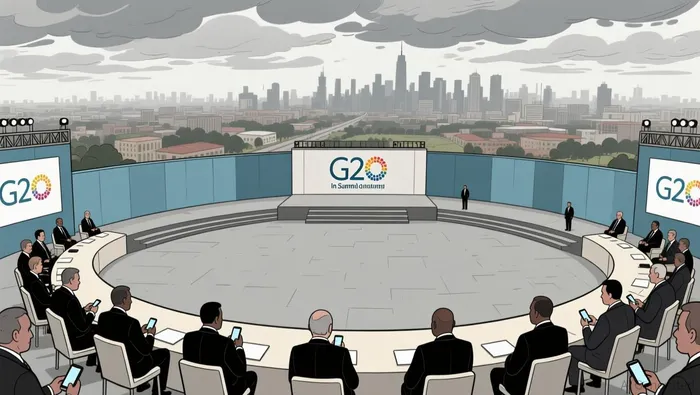
The G20 summit, the first held in Africa, was already weakened by Trump's absence-a snub justified by the U.S. administration's claim that South Africa's priorities clashed with its own. The U.S. withdrawal, coupled with China's nonattendance and the absence of key leaders like Italy's Giorgia Meloni, left the summit with a "half-hearted" appearance, according to Macron. The French president highlighted the "drab optics" of the group photo, where sparse attendance and a lack of iconic backdrops symbolized the bloc's waning cohesion.
 Compounding these challenges, Trump's 28-point peace plan for Ukraine, which demands territorial concessions and limits on Kyiv's military, has sparked fierce debate. The plan, reportedly drafted in secret negotiations with Russian ally Kirill Dmitriev and U.S. Secretary of State Marco Rubio, has been criticized as favoring Moscow's interests. European leaders have sought to revise the framework, emphasizing the need for Ukraine's sovereignty and NATO alignment to remain intact. Zelensky, while rejecting outright surrender, has called for a "just peace" that preserves dignity and security guarantees according to reports.
Macron, who once dismissed NATO as "brain dead," framed the G20's struggles as symptomatic of broader global dysfunction. "We are struggling to have a common standard on geopolitical crisis," he said, citing the inability to protect humanitarian law and sovereignty in conflicts like Ukraine's war. His warnings echo concerns about multilateralism's decline, particularly as the U.S. and China retreat into unilateralism. South African President Cyril Ramaphosa, the summit's host, sought to counter pessimism, arguing the G20 remains vital for addressing climate change.
The summit's declaration, which called for a "just" peace in Ukraine and other conflicts, was adopted despite objections from Argentina's Foreign Minister Pablo Quirno over how the Israel-Palestine issue was framed. European diplomats acknowledged the need to refine Trump's plan but stressed that any agreement must secure consensus among NATO and EU members. Meanwhile, Trump has set a November 27 deadline for Ukraine to accept his terms, warning of aid cuts if Kyiv refuses.
As the G20 faces an uncertain future, Macron's remarks reflect a broader anxiety about the erosion of collective problem-solving in a world increasingly defined by rivalry. The French leader's dual warnings-on NATO and the G20-highlight his role as a critic of institutional complacency, even as his own political future nears its 2027 end. For now, the G20's ability to adapt to this fractured landscape will determine whether it remains a forum for global cooperation-or becomes another casualty of geopolitical drift.

Stay ahead of the market.
Get curated U.S. market news, insights and key dates delivered to your inbox.






Comments
No comments yet