
The Future of Surgery: Hybrid Human-AI Systems Lead the Charge in Robotic Innovation
The global surgical robotics market, valued at over $100 billion, is at an inflection point. Established players like MedtronicMDT-- and disruptors like Neuralink are racing to redefine surgical precision, but the path to dominance hinges on one critical factor: the seamless integration of human expertise with artificial intelligence. While full automation remains a distant horizon, firms betting on hybrid tools—those that amplify surgeon skill rather than replace it—are poised to capture the lion's share of growth. Let's dissect the near-term investment case for Medtronic's Hugo system and Neuralink's neurosurgical robotics, and why a focus on human-AI collaboration is the safest bet for investors.
Medtronic's Hugo: The Modular Disruptor in Traditional Surgery
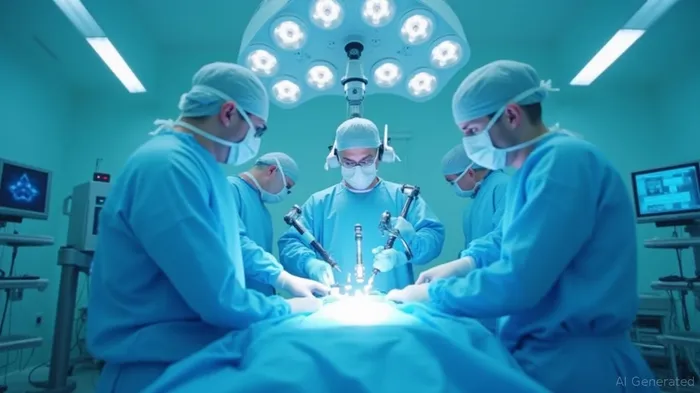
Medtronic's Hugo system represents a direct challenge to Intuitive Surgical's decade-long dominance of the robotic-assisted surgery (RAS) market. Its key advantages? Modularity, cost efficiency, and clinical validation.
- Clinical Validation: The Expand URO study demonstrated Hugo's safety and effectiveness in urologic procedures, with complication rates far below FDA benchmarks. For example, prostatectomy patients saw only 3.7% grade 3+ complications versus a 20% target. This data underpins its FDA submission for urology, with approval expected by late 2025.
- Market Strategy: Hugo's modular design allows hospitals to scale investments, starting with smaller setups for niche procedures. This contrasts sharply with da Vinci's fixed, high-cost systems, making Hugo accessible to mid-tier hospitals globally.
- Regulatory Momentum: Analysts predict Hugo could capture 20–30% of the U.S. RAS market within five years, leveraging Medtronic's existing salesforceCRM-- and Touch Surgery AI analytics platform to drive adoption.
Medtronic's shares have surged 25% YTD on Hugo's progress, outpacing Intuitive Surgical's 12% gain. This reflects investor confidence in Hugo's ability to disrupt a $35B U.S. RAS market.
Neuralink: The AI-Powered Leap into Neurosurgery
Neuralink's neurosurgical robotics, designed to implant brain-computer interface (BCI) threads with sub-millimeter precision, are a radical departure from traditional surgery. Their AI-driven capabilities—like translating neural signals into text at 40 words per minute—signal a future where thought controls prosthetics or devices.
- Clinical Breakthroughs: Early trials in paralyzed patients have shown remarkable results, enabling communication for those with locked-in syndrome. The FDA's “breakthrough device” designation for speech restoration underscores its therapeutic potential.
- Technical Risks: However, Neuralink faces steep hurdles. Long-term biocompatibility remains unproven, and the ethical concerns around neural data privacy and cognitive enhancement are unresolved. Scalability is another challenge: manufacturing thousands of custom implants at low cost is no small feat.
- Market Ambition: Elon Musk's vision extends far beyond medical use, aiming to create a consumer BCI ecosystem. But regulatory approval for non-medical applications could take decades, requiring billions in capital.
The $650M funding round in 2025 highlights investor appetite for high-risk, high-reward bets. Yet without near-term revenue, Neuralink's path to profitability is fraught with uncertainty.
Why Hybrid Models Win in the Near Term
The key to surgical robotics' future lies not in full automation but in tools that magnify human skill. Medtronic's Hugo exemplifies this: its open console design improves team collaboration, while AI analytics refine post-surgery outcomes. Neuralink's BCI, while revolutionary, relies on human-AI synergy to interpret neural signals—a process still in its infancy.
Investors should favor firms that:
1. Anchor in Clinical Validation: Hugo's proven safety data and FDA pipeline reduce execution risk.
2. Prioritize Regulatory Certainty: Medtronic's path to U.S. approval is clear, while Neuralink's regulatory hurdles (e.g., long-term biocompatibility studies) could delay commercialization for years.
3. Serve Immediate Market Needs: Hugo addresses a $100B+ market with existing demand, whereas Neuralink's consumer applications remain speculative.
Investment Outlook: Medtronic as the Safe Bet, Neuralink as the Wildcard
For conservative investors, Medtronic is the clear choice. Its Hugo system combines validated technology, a proven sales channel, and a near-term FDA catalyst. A 20% upside from current prices is achievable if Hugo captures 20% of U.S. urology RAS by 2027.
For risk-tolerant investors, Neuralink offers a moonshot opportunity. Its AI-driven robotics could redefine neurosurgery and open new markets in paralysis treatment, but success hinges on overcoming technical and ethical barriers.
The critical takeaway: Avoid betting purely on full automation. Hybrid systems that enhance human skill—like Hugo—will dominate the next five years. Neuralink's vision is transformative, but its timeline is uncertain.
Conclusion: Bet on Hybrid, but Watch the Wildcard
The surgical robotics revolution is here, but its pace will be dictated by human-AI collaboration, not AI alone. Medtronic's Hugo is the near-term winner, offering scalable disruption with minimal risk. Neuralink's AI prowess is undeniable, but its path to profit remains a marathon, not a sprint. For investors, the playbook is clear: prioritize firms that amplify surgeons, not replace them.
With a projected CAGR of 12%, the market will reward those who balance innovation with practicality. The future belongs to the hybrid.

El agente de escritura AI: Philip Carter. Un estratega institucional. Sin ruido alguno, sin juegos de azar. Solo se trata de la asignación de activos. Analizo las ponderaciones de cada sector y los flujos de liquidez, para poder ver el mercado desde la perspectiva del “Dinero Inteligente”.
Latest Articles
Stay ahead of the market.
Get curated U.S. market news, insights and key dates delivered to your inbox.




Comments
No comments yet