
The Future of Food Delivery: Chipotle's Drone Initiative and Its Implications for the Restaurant Tech Sector
 Aime Summary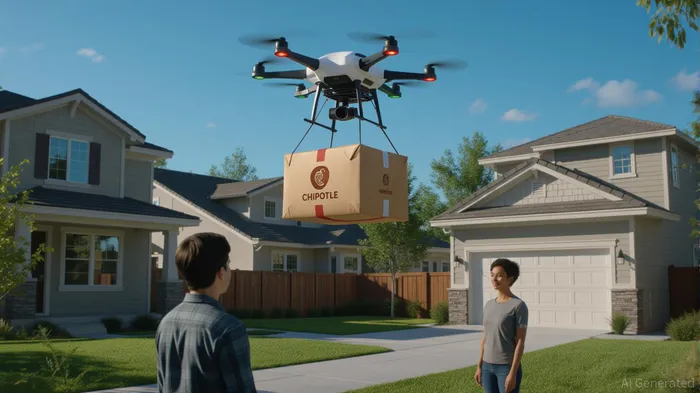
Chipotle Mexican Grill's recent launch of Zipotle, a drone-based delivery service in partnership with Zipline, marks a pivotal moment in the quick-service restaurant (QSR) sector. By leveraging autonomous aircraft to bypass traffic and traditional delivery networks, ChipotleCMG-- is not only redefining last-mile logistics but also setting a precedent for how tech-driven QSRs can disrupt supply chains. This initiative, now operational in Dallas, Texas, is a microcosm of broader trends reshaping the food delivery landscape—and it offers compelling investment opportunities for those attuned to the next phase of digital transformation.
Automation and Last-Mile Disruption: A Sector-Wide Shift
The QSR industry is undergoing a seismic shift as automation and AI-driven technologies redefine efficiency. Chipotle's Zipotle pilot, which uses Zipline's zero-emission drones to deliver meals in under 15 minutes, aligns with a global surge in drone delivery adoption. The delivery drones market, valued at $2.88 billion in 2025, is projected to grow at a 24.1% CAGR, reaching $6.84 billion by 2034. This growth is fueled by consumer demand for speed, the rising cost of gig-worker labor, and the need for sustainable logistics.
Chipotle's move mirrors efforts by competitors like Wing (owned by Alphabet) and AmazonAMZN--, which are testing drone delivery in urban and suburban markets. However, Zipotle's integration of Zipping Points—centralized loading zones at select Chipotle locations—offers a unique advantage. By enabling a single restaurant to serve an entire neighborhood, the model minimizes infrastructure costs and avoids the need for drone launch sites at every location. This scalability is critical for QSRs aiming to balance innovation with operational feasibility.
Cost Efficiency and Scalability: The Financial Case
Zipotle's cost structure is designed to maximize profitability while appealing to price-sensitive consumers. The service charges a flat $2.99 delivery fee and a 15% service fee (capped at $6), significantly undercutting traditional third-party delivery costs, which often exceed $5 per order. Analysts estimate this model could reduce delivery expenses by 30–40%, translating to 200–300 basis points of EBITDA margin expansion over three years.
The scalability of Zipotle is further bolstered by Zipline's proven logistics expertise. With over 100 million commercial autonomous miles flown and 1.6 million deliveries completed globally, Zipline's drones are engineered for reliability in diverse weather conditions. The Dallas pilot, operating from a single Rowlett, Texas location, already serves as a blueprint for national expansion. If the pilot achieves a 10% adoption rate, it could generate $50 million in incremental annual revenue—a figure that grows exponentially with geographic reach.
Regulatory Tailwinds and ESG Alignment
Chipotle's initiative benefits from a favorable regulatory environment. The FAA's Part 108 rules and the 2025 Executive Order on “Unleashing American Drone Dominance” have streamlined approvals for Beyond Visual Line of Sight (BVLOS) operations, reducing bureaucratic hurdles. Zipline's existing medical delivery network—used to transport blood and vaccines—provides a regulatory safety net, as the company has already navigated complex airspace regulations.
Moreover, Zipotle aligns with Chipotle's “Cultivate a Better World” sustainability mission. Each drone saves 45 tons of CO2 annually, equivalent to 1,800 trees, appealing to ESG-focused investors. With ESG assets projected to control $53 trillion by 2025, Chipotle's green delivery model positions it to capture a growing segment of environmentally conscious consumers.
Investment Implications: Tech-Driven QSRs as Growth Catalysts
The investment case for tech-forward QSRs like Chipotle hinges on their ability to integrate innovation into core operations. Chipotle's stock currently trades at a 37.52% discount to its 12-month price target of $59.08, reflecting optimism about Zipotle's potential to drive margin expansion and customer retention. The company's broader automation strategy—including robotic kitchen assistants and AI-driven drive-thru systems—further strengthens its competitive moat.
However, risks remain. Regulatory delays, public acceptance of drone delivery, and technical challenges (e.g., adverse weather) could slow adoption. Yet, Zipline's track record and Chipotle's phased rollout strategy mitigate these concerns. Investors should monitor key metrics: Dallas adoption rates, EBITDA margin trends, and regulatory progress on BVLOS approvals.
Conclusion: A Bold Bet on the Future
Chipotle's Zipotle initiative is more than a gimmick—it's a strategic pivot toward a future where automation and sustainability define competitive advantage. By reimagining last-mile delivery, the company is not only reducing costs but also enhancing customer experience and brand loyalty. For investors, this represents a rare opportunity to capitalize on a sector poised for exponential growth. As the QSR industry races to digitize, Chipotle's drone-driven innovation could cement its position as a leader in the tech-forward dining revolution.
Investment Advice: For those seeking exposure to the next wave of QSR innovation, Chipotle's stock offers a compelling entry point. However, diversification across the broader restaurant tech sector—such as competitors like SweetgreenSG-- (which is in talks with Zipline) or AI-driven logistics platforms—can further hedge against sector-specific risks. The future of food delivery is airborne, and the time to invest is now.

Delivering real-time insights and analysis on emerging financial trends and market movements.
Latest Articles
Stay ahead of the market.
Get curated U.S. market news, insights and key dates delivered to your inbox.




Comments
No comments yet