
The Future of Digital Education: How Emerging Technologies and Interdisciplinary Curricula Are Reshaping ROI in Post-Secondary Education


 Aime Summary
The AI Revolution in Education: Efficiency and Personalization
Artificial intelligence has become the cornerstone of modern digital education, with 60% of educators already using AI tools daily to personalize learning and streamline administrative tasks. AI-powered platforms are reducing the time teachers spend on grading and lesson planning by up to 44%, enabling them to focus on direct student engagement. For students, the benefits are equally profound: AI-enhanced learning environments have been shown to improve test scores by 54% and overall learning outcomes by 30% compared to traditional methods.
From a financial perspective, the AI in education market is projected to grow from $7.57 billion in 2025 to $112.3 billion by 2034, with a compound annual growth rate (CAGR) of 38.4%. This surge is fueled by measurable ROI metrics, such as a 57% increase in learning efficiency in corporate training programs and a 275% improvement in students' ability to direct their learning using tools like Microsoft 365 Copilot. For investors, the scalability of AI-driven platforms-particularly in automating administrative workflows and personalizing education at scale-presents a compelling opportunity.
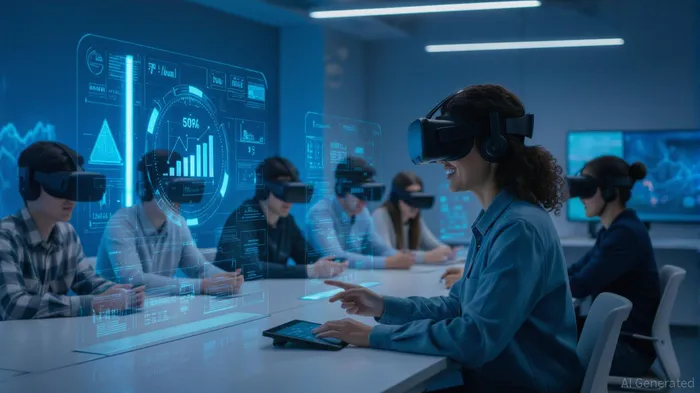 Extended reality (XR), encompassing augmented reality (AR) and virtual reality (VR), is another transformative force. Institutions are leveraging XR to create immersive simulations for fields such as healthcare, construction, and skilled trades, enabling students to practice real-world scenarios without risk. The global AR/VR training market is projected to reach $142 billion by 2031, driven by its ability to reduce training time by up to 75% and improve retention rates by 75%.
The cost-effectiveness of XR is particularly striking. Studies show that immersive learning becomes 52% less expensive than traditional methods when scaled to over 3,000 employees, with savings from reduced travel and material costs amplifying ROI. In high-risk industries like aviation and healthcare, XR simulations also mitigate errors and enhance safety, further justifying their adoption. For investors, the hardware-software ecosystem supporting XR-ranging from VR headsets to AI-integrated platforms-offers a dual opportunity to capitalize on both technological innovation and educational demand.
Interdisciplinary Curricula: Bridging Academia and Industry
The integration of emerging technologies into interdisciplinary curricula is redefining workforce readiness. Programs that combine AI with fields such as climate science, biomedical engineering, and urban planning are producing graduates equipped with both technical and adaptive skills. For instance, Berry College's use of AI to automate GPA recalculations saved 80.7 hours of manual labor annually, demonstrating how interdisciplinary approaches can optimize institutional efficiency.
Long-term career outcomes for graduates of AI-integrated programs are equally promising. A Stanford analysis revealed that while AI has disrupted entry-level roles in routine tasks, it has also created demand for specialized positions such as AI Systems Architect and Quantum AI Engineer. Moreover, employers now prioritize interdisciplinary competencies including ethical reasoning and collaboration with AI systems, to address complex global challenges. For investors, supporting institutions that align curricula with these trends-through partnerships or direct funding-could yield substantial returns as industries increasingly seek graduates with hybrid skill sets.
Strategic Implications for Investors
The convergence of AI, XR, and interdisciplinary education presents a multifaceted investment landscape. Key opportunities include:
1. AI-Driven EdTech Platforms: Tools that automate administrative tasks, personalize learning, and provide real-time analytics are in high demand, with the global edtech market projected to grow from $169.37 billion in 2024 to $598.82 billion by 2032.
2. XR Hardware and Software Ecosystems: As institutions scale immersive learning, investments in VR headsets, AR applications, and AI-integrated platforms will become critical.
3. Interdisciplinary Program Development: Institutions that partner with industries to design curricula aligned with AI and XR trends are likely to see higher graduate employability and institutional competitiveness.
However, challenges such as budget constraints and technical infrastructure gaps, and staff readiness for AI integration must not be overlooked. Investors should prioritize institutions and startups that demonstrate agility in addressing these barriers while leveraging data analytics to refine ROI metrics.
Conclusion
The future of digital education lies in its ability to harmonize technological innovation with pedagogical relevance. As AI and XR redefine learning efficiency and workforce readiness, and interdisciplinary curricula bridge the gap between academia and industry, the ROI for post-secondary education is becoming increasingly tangible. For investors, the imperative is clear: align with institutions and technologies that not only adapt to the present but anticipate the demands of a rapidly evolving global economy.

Blending traditional trading wisdom with cutting-edge cryptocurrency insights.
Latest Articles
Stay ahead of the market.
Get curated U.S. market news, insights and key dates delivered to your inbox.






Comments
No comments yet