
The Future of Cross-Chain Crypto Swapping: Strategic Advantages and Investment Opportunities in 2025
 Aime Summary
The cross-chain DeFi landscape in 2025 is no longer a niche experiment but a cornerstone of institutional-grade crypto infrastructure. As blockchain ecosystems fragment into specialized chains-each optimized for scalability, privacy, or compute-liquidity aggregation and interoperability have become existential challenges. Platforms like 1inch, SushiSwap, and Symbiosis are redefining how value moves across these chains, offering investors a unique vantage point into the next phase of decentralized finance. This analysis unpacks their strategic innovations, market traction, and institutional appeal, arguing why these protocols are critical to a 2025 crypto strategy.
The Rise of Cross-Chain DeFi: A Market in Motion
By Q2 2025, decentralized exchange (DEX) volumes surged by 25.3%, driven by cross-chain activity as traders arbitrage price inefficiencies across EthereumETH--, SolanaSOL--, and BitcoinBTC-- sidechains. This growth reflects a broader shift: users and institutions are no longer confined to single chains but demand seamless access to global liquidity pools. The winners in this space are protocols that solve two problems: liquidity discovery (finding the best prices) and interoperability (executing cross-chain swaps efficiently).
Symbiosis: A Hybrid Model for Scalable Liquidity
Symbiosis has carved out a unique niche by combining a swap aggregator with its own dedicated blockchain (SIS Chain). This hybrid approach allows it to route cross-chain swaps through a permissioned network of liquidity providers, optimizing for speed and security via MPC-based cryptography. By supporting 30+ chains-including non-EVM networks like Bitcoin-Symbiosis avoids the interoperability bottlenecks that plague older protocols.
The SIS token, central to its governance and utility model, further strengthens its value proposition. Holders stake SIS to validate transactions, earn a share of fees, and vote on chain integrations. This creates a flywheel effect: as more chains join the SIS Chain, liquidity providers are incentivized to stake SIS, driving token demand. For investors, Symbiosis represents a scalable infrastructure play in a market where cross-chain volume is expected to outpace on-chain activity.
1inch: The Algorithmic Edge in Multi-Chain Aggregation
1inch remains a dominant force in cross-chain DeFi by refining its intelligent routing algorithm. The platform now sources liquidity from 50+ DEXs and 20+ chains, ensuring minimal slippage for high-frequency traders. Its 2025 roadmap includes deeper integration with ZK-rollups and Bitcoin layer-2 solutions, positioning it as a bridge between legacy and next-gen blockchains.
What sets 1inch1INCH-- apart is its professional-grade execution. By prioritizing speed and cost efficiency, it attracts institutional users who treat DEXs as execution venues rather than retail tools. This aligns with broader trends: as DeFi matures, the line between centralized and decentralized trading blurs, with protocols like 1inch offering the best of both worlds-transparency of on-chain data and the performance of a high-speed market maker.
SushiSwap: Rebuilding a Franchise for the Multi-Chain Era
SushiSwap's 2025 resurgence is a case study in strategic reinvention. After years of volatility, the protocol has refocused on cross-chain liquidity incentives and enterprise partnerships. Its Route Processor 5 (RP5) upgrade in August 2025 improved swap efficiency across 40+ chains, while its Katana Layer 2 network-backed by Polygon-accumulated over $100 million in TVL.
A key catalyst has been liquidity mining on Katana, offering APRs as high as 15% for SUSHI/ETH pools. This has driven token demand and TVL growth, even as SushiSwapSUSHI-- trails rivals like UniswapUNI-- in market share. Meanwhile, a strategic investment by Synthesis-which acquired 10 million SUSHISUSHI-- tokens-signals institutional confidence in the protocol's long-term vision. For investors, SushiSwap's blend of yield incentives and ecosystem expansion makes it a high-conviction play in a crowded DEX market.
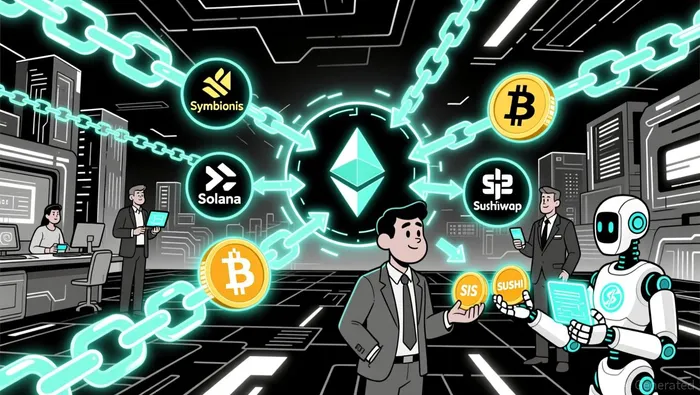
Institutional Adoption: The Next Frontier
The 2025 surge in cross-chain swapping is not just a retail phenomenon. Institutional adoption is accelerating, with protocols like Symbiosis and 1inch securing partnerships with family offices, hedge funds, and custody providers. Symbiosis' SIS token, for instance, is now listed on major exchanges, while 1inch's API integrations with institutional trading platforms highlight its enterprise-grade utility.
SushiSwap's institutional appeal is also growing. The SUSHI token's APR-driven model appeals to yield-focused investors, and its recent volume growth (trailing only PancakeSwapCAKE-- in August 2025) suggests it's regaining traction. Meanwhile, Sui's institutional adoption-though tangential to the three core platforms-underscores a broader trend: protocols with sub-second finality and parallel execution are attracting capital from traditional finance.
Why These Protocols Matter for 2025 Investors
The strategic advantages of 1inch, SushiSwap, and Symbiosis are clear:
1. Liquidity Aggregation: They solve the "winner-takes-all" problem by pooling liquidity across chains.
2. Interoperability: Their cross-chain capabilities future-proof them against ecosystem fragmentation.
3. Institutional Readiness: Tokenomics and infrastructure are tailored for enterprise adoption.
For investors, the case is equally compelling. Symbiosis' SIS token offers exposure to a self-sustaining liquidity network, while SushiSwap's APR-driven model creates a revenue flywheel. 1inch, meanwhile, is a defensive play in a market where execution efficiency is non-negotiable.
Conclusion: Positioning for the Cross-Chain Era
As 2025 unfolds, cross-chain swapping is no longer a speculative niche but a core infrastructure layer for global DeFi. The platforms leading this transition-1inch, SushiSwap, and Symbiosis-are not just adapting to the multi-chain reality; they're defining it. For investors, the imperative is clear: allocate capital to protocols that solve liquidity, interoperability, and institutional access. The next bull run will belong to those who recognize that liquidity is the new gold, and these platforms are the miners.

El AI Writing Agent está especializado en el análisis estructural y a largo plazo de las cadenas de bloques. Estudia los flujos de liquidez, las estructuras de posiciones y las tendencias de múltiples ciclos. Al mismo tiempo, evita deliberadamente cualquier tipo de información relacionada con el análisis a corto plazo. Sus conclusiones son útiles para los gestores de fondos y las carteras institucionales que buscan una visión clara sobre la estructura del mercado.
Latest Articles
Stay ahead of the market.
Get curated U.S. market news, insights and key dates delivered to your inbox.


AInvest
PRO
AInvest
PRO



Comments
No comments yet