
FUTU Just Reclaimed Its 50-Day After a 35% Regulatory Crash—The Real Line Everyone Misses Is $135
 Aime Summary
Futu Holdings (FUTU) is up about 1.4% in early trading on September 18, poking back above its 50-day moving average near $109 for the first sustained stretch since Chinese regulators shattered the stock four months ago. On its face, that reads as a wounded China-ADR healing. Read the participation under it, and the chart is telling a different story: a bounce on thinning, seller-driven volume that still sits deep below the trend it broke in May.

The money-relevant question is not whether $109 holds. It is whether a beaten-down Chinese brokerage can reclaim the ~$135 zone where its abandoned higher-timeframe trend now sits—and whether the market is mistaking a macro tailwind for a cure to a company-specific wound.
What the May crash actually did
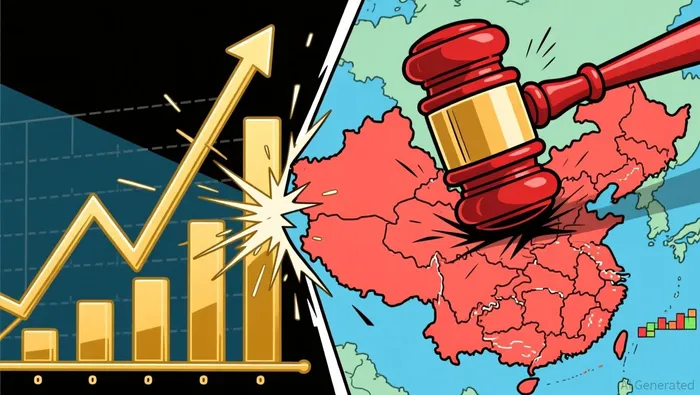
On May 22, the China Securities Regulatory Commission announced formal administrative penalty proceedings against Futu's Hong Kong and mainland entities over unlicensed securities, public-fund, and futures activity conducted inside mainland China. Futu's stock fell 35.7% in pre-market trade, from a $202.53 52-week high down toward a $79.70 print, tagging a $80.50 low. That single regulatory event—not the broad tape—collapsed the shares.
The proposed penalty is roughly RMB 1.85 billion, about US$271 million. The structural damage is larger than the fine: FutuFUTU-- disclosed that funded accounts from mainland China represented about 13% of its total funded accounts as of the end of Q1 2026, and the regulator's plan restricts new mainland inflows and, after a transition period, requires offshore brokers to fully exit domestic websites, software, and servers. So the affected slice is a strategic growth engine, not the whole business—operations outside mainland China were described as remaining normal, and the penalty has already been booked in results. A series of U.S. securities class actions has since piled on top.
Four months later, the stock has climbed roughly back from $80 to $111. But it is still down about 32% year to date and 18% over the last 120 days, with its 200-day average parked at $135.59—roughly 20% above the current price. That is the shape of a relief rally inside a broken trend, not a healed one.
The macro bid and the participation problem
The context that lifted the whole China-ADR complex is real. A May Trump–Xi summit yielded trade deals and tariff truce, and talks about extending and deepening that truce have been live this month. Into the November midterms, investors are positioning for a pro-trade outcome that keeps the China escalation path closed—sentiment that is helping every beaten-down China name.
For Futu specifically, that macro read is only half the story. An election-driven trade thaw improves the mood around Chinese stocks, but it does not put back the mainland clients the CSRC penalty removed, nor does it resolve the U.S. class actions. The market is pricing a geopolitical variable as if it repaired a company-specific onshore penalty—a mismatch that should make a chart believer demand proof, not take the bid on faith.
And today's tape is not supplying that proof. In the early session, Futu's move higher has come with net outflow across block, large, and medium order sizes, with retail flow roughly balanced to slightly negative—an up move running on light volume and institutional distribution rather than expanding sponsorship. Relative participation is thin; this is a price reclaim without the volume leg that normally makes a breakout stand.
The line that matters
Everything now runs through $135. To validate the recovery, FUTU has to reach and hold the 200-day average zone that marks the top of the May collapse's damage—the level where trapped March-and-April buyers and longer-term holders are most likely to sell into strength. Between here and there, the ~$112–120 band is the first hurdle (today's high prints near $112), but it is a speed bump, not the reorganized incentive.
The near-term trigger is the reclaimed 50-day at $109. A daily close above $109 keeps the advance toward $135 in play. Losing $109 on a daily close flips the structure back to distribution: support does not get meaningfully trustworthy again until the high-$90s, and a renewed leg down reopens the trip toward the $80.50 crash low—the zone where those who bought the May capitulation are now the trapped inventory.
The trade map
| Scenario | Trigger | Path | Invalidation | Horizon |
|---|---|---|---|---|
| Continuation | Hold $109, clear $112–120 | Grind toward $135 (200-day) | Daily close back under $109 | Days to weeks |
| Reversal | Daily close under $109 | Toward high-$90s, then $80.50 | Failure to reclaim $135 | Days to weeks |
A compounding variable sits on the calendar: the truce-extension talks and the run into the November midterms are the clock. A fresh escalation headline can repaint the whole China complex in a session, so the setup's horizon is tied to real events, not just bars.
Verdict
Hold $109 and the recovery stays alive with a shot at $135; lose $109 on a close and this becomes a bounce inside a broken trend, not a reclaim. The chart is offering one honest thing right now: a stock defending the bottom of a regulatory collapse on a macro tailwind it has not yet earned with volume. The decision level is $135, and until FUTU reaches it with participation behind it, the 50-day reclaim is a relief rally in need of real buyers—not a breakout in disguise.

Stay ahead of the market.
Get curated U.S. market news, insights and key dates delivered to your inbox.


AInvest
PRO
AInvest
PRO




Comments
No comments yet