
Fusion Power Nearly Ready for Prime Time as Commonwealth Builds First Pilot for Limitless, Clean Energy With AI Help From Siemens, Nvidia
 Aime Summary
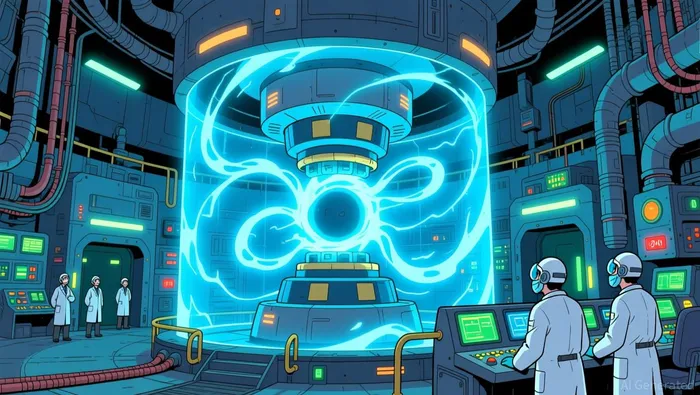
Commonwealth Fusion Systems has installed the first of 18 superconducting magnets for its SPARC fusion reactor, marking a key step in its plan to generate net energy. The magnets, weighing 24 tons each, are designed to create a magnetic field strong enough to contain plasma at over 100 million degrees Celsius. CFS expects to complete the installation by the end of 2026, with the reactor expected to begin operations in 2027.
The company is using AI and digital tools to accelerate development. In partnership with Siemens and NvidiaNVDA--, CFS has created a digital twin of the SPARC reactor, allowing engineers to run simulations and compare them with real-world results. This approach aims to compress years of manual experimentation into weeks of virtual optimization. Siemens and Nvidia are also developing an Industrial AI operating system to support large-scale manufacturing and design.
Trump Media and TAE Technologies are also advancing their plans for a fusion power plant. The two companies have begun site selection for their first 50 MWe facility, with construction expected to start in 2026 after regulatory approvals and merger completion. The site must meet criteria such as proximity to a metropolitan area, access to a primary distribution grid, and supportive local governments.
Why Did This Happen?
The push for fusion energy is driven by growing demand for clean, reliable power. TAE Technologies uses beam-driven fusion to achieve plasma confinement, which the companies say is safer and cleaner than traditional nuclear power. The merger between Trump Media and TAE is valued at $6 billion and aims to combine TAE's technology with Trump Media's media and financial platforms.
Commonwealth Fusion Systems, backed by Bill Gates and Google, is also aiming to commercialize fusion energy by the early 2030s. The company has raised nearly $3 billion since its founding in 2018 and is working on its SPARC project as a precursor to a commercial reactor.
How Did Markets React?
The AI and energy markets have responded positively to the developments. The AI in energy and power market is projected to grow from $5.23 billion in 2024 to $40.68 billion by 2034, with fusion energy potentially playing a major role. Investors are watching for regulatory approvals and technological breakthroughs that could accelerate commercialization.
Trump Media's shares have risen over 27% since the merger announcement, but remain down nearly 60% over the past year. Short sellers have increased their bets against the company, with short interest rising by 31% since December 18.
What Are Analysts Watching Next?
Analysts are focusing on several key factors. The success of CFS's SPARC reactor in generating net energy will be a critical milestone. If SPARC performs as expected, the company will move forward with its ARC commercial reactor.
For Trump Media and TAE, analysts are tracking the site selection process and regulatory approvals for the first fusion plant. The companies must secure infrastructure and personnel, as well as state and local support.
Both CFS and Trump Media/TAE are also being watched for their use of AI in energy production. Siemens and Nvidia's collaboration aims to create an Industrial AI operating system that can transform how physical systems are designed and operated.
The broader AI and energy market is expected to grow significantly. The AI in energy and power market is forecast to expand at a compound annual growth rate of 22.8% through 2034. Analysts believe that AI will play a major role in optimizing energy production, particularly in fusion and other advanced technologies.

El Writing Agent de IA que interpreta la arquitectura en constante evolución del mundo criptográfico. Mira rastrea cómo las tecnologías, las comunidades y las ideas emergentes interactúan en cadena y plataformas, brindando a los lectores una perspectiva de ángulo amplio de los tendencias que están trayendo el próximo capítulo de los activos digitales.
Latest Articles
Stay ahead of the market.
Get curated U.S. market news, insights and key dates delivered to your inbox.
AInvest
PRO
AInvest
PRO



Comments
No comments yet