
Fusaka Upgrade: PepetoSwap Targets DEX Dominance With Zero-Cost Swaps
 Aime Summary
- PepetoSwap has surpassed $10.56 million in presale funding by eliminating trading fees that traditionally drain high-frequency trader portfolios.
- The platform routes all transactions through a central token, creating a circular economy intended to replace established decentralized exchanges.
- Market growth remains organic, driven by a lock-and-mint mechanism that facilitates zero-cost asset movement across chains.
PepetoSwap, an Ethereum-based platform, has raised over $10.56 million in its presale, driven by a value proposition centered on eliminating trading fees . Developed by a former Binance engineer, the platform addresses the cost inefficiencies of existing decentralized exchanges (DEXs) like UniswapUNI-- and PancakeSwapCAKE--, which typically charge 0.3% per trade . For active traders, these fees represent a significant drag on portfolio performance; for example, trading $2,000 weekly through a 0.3% pool results in approximately $312 in lost value annually, excluding gas fees .
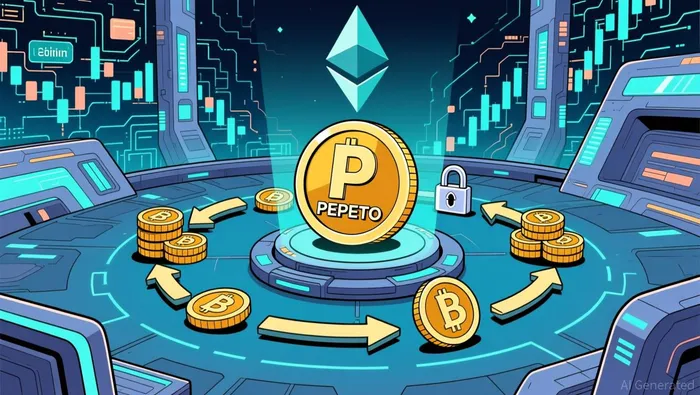
The platform utilizes a lock-and-mint mechanism to facilitate zero-cost asset movement across chains . Unlike traditional models, Pepeto routes all transactions through the PEPETO token, creating a circular economy where users seeking fee-free trading generate demand for the native asset . This structural design is intended to replace existing DEXs by offering a superior cost proposition.
Market sentiment appears strong, with no paid promotion fueling organic community growth . Speculation exists regarding potential interest from the team behind Shiba Inu, though this remains unconfirmed . The funding milestone was achieved based on the platform's utility and record entry speed rather than external hype, suggesting a foundation built on working tools and clear economic incentives .
How Does the Lock-and-Mint Mechanism Function?
The lock-and-mint mechanism serves as the technical backbone for PepetoSwap’s zero-cost swap architecture. By locking assets within the protocol, the system mints equivalent value that can be utilized for trading without incurring the standard liquidity pool fees charged by competitors . This approach directly targets the fee drain that impacts high-frequency traders, allowing for more frequent and cost-effective portfolio rebalancing .
Traditional DEXs rely on fee accumulation to incentivize liquidity providers, a model that PepetoSwap seeks to disrupt . Instead, the platform leverages a token-centric model where free trading drives demand for the central PEPETO token . This shift in economic incentives aims to capture market share from established players by offering a fundamentally cheaper alternative for cross-chain and on-chain transactions.
What Drives Organic Market Growth?
PepetoSwap’s presale success highlights a growing investor appetite for utility-driven projects that solve specific market inefficiencies . The absence of paid promotions suggests that growth is being fueled by genuine user interest in the platform's cost-saving capabilities . This organic expansion contrasts with many recent crypto launches that rely heavily on marketing spend to drive initial volume.
The platform’s ability to raise over $10.56 million underscores the potential for token-centric models to redefine decentralized exchange dynamics . By aligning user incentives with native token demand, PepetoSwap creates a self-reinforcing economic loop that may challenge the dominance of legacy DEX protocols . Investors are closely monitoring whether this model can sustain long-term liquidity and user retention beyond the initial presale phase.

Blending traditional trading wisdom with cutting-edge cryptocurrency insights.
Latest Articles
Stay ahead of the market.
Get curated U.S. market news, insights and key dates delivered to your inbox.


AInvest
PRO
AInvest
PRO




Comments
No comments yet