
Fusaka Upgrade Fuels Record Address Poisoning on Ethereum
 Aime Summary
- The EthereumETH-- Fusaka upgrade unintentionally enabled large-scale address poisoning attacks by slashing gas fees sixfold, allowing attackers to spam low-cost transactions that exploit user errors in address copying and pasting according to analysis.
- Ether has experienced increased volatility, driven by macroeconomic factors, institutional flows, and Ethereum's structural challenges as reported.
- Over 167,000 daily dust transactions have been sent, resulting in $63 million in losses post-upgrade according to data.
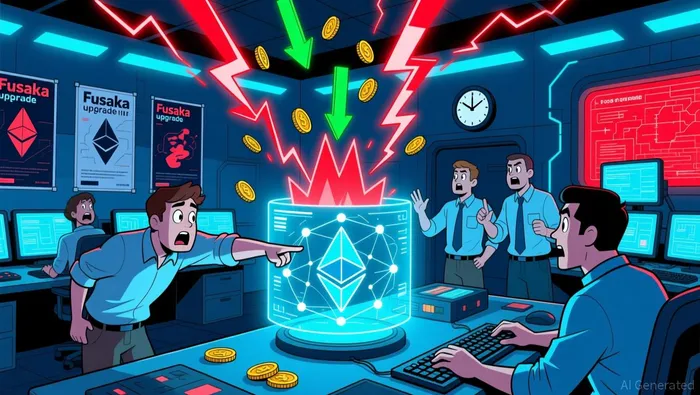
The Ethereum Fusaka upgrade, implemented in December 2024, dramatically reduced the cost of sending transactions by enabling more efficient data handling on the network. While intended to improve usability for Layer 2 scaling solutions, the unintended consequence was an economic opening for attackers to execute spam campaigns at minimal cost as detailed.
Address poisoning attacks involve sending tiny amounts of cryptocurrency to user wallets with the intent of tricking users into sending funds to a malicious address. The reduced gas fees made these attacks significantly more scalable and economically viable according to analysis.
Security researchers have highlighted the need for additional user education and technological safeguards such as address truncation on block explorers and safer address book practices . Despite these efforts, the Fusaka upgrade has underscored the trade-off between scalability and security in Ethereum's upgrade roadmap.
What Risks Do Address Poisoning Attacks Pose to Users?
Address poisoning attacks exploit simple user errors in copying and pasting wallet addresses. These errors can be magnified by the reduced transaction costs post-Fusaka, making it easier for attackers to overwhelm users with misleading small-amount transactions according to analysis.
The impact on individual users can be significant, with financial losses reported across multiple wallets and platforms. The increased frequency of these attacks has also placed pressure on wallet providers to adopt defensive measures like improved address verification according to reports.
Institutional investors have expressed concerns about the broader implications for user trust in Ethereum-based platforms. While the Ethereum Foundation has acknowledged the issue, it has not yet proposed a protocol-level solution to mitigate the economic incentives for these types of attacks as stated.
How Is Ethereum Addressing Scalability and Security in 2026?
Ethereum's 2026 development roadmap continues to prioritize three main areas: scalability, user experience, and security according to the roadmap. The Fusaka upgrade, along with the Pectra upgrade, introduced key features like transaction batching and the PeerDAS system to improve Layer 2 performance according to analysis.
The upcoming Glamsterdam upgrade aims to further refine Ethereum's scalability by increasing gas limits and enabling parallel transaction processing. These changes are expected to enhance throughput and data capacity for Layer 2 networks according to projections.
Security improvements are also a focal point, with the Ethereum Foundation exploring post-quantum threats and other vulnerabilities. The roadmap emphasizes balancing innovation with user safety, particularly in the context of ongoing address poisoning concerns according to the foundation.
What Challenges Face Ethereum's Layer 2 Ecosystem?
Data from L2Beat indicates that over 80% of Ethereum's 135 Layer 2 projects record less than one user operation per second, signaling minimal traffic for most Layer 2 solutions according to data.
Vitalik Buterin has expressed concerns about the current L2 ecosystem, suggesting that the "original vision of L2s no longer makes sense." He has argued for a new path that emphasizes specialization, innovation, and unique value propositions as reported.
The Dencun and Fusaka upgrades have also made mainnet transactions cheaper, shifting some activity back to Layer 1. This has created uncertainty for Layer 2 projects, many of which are struggling to justify their existence in a post-upgrade environment according to analysis.
Major L2s like ArbitrumARB--, Optimism, and Base have responded to these challenges by agreeing on the need for L2s to focus on unique value and avoid being mere "branded shards." This shift could reshape the future of Ethereum's scaling ecosystem according to industry reports.
The Ethereum Foundation is also forming a dedicated DeFi unit to support projects that are permissionless, censorship-resistant, and privacy-first. This initiative aligns with the foundation's broader vision for the future of decentralized finance according to the foundation.
The new DeFi unit, part of the App Relations team, is led by experienced professionals and aims to strengthen relationships with teams, enhance security, and advance privacy. It is also exploring intersections with AI, institutional adoption, and stablecoins according to the foundation.
Ethereum currently leads in total value locked in DeFi with $53.8 billion. The foundation plans to continue supporting innovation while ensuring that Ethereum remains the leading platform for decentralized finance according to the foundation.

Blending traditional trading wisdom with cutting-edge cryptocurrency insights.
Latest Articles
Stay ahead of the market.
Get curated U.S. market news, insights and key dates delivered to your inbox.


AInvest
PRO
AInvest
PRO



Comments
No comments yet