
Fusaka Upgrade Enhances Ethereum Scalability and Institutional Adoption
 Aime Summary
- The Fusaka upgrade enables 8× higher Layer 2 capacity and reduces data costs by up to 85%.
- Institutional adoption accelerated with $140M+ asset deployments from major firms post-upgrade.
- Ethereum recorded 8.7M smart contract deployments in Q4 2025, its highest quarterly figure.
- Protocol-driven deflationary dynamics strengthen ETH's value proposition amid growing usage.
Ethereum's Fusaka upgrade activated in December 2025 represents its most significant technical advancement since The Merge. This upgrade enhances scalability while reducing transaction costs for Layer 2 networks. It also accelerates institutional adoption through improved security and efficiency features. These changes solidify Ethereum's position as foundational infrastructure for real-world assets and Web3 applications.
How Does Fusaka Improve Ethereum's Scalability and Layer 2 Efficiency?
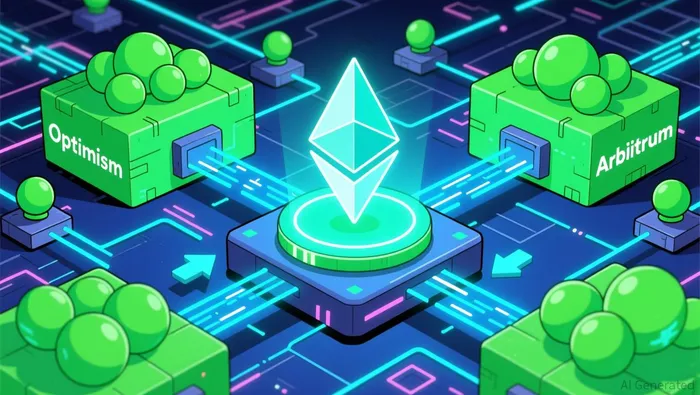
Peer Data Availability Sampling slashes bandwidth needs by 85% while expanding blob capacity from 12 to 128 per block. This allows L2 networks like ArbitrumARB-- and OptimismOP-- to process 3.5× more transaction data than before. The EIP-7918 gas fee reserve stabilizes L2 pricing by setting minimum fee floors during peak demand. Reduced operational costs help maintain sub-penny transaction fees critical for emerging market use cases. These efficiency gains support record network activity including 8.7M Q4 smart contract deployments.
Verkle Trees and gas limit increases to 60 million units further boost Layer 1 throughput. The upgrade's Blob Parameter Only fork mechanism enables dynamic scaling adjustments without disruptive hard forks. That architectural flexibility ensures EthereumETH-- can adapt to growing rollup demand. Technical optimizations yield measurable cost reductions like Nigerian remittance fees dropping from 10% to under 2%. These improvements address scalability concerns that previously hindered DeFi execution quality.
What Impact Is Fusaka Having on Institutional Adoption?
Institutional participation surged with secp256r1 security upgrades enabling hardware-backed passkey authentication. The validator stake limit increase from 32 ETH to 2,048 ETH simplifies large-scale staking operations. Financial giants like BlackRock and JPMorgan deployed over $140 million in Ethereum-based assets post-upgrade. These entities leverage Ethereum for tokenized money markets and Treasury products. Regulatory clarity from initiatives like the U.S. Clarity Act further enables institutional entry.
Brazil's government now uses Ethereum L2s for land registry tokenization cutting bureaucratic delays by 70%. The infrastructure supports real-time tracking of agricultural exports representing 25% of Brazil's GDP. Code-embedded compliance features help institutions meet regulatory requirements without exposing proprietary strategies. These developments transform Ethereum from a speculative platform to a production-grade settlement layer. The network's deflationary dynamics following the upgrade provide additional economic incentives for long-term holders.
How Does Fusaka Position Ethereum for Future Growth?
The upgrade establishes a flywheel effect where L2 growth drives higher Ethereum fee revenue and ETH scarcity. Protocol-driven deflation could push ETH toward $7,000-$12,000 price targets by 2026 according to analyst projections. Fusaka initiates Ethereum's shift to more frequent upgrades with Hegota already planned for late 2026. This accelerated development cadence helps maintain competitiveness against faster blockchains.
The Ethereum Foundation restructured research teams to prioritize scaling solutions and blobspace expansion post-Fusaka. Their financial policy now caps annual treasury spending at 15% to ensure long-term sustainability. Emerging market applications demonstrate Ethereum's capacity to solve systemic challenges like microloan access in rural India. These developments align with the Kinetic Finance paradigm where liquidity efficiency surpasses raw network speed as the primary value metric. Ethereum increasingly functions as global capital markets infrastructure rather than just a smart contract platform.

La combinación de la sabiduría tradicional en el comercio con las perspectivas más avanzadas relacionadas con las criptomonedas.
Latest Articles
Stay ahead of the market.
Get curated U.S. market news, insights and key dates delivered to your inbox.


AInvest
PRO
AInvest
PRO



Comments
No comments yet