
Fueling Growth: How Lower Gas Prices Could Shift California's Economic Landscape and Investment Outlook
California's gasoline prices have seen a notable decline in June 2025, with Los Angeles averaging $4.64 per gallon—a 17-cent drop from June 2024. This 3.6% decrease signals a turning point in energy market dynamics, driven by lower crude oil prices, shifting supply chains, and regulatory adjustments. While short-term volatility remains a risk, this trend could have lasting implications for consumer spending, equity markets, and strategic investment decisions. Here's how investors should navigate this evolving landscape.
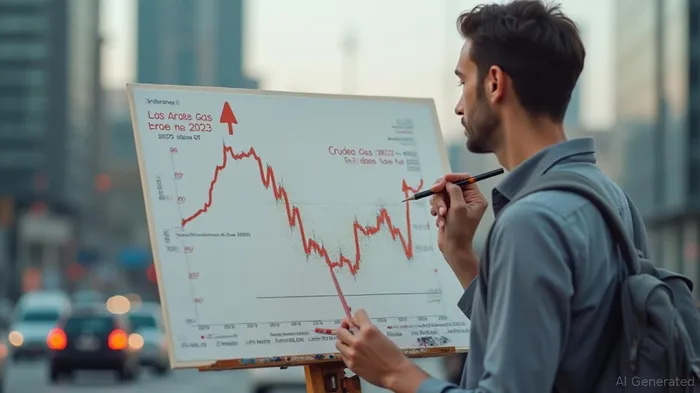
The Supply-Side Story: Why Gas Prices Are Falling
The drop in gas prices stems from a confluence of factors:
1. Global Crude Oil Oversupply: U.S. crude inventories rose to 436.1 million barrels in June, while OPEC+ output cuts have been offset by rising non-OPEC production.
2. Refinery Closures and Imports: California's shrinking refining capacity (losing 20% by 2026) has forced reliance on imported fuels from Asia. While this introduces logistical risks, it also creates a temporary supply cushion.
3. Regulatory Relief: Delays in implementing stricter Low Carbon Fuel Standards (LCFS) and a paused refinery profit margin cap have eased near-term price pressures.
Consumer Discretionary: Winners of the Gas Price Decline
Lower gas costs could free up $1.3 billion annually for California households, assuming a 50-cent-per-gallon drop and 5 billion gallons consumed yearly. This windfall is likely to boost spending in sectors like:
- Travel: Airlines (e.g., Southwest Airlines) and hotel chains (e.g., Marriott) stand to benefit from increased leisure travel.
- Retail: Auto retailers (e.g., Tesla) and big-box stores (e.g., Walmart) may see higher traffic as disposable income rises.
- Entertainment: Restaurants and movie theaters could see a sales uptick, as consumers reallocate savings from gas.
The Risks: Volatility and Regulatory Overhang
While the short-term outlook is bullish, several risks loom:
1. Oil Price Volatility: Geopolitical tensions (e.g., Middle East conflicts) or supply disruptions (e.g., hurricane season) could spike crude prices.
2. Inflationary Pressures: Lower energy costs might ease headline inflation, but core inflation (excluding energy) remains sticky.
3. Regulatory Headwinds: The LCFS, set to tighten in July 2025, could add 5–8 cents per gallon by 2026, reversing recent gains.
Investment Strategies: Positioning for Both Sides
Investors should adopt a dual-pronged approach:
1. Short-Term Plays:
- Consumer Discretionary ETFs: Consider the iShares U.S. Consumer Services ETF (IYC) or the S&P 500 Consumer Discretionary Sector ETF (XLY).
- Airline Stocks: DeltaDAL-- (DAL) and JetBlueJBLU-- (JBLU) have historically outperformed when gas prices drop.
- Long-Term Hedge:
- Energy Infrastructure: Companies like Kinder MorganKMI-- (KMI) or pipeline operators benefit from stable demand and fee-based models.
Renewable Energy: California's EV adoption (now 45th in per capita gas consumption) suggests long-term growth in EV charging (e.g., ChargePointCHPT-- Holdings) and solar/wind infrastructure.
Risk Mitigation:
- Consumer Staples: Defensive plays like Procter & Gamble (PG) or Coca-ColaKO-- (KO) buffer against economic uncertainty.
- Inverse Oil ETFs: ProShares UltraShort Oil & Gas (DUG) could hedge against crude price spikes.
Historical Precedent: The 2014–2016 Oil Crash Lessons
During the 2014–2016 oil price collapse, U.S. consumer spending on discretionary goods rose by 3.2%, while energy stocks fell 25%. However, investors who balanced exposure to energy infrastructure (e.g., pipeline stocks) and consumer sectors weathered the storm. Today's environment mirrors this dynamic but with added regulatory complexity.
Conclusion: A Balanced Portfolio for a Shifting Energy Landscape
The recent gas price decline presents a short-term tailwind for California's consumer-driven economy. Yet, long-term investors must account for regulatory shifts, EV adoption, and oil market instability. By combining exposure to consumer discretionary sectors with defensive energy plays, portfolios can capture upside while mitigating risk. Monitor crude oil prices and LCFS compliance costs closely—these will be key drivers of both gas prices and equity market direction in the quarters ahead.

Stay ahead of the market.
Get curated U.S. market news, insights and key dates delivered to your inbox.
AInvest
PRO
AInvest
PRO



Comments
No comments yet