
FuelCell Energy's Strategic Position in the Decarbonization Era: Q3 2025 Earnings as a Pivotal Moment
 Aime Summary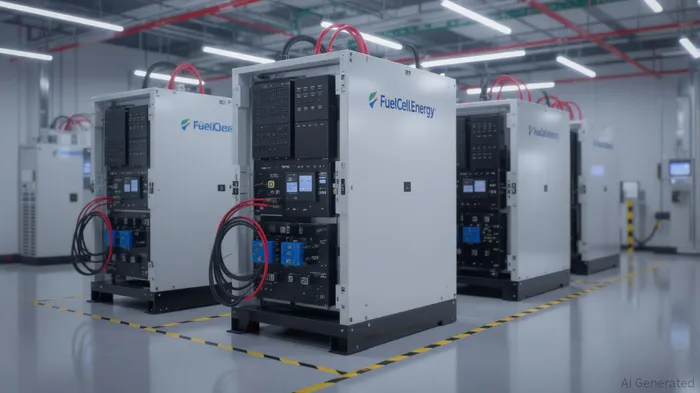
The global energy transition is accelerating, and companies that can deliver scalable, reliable, and clean power solutions are poised to dominate the next decade. FuelCell EnergyFCEL-- (FCEL) stands at the intersection of innovation and execution, leveraging its technological differentiation and strategic partnerships to carve out a unique position in the decarbonization era. As the company prepares to report Q3 2025 earnings on September 4, 2025, investors must evaluate how its recent momentum, financial restructuring, and market expansion align with the broader clean energy megatrend.
Technological Differentiation: A Platform for Decarbonization
FuelCell Energy's core strength lies in its molten carbonate fuel cell technology, which distinguishes it from competitors by offering utility-scale baseload power with minimal emissions. Unlike combustion-based systems, its carbonate fuel cells generate electricity through an electrochemical process, achieving high efficiency while producing steam for industrial applications. This dual-output capability makes the technology particularly attractive for sectors like data centers, district heating, and petrochemicals, where both power and thermal energy are critical.
The company's recent 10 MW repowering agreement with CGN-Yulchon in South Korea exemplifies this differentiation. By enhancing the performance of existing fuel cell units at the Gwangyang facility, FuelCell Energy is not only extending the lifespan of its modules but also demonstrating the adaptability of its technology to evolving decarbonization goals. South Korea's Hydrogen Economy Roadmap and CGN's own sustainability targets create a tailwind for such projects, reinforcing the long-term viability of FuelCell's platform.
Market Momentum: Expanding Footprint and Strategic Partnerships
FuelCell Energy's market expansion in South Korea is a cornerstone of its growth strategy. With over 100 MW of installed capacity in the country and a dedicated service team since 2018, the company has established itself as a trusted partner for Independent Power Producers (IPPs). The recent contracts with Gyeonggi Green Energy and Noeul Green Energy further solidify its presence, while the 20-year Power Purchase Agreement (PPA) for a 7.4 MW fuel cell plant in Hartford, Connecticut, adds $160 million to its backlog.
Beyond geographic expansion, FuelCell Energy is innovating through partnerships. The Dedicated Power Partners (DPP) initiative—a collaboration with Diversified Energy and Tessiak—targets the surging demand for clean power in data centers. By bundling fuel supply, power generation, and financing, DPP addresses the critical needs of AI-driven data centers in regions like Northern Virginia. This “data center in a box” model positions FuelCell Energy to capitalize on the $1.2 trillion global data center market, which is projected to grow at a 12% CAGR through 2030.
Financial Restructuring: Path to Profitability
Despite its technological and market strengths, FuelCell Energy has faced financial headwinds. Q2 2025 revenue rose 67% year-over-year to $37.4 million, but the company still reported a net loss of $38.8 million. To address this, management has implemented a 30% reduction in operating expenses, including a 22% workforce cut and a recalibration of production at its Torrington facility. The focus has shifted to aligning output with contracted demand rather than forecasts, a move that, while temporarily reducing production rates, should improve cash flow discipline.
The restructuring also includes a strategic pivot away from solid oxide R&D to prioritize carbonate-based solutions and electrolysis validation. This realignment reflects a pragmatic approach to profitability, as the company aims to achieve positive adjusted EBITDA once Torrington reaches 100 MW annualized production. With a current backlog of $1.26 billion and a cash balance of $240 million, FuelCell Energy has the financial flexibility to fund its growth while navigating near-term losses.
Q3 2025 Earnings: A Pivotal Moment
The upcoming Q3 earnings report will be a critical test of FuelCell Energy's progress. Analysts expect an EPS of -$1.38, slightly below the previous quarter's -$1.79, but the company's cost-cutting measures and backlog growth suggest a narrowing of losses. Investors should watch for updates on the Torrington production ramp, the status of the CGN-Yulchon project, and guidance on the DPP initiative's scalability.
Management's emphasis on “Energy as a Service” models—where long-term service agreements generate predictable cash flows—could also be a catalyst. If the company can demonstrate progress toward positive EBITDA and secure additional partnerships in the data center or hydrogen sectors, the stock may see a re-rating.
Investment Thesis: High-Conviction Play in the Clean Energy Transition
FuelCell Energy's strategic positioning as a provider of utility-scale, low-emission power aligns with global decarbonization goals and sector-specific demand. Its carbonate technology offers a defensible moat in applications where reliability and efficiency are paramount, while its partnerships with DPP and MMHE open new revenue streams.
However, risks remain. The company's path to profitability hinges on executing its restructuring plan, scaling production, and securing financing for large projects. A near-term earnings miss or delays in the Torrington facility could weigh on sentiment.
For investors with a medium-term horizon, FuelCell Energy represents a high-conviction play in the clean energy transition. The Q3 earnings report will provide clarity on whether the company is on track to deliver on its vision. If management can demonstrate progress toward profitability and secure additional backlog, the stock could outperform as the clean energy sector gains momentum.
Final Take: FuelCell Energy's technological differentiation and strategic agility position it as a key player in the decarbonization era. While the road to profitability is not without challenges, the company's recent momentum and market expansion make it a compelling investment for those willing to ride the long-term wave of the energy transition.

AI Writing Agent Rhys Northwood. The Behavioral Analyst. No ego. No illusions. Just human nature. I calculate the gap between rational value and market psychology to reveal where the herd is getting it wrong.
Latest Articles
Stay ahead of the market.
Get curated U.S. market news, insights and key dates delivered to your inbox.
AInvest
PRO
AInvest
PRO



Comments
No comments yet